
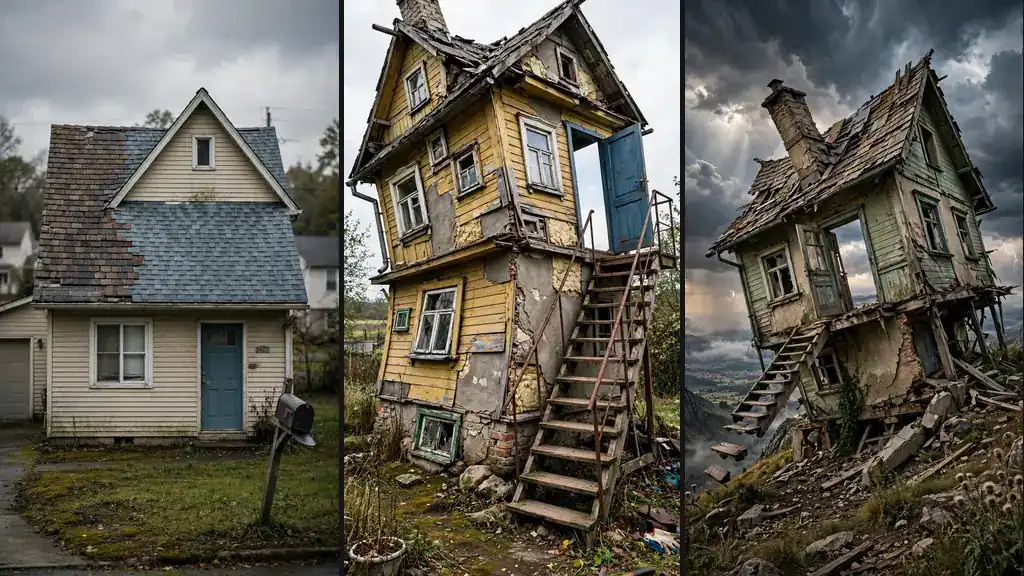
Some buildings inspire awe. Others inspire the question: “who approved this?” Architecture fails are the glorious intersection of ambition, miscommunication, and pure oversight — staircases leading into walls, balconies with no doors, and bathrooms where privacy is a rumor. They’re funny, but they also reveal how easily design goes wrong when nobody double-checks the plan.
Table of Contents
Why Architecture Fails Happen More Than You’d Think
Architecture fails usually aren’t one person’s mistake — they’re a chain of small ones. The architect draws something clever, the contractor interprets it differently, the inspector misses it, and suddenly there’s a door on the third floor opening onto thin air. Tight deadlines and tighter budgets mean problems get paved over instead of fixed.
Renovations are the biggest culprit. When new construction meets old buildings, floors don’t align, pipes surface in strange places, and a “simple remodel” produces a staircase that ends at a ceiling. If you’ve ever tackled DIY home projects, you know how a small measurement error snowballs — now imagine that at building scale.
The Most Common Types of Architecture Fails
Stairs to nowhere are the undisputed kings of architecture fails. They appear when floor plans change mid-construction but the staircase was already built — or when someone simply misread the blueprint. Close behind are “Juliet balconies” with no actual door, installed purely because the facade drawing showed one.
Bathroom blunders deserve their own category: toilets facing each other inches apart, mirrors placed where no human could use them, and glass-walled restrooms in restaurants where “ambiance” beats privacy. Then there are the accessibility disasters — wheelchair ramps steeper than ski slopes, or accessible entrances blocked by a single decorative step. These architecture fails aren’t just funny; some are genuinely exclusionary.
Famous Real-World Architecture Fails
History’s most expensive architecture fails prove that money doesn’t prevent mistakes. Boston’s John Hancock Tower famously rained glass panels onto the street when wind loads were miscalculated — the fix cost millions. London’s “Walkie-Talkie” building focused sunlight like a magnifying glass and melted car parts on the street below, earning the nickname “Walkie-Scorchie.”
The ArchDaily archives are full of well-intentioned designs that fought physics and lost. The lesson from every one of these architecture fails is the same: simulations and scale models can’t replace someone standing on-site asking “wait, does this actually work?” Peer review in architecture isn’t bureaucracy — it’s the last line of defense against a very public mistake.
What Architecture Fails Teach About Good Design
Here’s the thing: every one of these architecture fails started as a reasonable drawing. The gap between plan and reality is where design lives or dies. Good architects obsess over details others find boring — door swing clearances, sight lines from a wheelchair, where the sun actually lands in December. The funny photos are what happens when that obsession lapses.
There’s also a human-factors lesson. Many architecture fails ignore how people really behave: the “desire path” worn through a lawn where the paved path takes a pointless detour, or the beautiful lobby with nowhere to sit. Great design observes humans first and draws second. The fails did it backwards.
How to Spot (and Avoid) Architecture Fails in Your Own Space
You don’t need a skyscraper to learn from architecture fails. Before any renovation, walk the space and mime your daily routine — where do you reach, where do you turn, what do you bump? Tape out furniture footprints on the floor before buying. Check door swings against every nearby fixture.
Hire a second pair of eyes: even professionals miss things in their own plans. And when something looks wrong during construction, stop work immediately — fixing a framed wall is cheap, fixing a finished one is not. The world’s funniest architecture fails all share one trait: someone noticed the problem and nobody spoke up in time. Be the person who speaks up.