
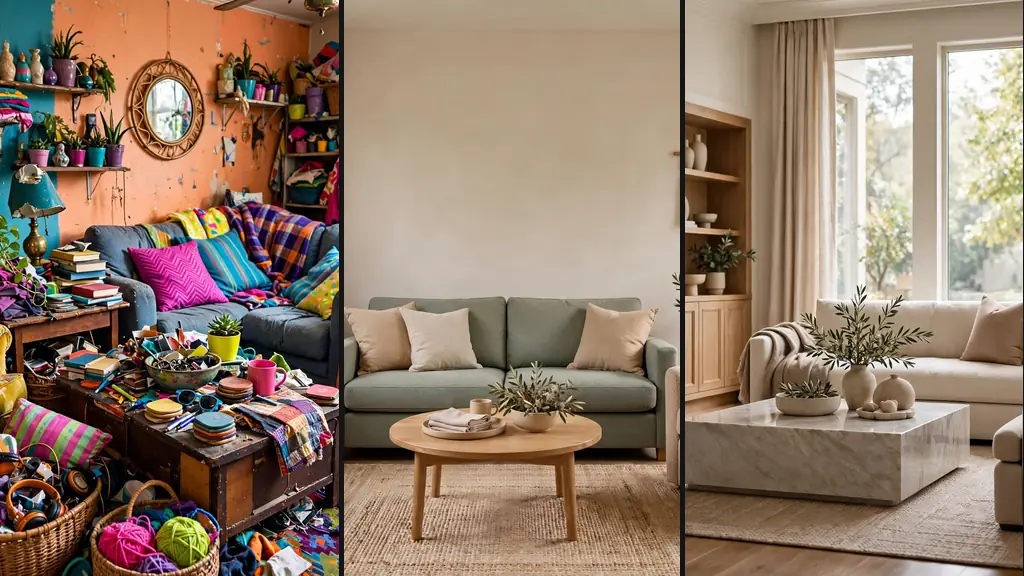
Most home decor mistakes have nothing to do with taste. I say that with confidence because I’ve made nearly all of them — the rug that was three sizes too small, the gallery wall hung at forehead-meets-ceiling height, the living room lit by a single sad ceiling fixture. The good news is that the most common home decor mistakes are also the easiest to fix, and almost none of the fixes require buying new furniture.
Table of Contents
- Home Decor Mistakes Usually Start With the Wrong-Size Rug
- Pushing Every Piece of Furniture Against the Wall
- Hanging Art Too High
- Living Under One Harsh Overhead Light
- Buying the Whole Matching Set
- Forgetting the Windows (or Hanging Curtains Wrong)
- The Fix for the Worst Home Decor Mistakes: Edit, Don’t Add
Home Decor Mistakes Usually Start With the Wrong-Size Rug
If I had to pick the single most common of all home decor mistakes, it would be the too-small rug. A postage-stamp rug floating in the middle of the room chops the space into pieces and makes everything on it look like it’s drifting. The rule is simple: a rug should anchor the furniture, not sit under it like a coaster.
In a living room, the front legs of the sofa and chairs should all be on the rug — for most rooms that means an 8×10, not a 5×7. In a dining room, the rug needs to fit the table plus the chairs when they’re pulled out, usually two feet of rug beyond the table on every side. In a bedroom, extend the rug about two feet past each side of the bed so your feet land on something soft. When you’re planning the layout, these living room sofa designs show how the right rug size pulls the whole seating area together instead of leaving it scattered.
Pushing Every Piece of Furniture Against the Wall
It feels logical — push everything to the edges and you’ll have more space in the middle. But rooms decorated this way feel like waiting rooms. Conversation needs closeness: people talk comfortably when they’re four to eight feet apart, not shouting across a dance floor.
Try pulling the sofa even a foot off the wall. Suddenly the room has breathing room, and you gain a slim zone behind it for a console table, a lamp, or a row of plants. Angle one chair slightly inward instead of lining everything up like soldiers. The room won’t feel smaller — it’ll feel intentional, like someone actually arranged it on purpose rather than defaulting to the perimeter.
Hanging Art Too High
Walk into most homes and the pictures are hung where they’d look right if you were standing on a chair. Art hung too high disconnects it from the furniture below and makes ceilings feel lower than they are. The museum standard exists for a reason: the center of a piece should sit about 57 to 60 inches from the floor, which is average eye level.
Above a sofa or console, hang the piece six to eight inches above the furniture — close enough that they read as one grouping, not two strangers. For a gallery wall, lay the whole arrangement on the floor first, treat it as one big piece with one center point, and hang around that. When in doubt, painter’s tape mock-ups on the wall beat patching nail holes later.
Living Under One Harsh Overhead Light
A single overhead fixture — especially one with a cool-white bulb — is the fastest way to make a room feel like a dentist’s office. Good lighting comes in layers: ambient light for general glow, task light for reading and working, and accent light for the pretty stuff. Most rooms need at least three sources at different heights.
Start with warm bulbs around 2700K, which flatter skin and wood tones instead of washing everything out. Put a floor or table lamp in the darkest corner, add a small lamp on a bookshelf, and consider dimmers — The Spruce has straightforward guides on layering light without an electrician. The difference between one overhead light and three warm sources is the difference between a room you pass through and a room you settle into.
Buying the Whole Matching Set
The matching bedroom set or the sofa-loveseat-chair trio from the same collection looks fine in the showroom and flat at home. Rooms with everything matching have no contrast, no story, nothing for the eye to land on — it’s the furniture equivalent of wearing one color head to toe.
Mix instead. Pair a wood coffee table with upholstered chairs. Combine wood tones rather than matching them — walnut, oak, and painted pieces can absolutely live together. The trick to keeping it cohesive is repetition: pick one finish or color and echo it twice somewhere else in the room. These luxury home decor tips lean on exactly this principle — high-end rooms look collected over time, not delivered in one truck.
Forgetting the Windows (or Hanging Curtains Wrong)
Bare windows make even a furnished room feel unfinished, like the house is still moving in. But badly hung curtains are nearly as common a problem: rods mounted right at the frame, panels that barely cover the glass, hems floating inches above the floor.
Mount the rod four to six inches above the window frame and extend it three to six inches past each side — this makes the window look bigger and lets the panels stack on the wall instead of blocking light. Panels should just kiss the floor, not puddle (dust magnets) or hover (awkward). And buy wide enough: two panels that actually close look rich; one stretched-flat panel looks like it’s trying too hard.
The Fix for the Worst Home Decor Mistakes: Edit, Don’t Add
Here’s the uncomfortable truth behind most home decor mistakes: the problem usually isn’t what’s missing, it’s what’s extra. Too many small accessories, too many competing patterns, every surface covered. Designers have a rule for this — when a room feels off, remove one thing before you add anything.
Walk each room with a box and pull out anything that doesn’t earn its place: the third throw pillow pattern, the decorative items you don’t actually like, the furniture piece that’s just filling space. Live with the edited room for a week before buying anything new. Negative space isn’t empty — it’s what lets the good pieces breathe. And if a fix does need a little hands-on work, these DIY home projects are an affordable way to make changes yourself, while Family Handyman covers the practical how-to side of hanging, mounting, and patching anything you move around.