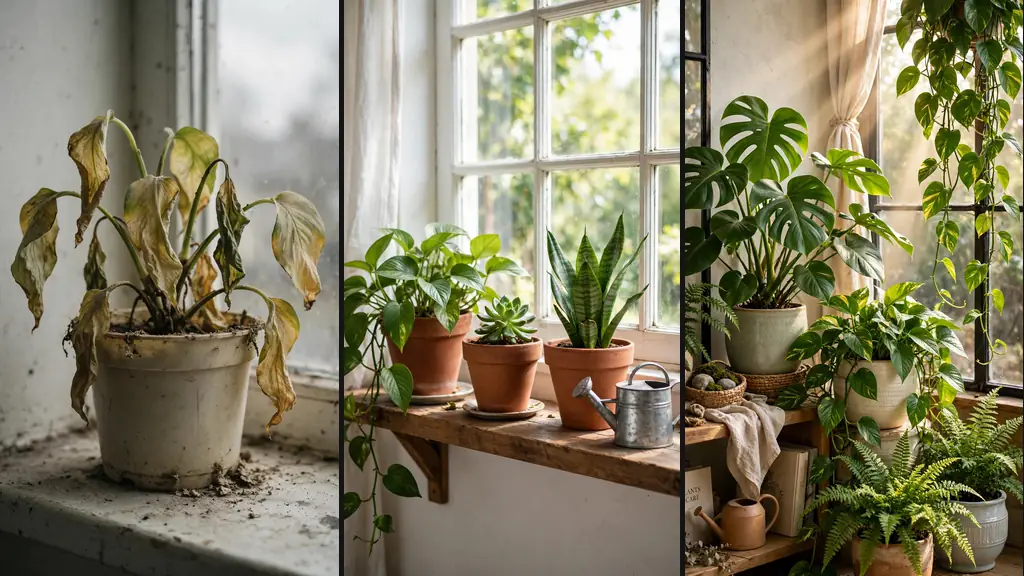
The internet is full of houseplant advice, and half of it contradicts the other half. So instead of generic lists, we went to the source: real plant parents with jungles for living rooms, who shared the plant care tips that work in their actual homes. These are the habits behind thriving monsteras, unkillable pothos, and fiddle-leaf figs that refuse to die.
Table of Contents
- Give Climbers Something to Climb
- Humidity: The Invisible Ingredient
- Try Semi-Hydro (LECA): A Plant Care Tip That Converts Skeptics
- Drainage Holes Are Non-Negotiable
- Aerate Your Soil Like It Matters (It Does)
- Water Less Than You Think
- Light: Bright but Not Brutal
- Feed Them, Check Them, Be Patient: Plant Care Tips That Work
Give Climbers Something to Climb
Monsteras, pothos, and philodendrons are climbers by nature — in the wild they scale trees toward the light. Give them a moss pole or coco coir pole and something remarkable happens: the leaves grow larger, develop those coveted splits and holes (fenestrations), and the plant grows upward instead of sprawling into a sad vine pile.
The trick: keep the moss pole damp so aerial roots actually attach. A dry pole is just a stick. Plants attached to moist poles mature far faster than ones left to trail — the single biggest upgrade for monstera and aroid growers.
Humidity: The Invisible Ingredient
Most popular houseplants are tropical natives expecting 50–70% humidity; the average heated home in winter sits around 30%. That gap browns leaf edges, crisps calatheas, and damages new growth. A humidifier near your collection is the fix plant parents mention most — more than any fertilizer or fancy pot.
Grouping plants together helps (they create a little humid microclimate), and pebble trays add a modest boost, but neither replaces a real humidifier for humidity-hungry species. If you’re building a beginner indoor garden setup, budget for the humidifier alongside the plants — of all the plant care tips that work, this one pays off fastest.
Try Semi-Hydro (LECA): A Plant Care Tip That Converts Skeptics
Semi-hydroponics — growing in LECA (lightweight expanded clay aggregate) instead of soil — is the method converts describe with near-religious enthusiasm. Roots sit in clay pebbles with a water reservoir at the bottom; the pebbles wick moisture up evenly. No more guessing whether the soil is dry. No more fungus gnats (they need soil to breed).
It shines for plants that hate wet feet but love consistent moisture: monsteras, alocasias, calatheas. The transition needs care — move a healthy plant, rinse roots thoroughly, and expect a 2–4 week adjustment while water roots replace soil roots. The Spruce’s guide to LECA growing walks through the setup if you want to try it on one plant first — which is exactly how most converts start.
Drainage Holes Are Non-Negotiable
This is the hill experienced plant people will die on: every pot needs drainage holes. No exceptions, no “but I’ll just water carefully.” Water that can’t escape sits at the bottom, roots rot, and the plant declines in a way that looks like underwatering — which tricks people into watering more, which accelerates the rot. It’s the most common houseplant death spiral there is — and the most repeated of all plant care tips that work is simply: check for drainage first.
If you fall in love with a pot that has no holes, use it as a cachepot: keep the plant in a plastic nursery pot with drainage inside the pretty pot, and empty any collected water after watering. Repotting into proper drainage at the first sign of trouble saves more plants than any other single intervention.
Aerate Your Soil Like It Matters (It Does)
Bagged potting mix is often too dense for tropicals — it compacts, holds too much water, and suffocates roots. The veteran fix: amend everything. A common recipe is roughly equal parts potting soil, perlite or pumice, and orchid bark — chunky, airy, fast-draining, giving roots both moisture and oxygen.
Silica fertilizer gets special mention from monstera growers: it strengthens cell walls for sturdier stems and damage-resistant leaves. Pair good soil structure with appropriate feeding and you’ve solved the two most common underground problems at once.
Water Less Than You Think
Overwatering kills more houseplants than underwatering — by a wide margin. The rule every veteran repeats: check the soil before you water, every time. Stick your finger two inches down; if it’s damp, walk away. Better yet, learn each plant’s weight — a freshly watered pot is noticeably heavier than a dry one, and lifting becomes second nature fast. It’s one of those plant care tips that work because they replace guessing with evidence.
Fixed schedules are the enemy — plants drink at different rates depending on light, season, pot size, and growth stage, and most need far less water in winter. When in doubt, underwater slightly: a thirsty plant perks up within hours, while a rotted one rarely recovers.
Light: Bright but Not Brutal
“Bright indirect light” is the most-used and least-understood phrase in plant care. What it means: near a window, but shielded from harsh direct sunbeams that scorch leaves. An east-facing window is the sweet spot for most houseplants — gentle morning sun, soft light the rest of the day. South and west windows work with a sheer curtain as a diffuser.
Watch the plant, not the label. Leggy, stretched growth reaching toward the window means more light needed; bleached or crispy patches mean too much direct sun. Reading your plant’s signals is one of the plant care tips that work for every species. And rotate your plants a quarter-turn every week or two so they grow evenly instead of leaning into a lopsided lean — if your brightest window still isn’t very bright, see our low-light houseplants guide.
Feed Them, Check Them, Be Patient: Plant Care Tips That Work
Three final habits from the veterans. First, fertilize in the growing season with balanced liquid fertilizer at half strength — full strength burns more than it helps — and flush soil occasionally to prevent salt buildup. Second, inspect leaf undersides and stem joints regularly for mealybugs, spider mites, and scale. Catching an infestation in week one versus month two is the difference between a wipe-down and a war.
Third — and this one came up constantly — be patient. Plants respond on plant time. A new leaf takes weeks; recovery from repotting takes longer. The growers with the best collections aren’t doing anything magical. They’re doing the boring fundamentals consistently: right pot, right soil, right light, water when dry, feed in season, check for bugs. Master those plant care tips that work, and the jungle builds itself.