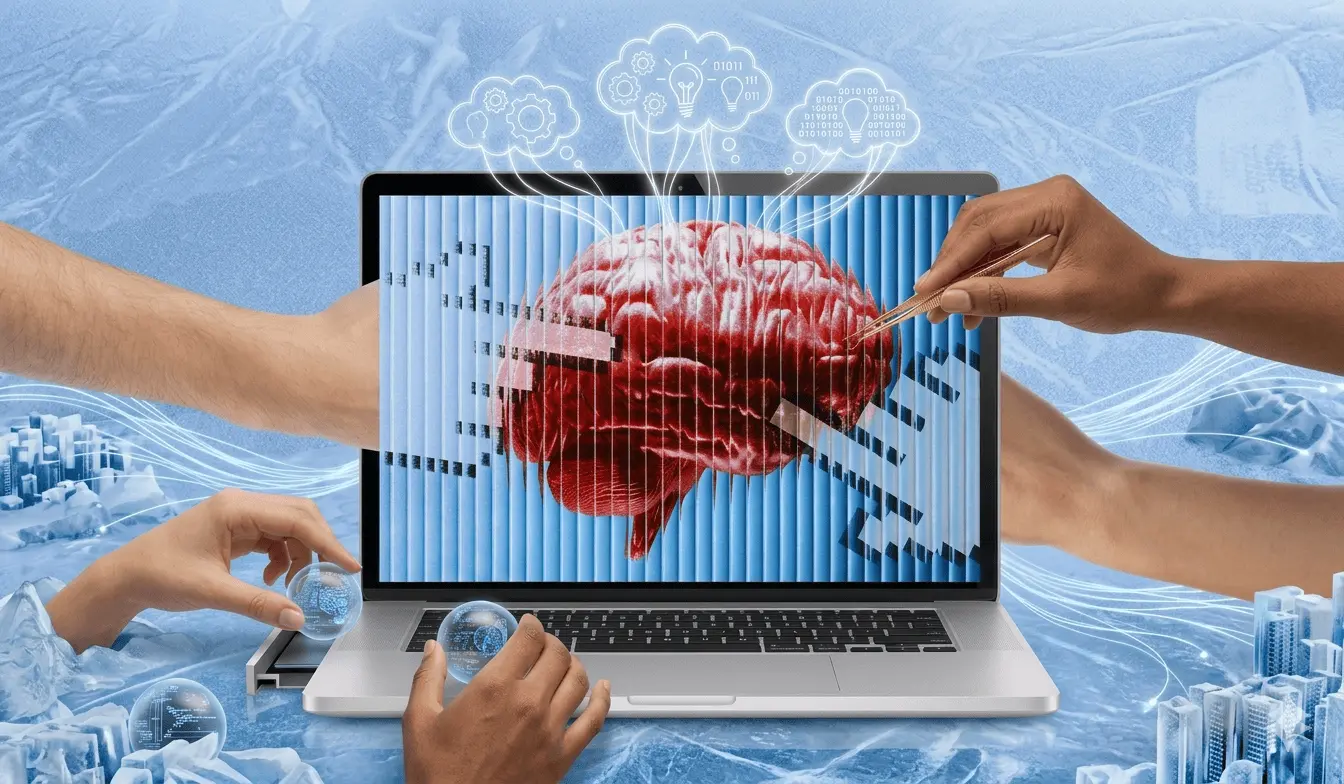
GPS ruined our sense of direction. Search engines weaken our memory. AI, scientists warn, could do the same to everything from creativity to critical thinking.
Years ago, I forced myself to start using AI as often as possible. If I were going to write about it, I would also have to use the technology. But an emerging crop of studies over the last year or so has me worried – am I harming my brain in the process?
These studies suggest that people who lean too heavily on tools like ChatGPT may have problems with creativity, attention span, critical thinking, memory, and more. Others raise concerns that AI users could be surrendering the cognitive friction that sharpens thinking, and that, as a society, we may have fewer original ideas. But the science on this is brand new, and we don’t have the answers. So should we be worried?
“On a high level, yes,” says Adam Green, a professor of neuroscience and director of the Laboratory for Relational Cognition at Georgetown University in the US. There’s a lot of nuance here, but AI will do work that used to require mental labor. “There’s plenty of evidence that if you are not doing as much of the actual thinking, then your capability to do that kind of thinking is going to atrophy.”
Even if you don’t seek to use ChatGPT or Claude, there are AI responses at the top of Google, and tech giants are rushing to shove more of it onto our phones. The technology is getting hard to avoid, but there are steps you can take to avoid the biggest potential risks.
This isn’t all or nothing, though, according to Jared Benge, a professor and clinical neuropsychologist at Dell Medical School at the University of Texas at Austin. Using AI doesn’t automatically mean it’s going to be bad for you. For example, if AI frees up your brain space for other, more important things, that might be great for your cognition.
“Why do we think AI is going to be that different from other things that our brain has already adapted to?” Benge says. “It’s not inherent to the tool to be good or bad.”
As with any other technology, how we use AI will determine whether it helps us or harms us. But the concerns are serious enough that you might want to rethink how you use these tools – before it’s too late.
With this in mind, I spoke with some leading experts in this field to find out how they think we should use AI to ensure it doesn’t dull our minds.
What are we worried about?
Twenty years ago, an idea cropped up that overreliance on technology might cause some kind of “digital dementia,” resulting in the deterioration of short-term memory and other cognitive processes. Benge recently co-authored a meta-analysis of 57 studies involving more than 411,000 adults. All told, he and his co-author found no evidence for digital dementia. Technology use actually seemed to reduce the risk of cognitive impairment.
But that doesn’t mean there’s nothing to fear.
Studies have found that people who rely on satellite navigation, such as GPS, stop building mental maps of their surroundings, and their spatial memory continues to decline over time. A similar phenomenon, called the “Google Effect,” emerged as search engines took over. Apparently, we’re less likely to remember information that we find using a search engine because it takes so little effort. It seems the brain gets worse at tasks when we outsource them. And AI is the most powerful outsourcing tool of all time.
AI could be making you less creative, less analytical, and worse at remembering things, but experts say there’s plenty you can do now (Credit: Serenity Strull/ BBC/ Getty Images)
“What’s happening with AI is that it’s giving us, for the first time, an easy way to trade process for product,” Green says. The essay can sound better. The presentation can look sharper. The retirement party joke can land perfectly. But the mental work, the struggle, the false starts, and that moment when something finally clicks are exactly what your brain needs. “It’s like you’re at the gym and a robot lifts the barbell for you,” he says. “You get nothing.”
So how can you use AI and still give your brain a workout?
Don’t take AI’s word for it.
One recent study found that heavier AI users scored significantly worse on a standard critical thinking test, apparently because they’re used to offloading their thought processes to robots. People even trust AI over their own thinking and intuition – even when the AI is wrong – something researchers at the University of Pennsylvania in the US call “cognitive surrender”.

The problem gets worse the less you know. A study by Microsoft Research found you’re most at risk when you’re less familiar with a subject. “If the user doesn’t have the expertise to judge whether the output is great or not,” says Hank Lee, a PhD candidate at Carnegie Mellon University who co-authored the study. “That’s the danger.”
The fix starts before you open the app. If you wouldn’t trust a random stranger’s answer to a question, you shouldn’t trust AI either, says Lee. Those are exactly the topics where you need to bring your own judgment first. Try forming a rough view on the subject and using AI to challenge your perspective before you get the robot’s opinion. That way, AI is pressure-testing your thinking, rather than replacing it.
Add friction to your research.
“If you look at something, it is in front of you, and your vision sees it, you often think it’s in long-term memory when it is not,” says Barbara Oakley, an emeritus professor of engineering at the University of Oakland in the US who studies how the brain learns.
There is some early research suggesting that AI can affect your ability to retain information. A survey of 494 students also found that those who used ChatGPT more often were more likely to report memory loss. Self-reported assessments aren’t hard science, but other research, such as an unpublished 2024 study, shows that priming your brain with some light problem-solving before using an AI chatbot can improve what you learn from it.
When you’re asking AI for information, remember that it’s also worth slowing down to engage with it. Take notes – ideally by hand, but typing them out works too. You can even ask the AI to quiz you or to come up with flashcards. The work makes it stick. It sounds fussy, but friction is the point.
Leave the blank page blank a little longer.
AI is remarkably good at generating ideas. That’s the problem. Research suggests that people who use AI for creative tasks produce ideas that are more predictable and less original than people who don’t. This could be weakening your ability to be creative.
Your brain builds creative capacity by making unexpected connections, Green says. Hand that job to AI, and you skip the workout. “We’re worried about losing your creative muscle,” says Green. “AI is tricking us in a number of ways to make us think that it is actually making us more creative.”
One approach to overcome this is to put your own ideas down on paper first, even if they’re rough. Spend more time with a blank page and write whatever comes to mind. The quality doesn’t matter. What matters is that your brain is making connections and drawing on your own experiences, memories, and knowledge to produce something only you could have come up with. That’s the workout. Then use AI to develop, poke holes in, or refine what you’ve got.
Pay attention
You’ve made it this far into the article. Well done. But if your attention is starting to wander, you’re not alone. It could be that my writing is boring you. Some research, however, also suggests that the onslaught of technology is making it harder for us to focus. AI could compound the problem: answers are at your fingertips, and with plenty of opportunities to skip difficulty and discomfort.
But you can apply a similar logic to the other tips here: do things the slow way on purpose. Don’t make ChatGPT summarise that long article. Sit with a hard problem before you ask a robot. Let yourself get bored. Unpleasant is the goal. That’s your brain learning to tolerate, and eventually enjoy, the friction that deeper thinking requires.
Human brains matter
I’m not here to tell you to stop using AI chatbots like ChatGPT, Claude, or Gemini. But I’m forcing myself to be more thoughtful when I reach for them to try and keep my brain in the driver’s seat.
And that could leave me – and you – in a better position in the future. Green says human brains are structurally different from AI in ways that really matter: we make connections that are personal, unexpected, and genuinely novel, which digital probability machines simply can’t replicate.
“The distinctness and diversity of human ideas is going to be the great value add in the coming years,” he says. Green predicts that forcing ourselves to “think outside the box” will become a natural survival impulse to make it in society.
And, as Benge points out, we’ve been down this road before. “Our brains have always adapted to technology. We adapt all the time. It is our strength as a species,” he says. “Have we lost the ability to run marathons because we have cars? No. It becomes something that humans do because we want to do it.”
The tools change. But apparently, the desire to think, create, and figure things out for ourselves is harder to automate.
For timely, trusted tech news from global correspondents to your inbox, sign up for the Tech Decoded newsletter, while The Essential List delivers a handpicked selection of features and insights twice a week.
For more science, technology, environment, and health stories from the borcdpanda.com, follow us on Facebook and Pinterest.
credit by: BBC
Preview photo credit AI-Generated Image, AI-Generated Image, AI-Generated Image