
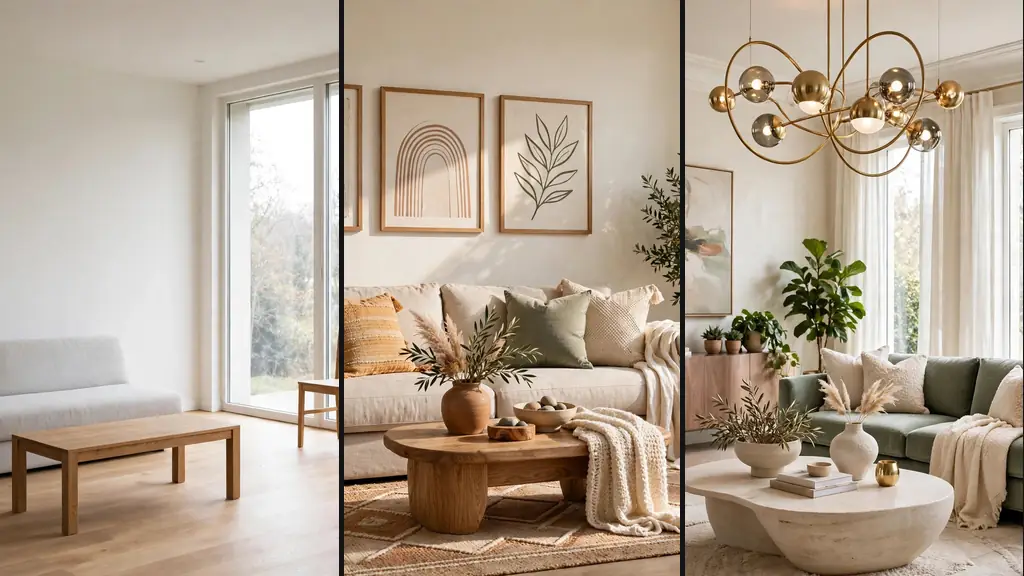
Ever walk into someone’s home and think, “Why does this look so much better than mine?” — even though they didn’t spend a fortune? It’s rarely about expensive furniture. Professional stylists rely on a handful of repeatable home styling tips that have nothing to do with budget and everything to do with how the eye reads a room. Here are ten of them, and you can start using most of them this weekend.
Table of Contents
Give Every Room a Focal Point
Secret #1: Every well-designed room has one thing your eye lands on first. It might be a fireplace, a bold piece of art, a statement sofa, or even a great view through a window. Once you identify (or create) that anchor, arrange everything else to support it rather than compete with it. Rooms that feel chaotic usually aren’t over-decorated — they’re missing a clear visual leader.
Secret #2: If you don’t have a natural focal point, make one. A large mirror, an oversized piece of art, or a painted accent wall can manufacture focus in a bland box of a room. This is one of the most powerful home styling tips for renters, because a single dramatic piece changes the whole read of a space without touching the walls permanently. Our guide to affordable home decor has plenty of focal-point ideas that cost very little.
Home Styling Tips for Layering Like a Pro
Secret #3: Designers never rely on a single light source. The classic formula is three layers — ambient (overhead), task (reading lamps, under-cabinet), and accent (picture lights, candles, a glowing corner). A room with only a ceiling light feels flat and interrogation-like no matter how nice the furniture is. Add a floor lamp and a table lamp, and suddenly the same room feels intentional.
Secret #4: Layer textures, not just colors. A room done entirely in smooth, matching finishes looks like a showroom — cold and untouchable. Mix linen with velvet, rough wood with polished metal, a nubby rug under a sleek coffee table. Texture is what makes people want to sit down and stay awhile. If your space feels “done but boring,” texture is almost always the missing ingredient. For inspiration on mixing rustic elements with modern pieces, browse our rustic home decor ideas.
The Rule of Three (and Other Grouping Secrets)
Secret #5: Style surfaces in odd numbers. Groups of three (or five) look naturally pleasing to the eye in a way pairs often don’t. Vary the heights — tall, medium, short — and you’ve got a vignette that looks effortless. This works on mantels, coffee tables, bookshelves, and nightstands alike.
Secret #6: Use trays to create order from clutter. A tray turns a random scatter of remotes, candles, and coasters into a deliberate arrangement. Designers use them constantly because they define a boundary: everything inside the tray reads as “styled,” everything outside reads as mess. It’s a two-second trick with an outsized payoff, and it makes dusting easier too.
Get the Scale Right — Size Is Everything
Secret #7: Most people buy rugs that are too small. It’s the single most common styling mistake in living rooms. A rug should be large enough that at least the front legs of your sofa and chairs sit on it — in a dining room, all chair legs should stay on the rug even when pulled out. A too-small rug makes the whole room feel cramped and disconnected, while the right size pulls everything together.
Secret #8: Hang curtains high and wide. Mount the rod close to the ceiling and extend it well past the window frame so the curtains just kiss the sides of the window when open. This makes windows look bigger and ceilings taller — it’s pure visual trickery, and it costs nothing extra. Tiny art hung at eye level in a vast empty wall has the opposite problem; when in doubt, go bigger than feels safe. We cover more scale mistakes in our interior design mistakes to avoid guide.
Edit Ruthlessly Before You Add Anything
Secret #9: Remove one thing from every styled surface. This old decorator’s rule survives because it works. Most rooms don’t need more decor — they need less, better-chosen decor. Before buying anything new, take everything off your shelves and mantels, then put back only the pieces you genuinely love, in those odd-numbered groupings from secret #5.
Editing also means being honest about “someday” items: the chair nobody sits in, the stack of magazines from last year, the gadget on the counter you use twice annually. Clearing them doesn’t make your home empty — it gives the things you kept room to breathe and be noticed. If you’re choosing a hero piece to build around, our living room sofa ideas can help you pick seating that anchors the space properly.
Home Styling Tips: The Finishing Layer That Makes It Yours
Secret #10: The difference between a styled room and a showroom is you. Every room needs a few things that couldn’t belong to anyone else — family photos, travel finds, books you actually read, a plant you’ve kept alive against the odds. Designers call this the “collected” layer, and it’s what stops a well-styled room from feeling like a hotel lobby.
The trick is curation, not quantity: three meaningful objects beat thirty random ones. And living things count double — a healthy plant or a bowl of fresh fruit adds color, texture, and life that no accessory can fake. The Spruce’s decorating guides at The Spruce are a good ongoing reference as you refine your eye. Start with one room, apply two or three of these home styling tips, and you’ll be surprised how quickly the whole house starts feeling like it was done on purpose — because now it was.