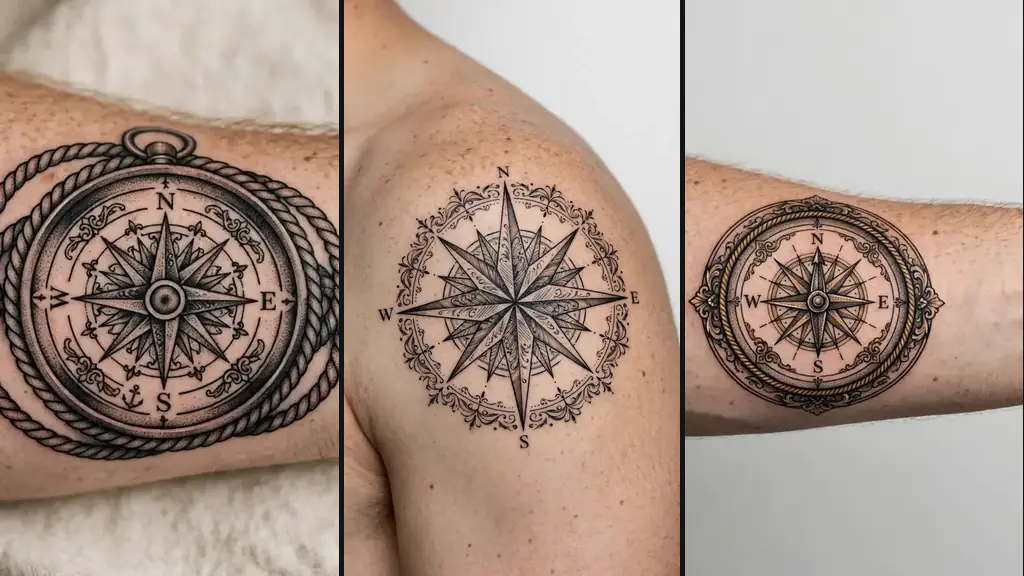
A compass tattoo is the rare design that looks just as good at two inches as it does across your whole back — and it carries a meaning nobody has to explain. Direction. Home. The promise that no matter how far you wander, you know your way back. Sailors wore it for luck at sea; today people wear it to mark a move, a recovery, a new chapter, or simply the person they navigate by.
If you are thinking about getting one, the real question is not whether a compass tattoo looks good — it does — but which compass is yours. The bold nautical one with a ship and waves? The tiny fine-line one only you know is there? Or the Vegvisir, the Norse wayfinder that promises you will never lose your way, even in a storm? This guide covers 40 compass tattoo ideas — every design with its own image, meaning, best placement and honest pain rating — plus cost, healing time and mistakes to avoid before you book.
Quick Answer
A compass tattoo symbolises direction, guidance, protection and finding your way home — the needle always returns to north, so it is often worn as a reminder of a goal, a hometown, or a person who keeps you steady. Small minimalist compass tattoos cost roughly $50–$150 and take 30–90 minutes, while large realistic or sleeve pieces run $500–$2,000+ and take several sessions. Pain depends on placement: the outer forearm rates about 4/10, while the ribs, sternum, chest and behind the ear rate 7–9/10.
What Does a Compass Tattoo Mean?
A compass tattoo carries more meaning per square inch than almost any other symbol, and the meaning changes depending on who wears it and where the needle points. Here are the layers that matter most.
Direction and guidance. This is the meaning everyone starts with. A compass points north no matter where you stand, so the tattoo works as a daily reminder to stay on your path — even when the route is not obvious. People get one after a divorce, a move, a career change or a long recovery, when “keep going in the right direction” stops being a poster quote and becomes a real plan.
Homecoming. The needle always returns to north, and plenty of people use that as a stand-in for home — a hometown, a family, or a person they navigate by. Add coordinates to the bezel and the meaning becomes exact. For more symbolism, see our guide to 50 tattoo meanings you must know before getting inked.
Protection and good luck. Sailors have worn compass tattoos for centuries as a talisman that would bring them home safely through storms — which is why the compass sits so naturally next to anchors, ships and nautical stars. It is also why so many travellers choose one before a big trip.
Independence. A compass points in one direction, and your path is no one else’s. People who have found their own direction often mark the moment with one. It says: I decide where I go next.
The four directions. The cardinal points also carry older symbolism: North for winter and survival, East for spring and fresh starts, South for summer and passion, West for autumn and transformation. If a compass points somewhere other than north, that direction is usually deliberate.
The Vegvísir — the “Viking compass”. You will see this one everywhere, and it deserves an honest note: the Vegvísir is documented in a 19th-century Icelandic manuscript, the Huld manuscript, not in the Viking age — so calling it a Viking compass is historically shaky. But its promise is real in the manuscript itself: “If this sign is carried, one will never lose one’s way in storms or bad weather, even when the way is not known.” That is why it still works as a tattoo: protection for the journey.
Is a compass tattoo bad luck? No — the superstition runs the other way. In most traditions the compass is a protective talisman, not a curse. The one exception is the broken compass: a cracked bezel or missing needle, worn to mark a period of being lost — and, often, of finding your way again.
A compass tattoo in faith. In Christianity the compass is sometimes read as direction in faith — a fixed point when everything else moves.
40 Compass Tattoo Ideas — The Gallery
Every design below comes with its own image, what it means, the best placement, and an honest pain note. Find the one that feels like you — then read the pain, cost and aftercare sections before you book.
Chapter 1 — Classic & Nautical Compass Tattoo Styles
The styles that built the compass’s reputation: bold, seafaring ink with real presence.
1. Classic Nautical Compass Tattoo
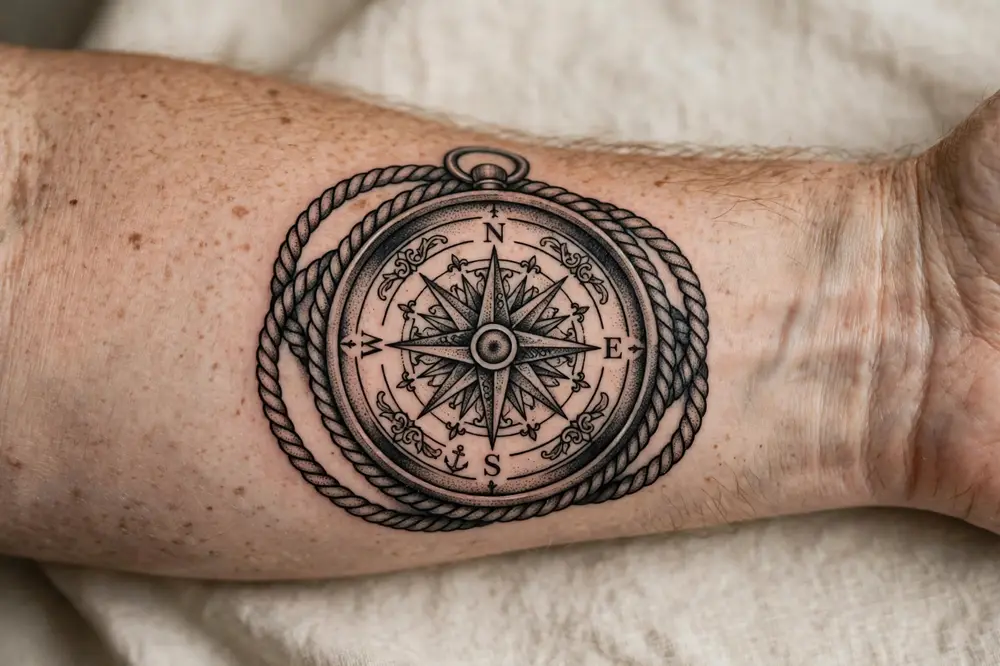
The original: an antique brass compass with a rope border and a full compass rose, the design sailors have worn for over a century. It suits the forearm, where flat skin keeps the circle true. Pain: 4/10 on the outer forearm. Downside: a detailed bezel needs at least 3–4 inches, or the tick marks blur within a few years.
2. Compass Rose Tattoo
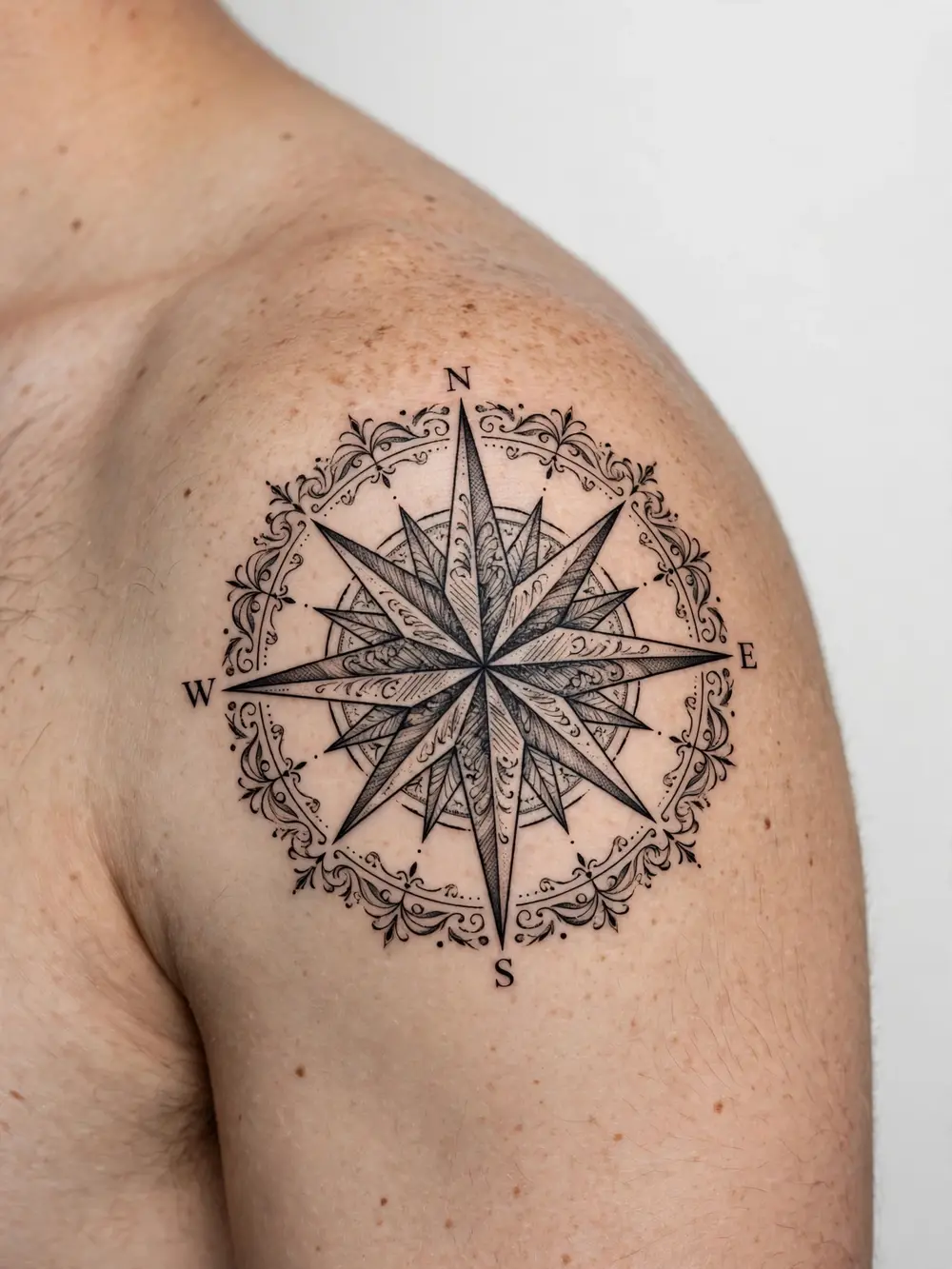
The compass rose — the “rose of the winds” from old sea charts — drawn as a pure star, no case, no needle, just geometry. The cleanest compass design there is, and it works almost anywhere. Pain: 4/10 on the shoulder. Downside: with more than four points, go bigger — a crowded rose at two inches becomes a grey blob.
3. American Traditional Compass Tattoo
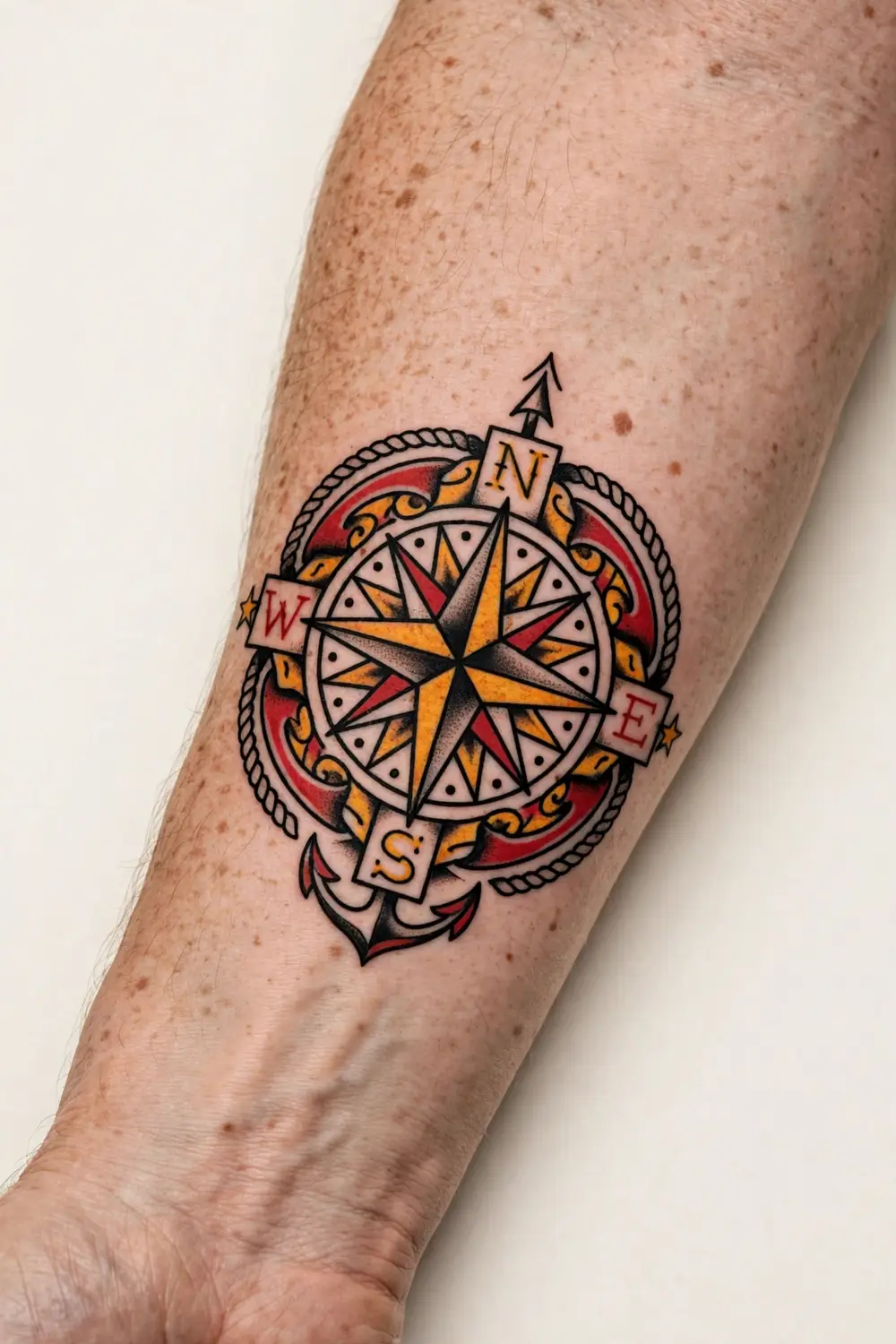
Bold black outlines, red, yellow and black, zero apology — the old-school sailor style that made the compass a tattoo classic, and it ages better than almost any other style. Pain: 4/10 on the forearm. Downside: if you want subtle, this is not it — traditional is loud by design.
4. Nautical Star Compass Tattoo
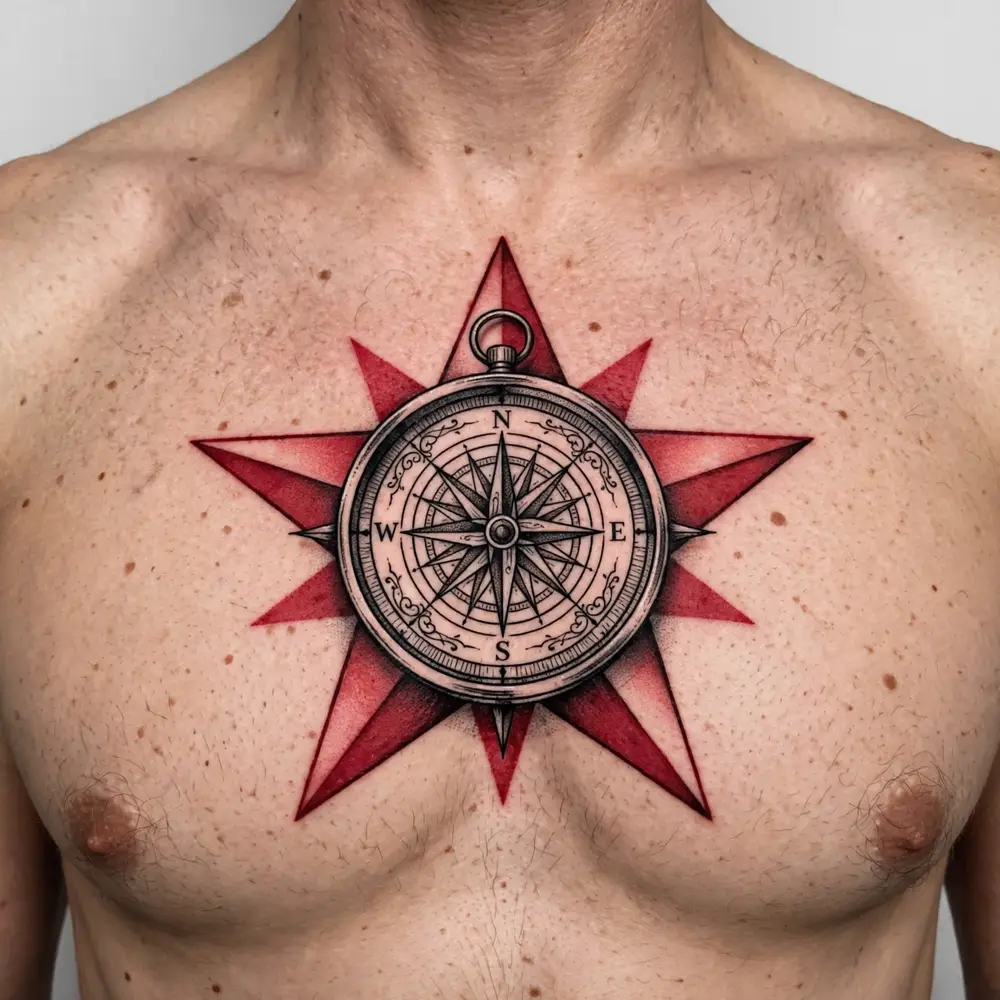
A five-pointed nautical star sits behind the compass dial, the way sailors once followed the North Star home. The pairing means “never forget where you come from.” Pain: 6/10 on the chest. Downside: the star’s sharp points need a skilled hand, or they soften into triangles.
5. Anchor and Compass Tattoo
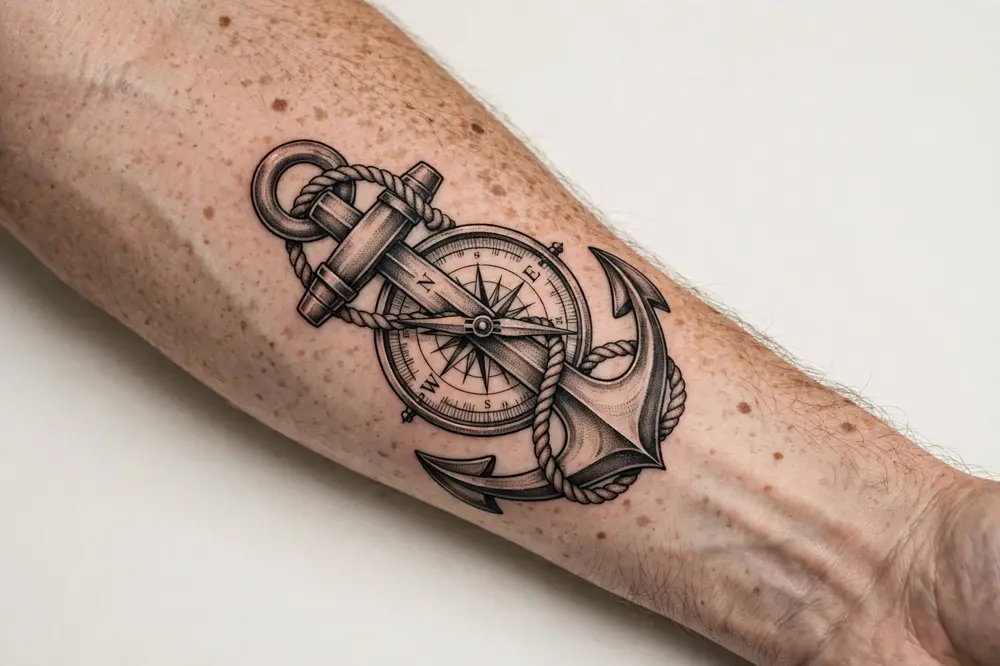
The anchor says “stay grounded,” the compass says “keep moving” — together the most balanced pairing in tattooing, and the most requested compass combination of all. Pain: 4/10 on the forearm. Downside: two strong shapes can fight each other, so let the artist make one the lead and the other the accent.
6. Ship and Compass Tattoo
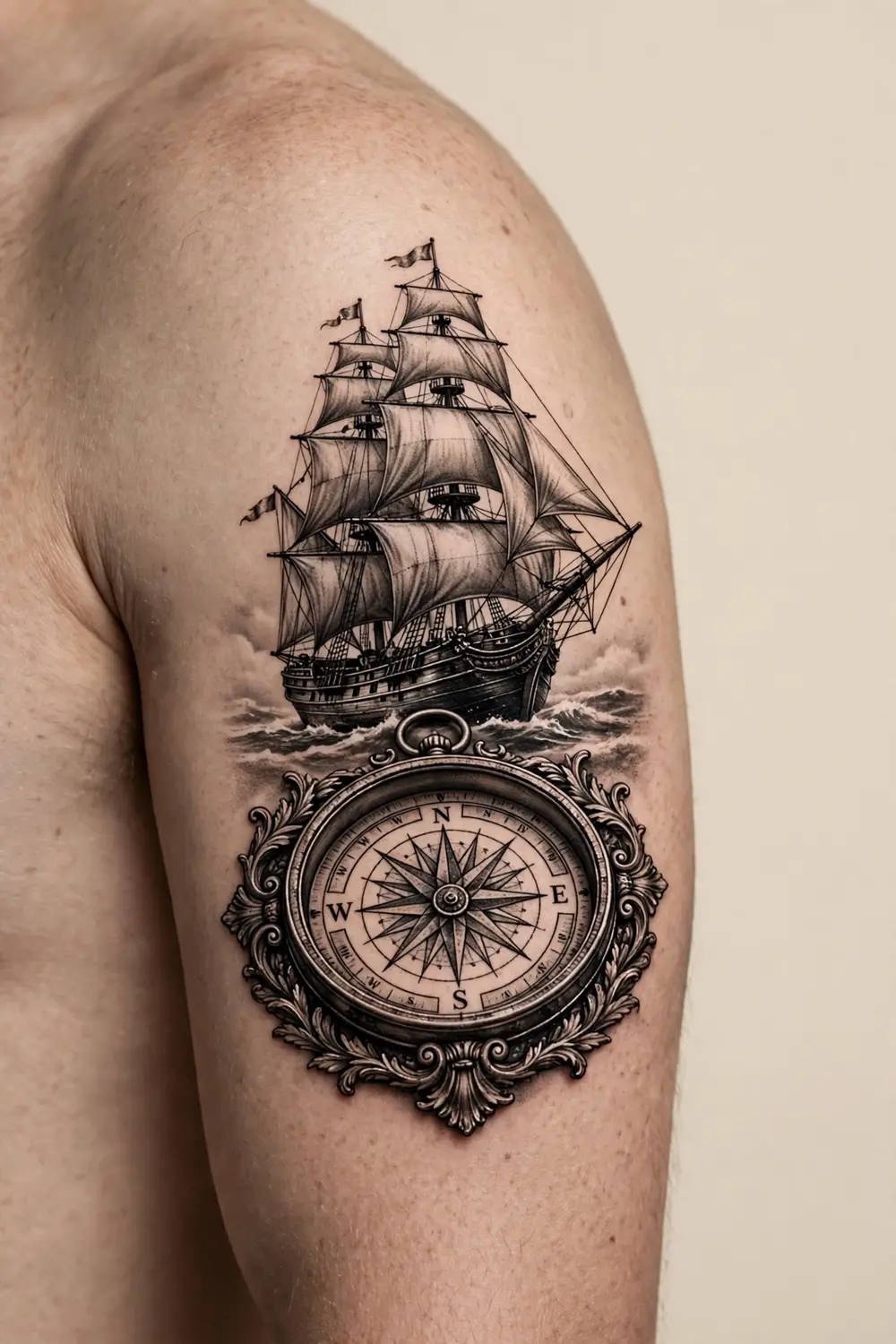
A tall ship with full sails above an ornate compass — a talisman that says a good vessel (body, mind and spirit) will take you far. It needs room, so the upper arm or thigh suits it best. Pain: 5/10 on the upper arm. Downside: a multi-hour piece; a rushed ship looks like a smudge.
7. Compass and Waves Tattoo
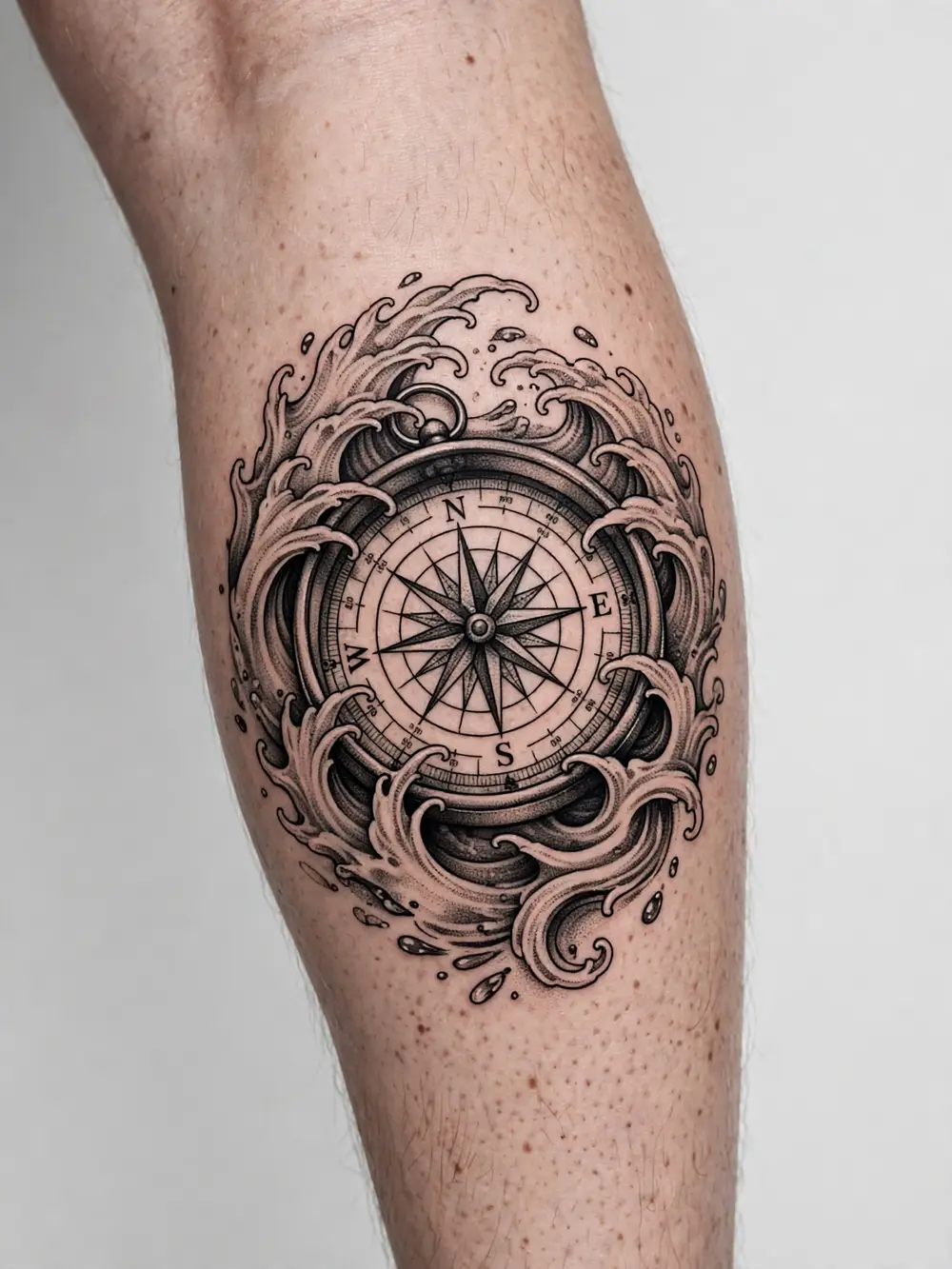
Curling ocean waves wrap around the compass dial, as if the sea itself is holding it. It suits the calf, where the waves flow with the muscle. Pain: 5/10 on the calf. Downside: waves need negative space — pack them too tight and the whole piece goes muddy.
8. Vintage Explorer Compass Tattoo
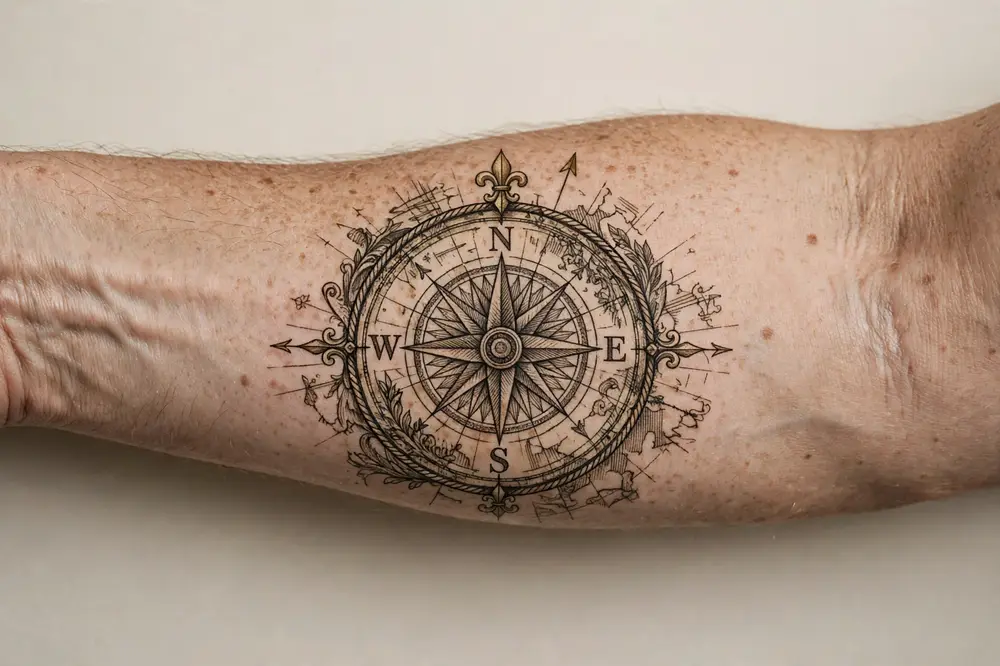
An antique map-style compass with engraved detail and faded sepia tones, like something lifted from a 19th-century explorer’s chart — the most romantic compass, and the one that most needs a big canvas. Pain: 4/10 on the forearm. Downside: fine engraved detail at small sizes is the first thing to blur, so treat this as a half-forearm piece minimum.
Chapter 2 — Small & Minimalist Compass Tattoos
Not every compass needs to shout. These eight are for people who want the meaning without the spectacle — small, clean, easy to hide.
9. Minimalist Line Compass Tattoo
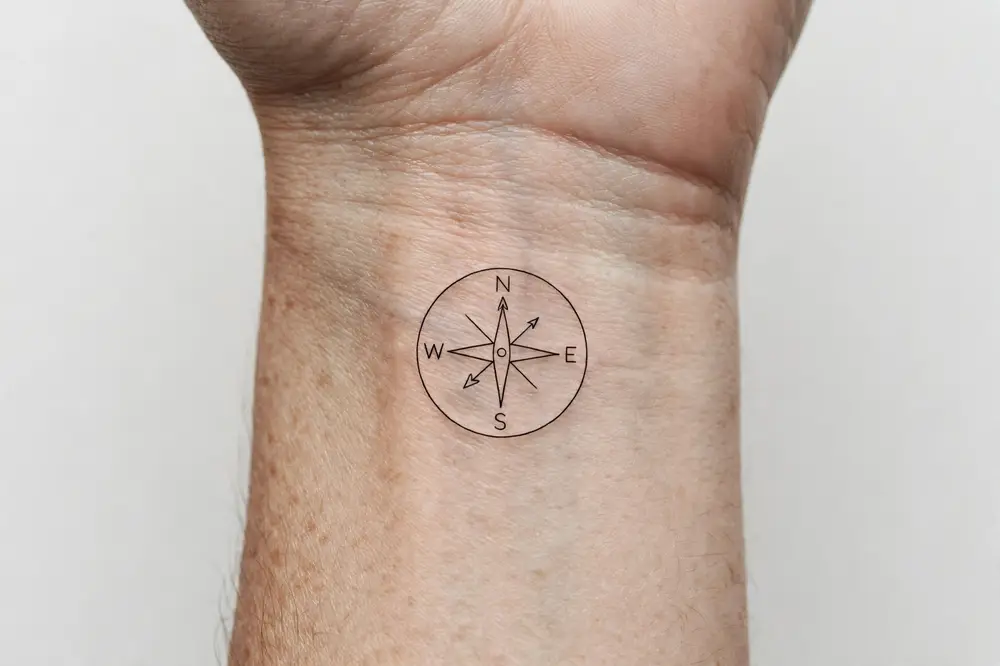
One continuous thin line draws the whole compass — dial, needle, four points — with nothing extra. The cheapest and fastest compass on this list, often a single short session. Pain: 3/10 on the wrist. Downside: thin lines spread and soften over the years, so expect a touch-up.
10. Tiny Wrist Compass Tattoo
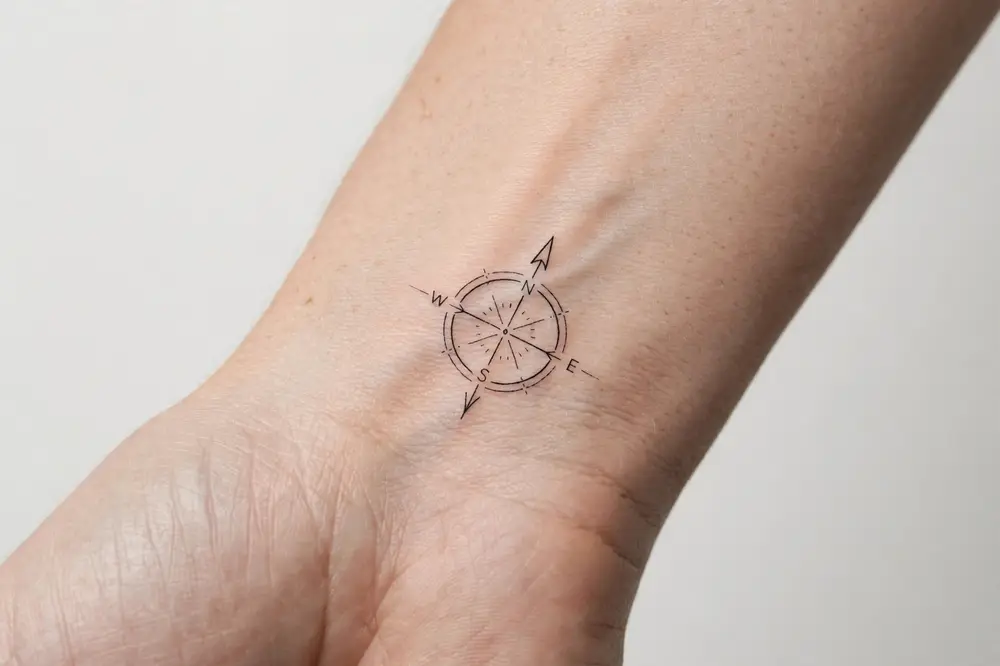
A compass no bigger than a coin, sitting quietly on the wrist where you can see it every day — direction literally close at hand. Pain: 5/10 — the wrist is bonier than it looks. Downside: at this size, keep it to four points, or the interior detail closes up.
11. Fine Line Compass Rose Tattoo
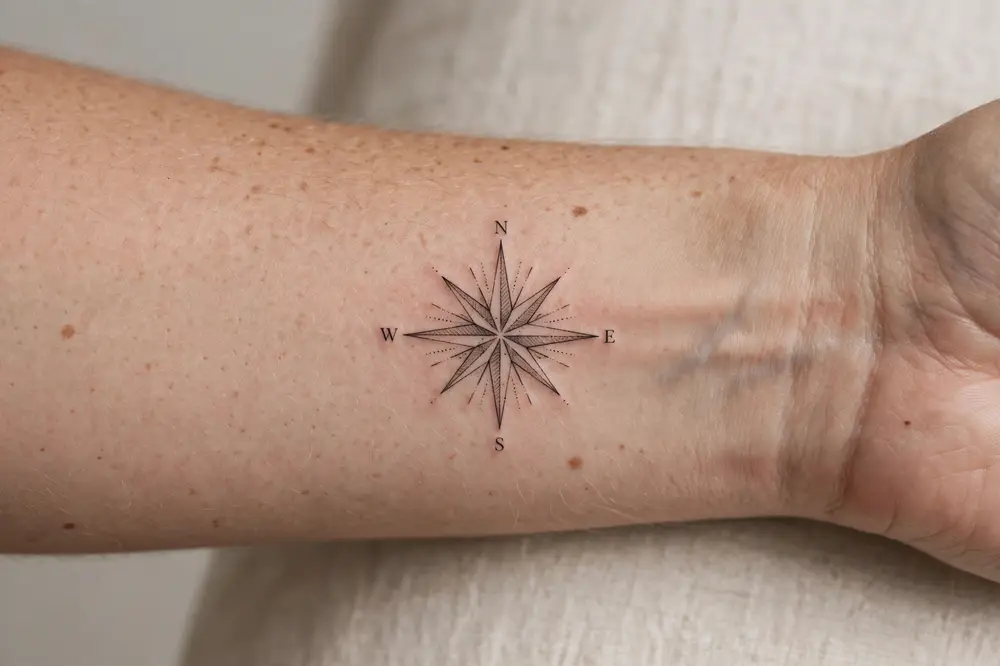
A delicate eight-point star in whisper-thin lines on the inner forearm — light, elegant, full of quiet wanderlust. Fine line work like this suits people who want the meaning without the weight. Pain: 3/10 on the inner forearm. Downside: fine line softens fastest, so budget for a touch-up in a few years.
12. Small Behind-the-Ear Compass Tattoo
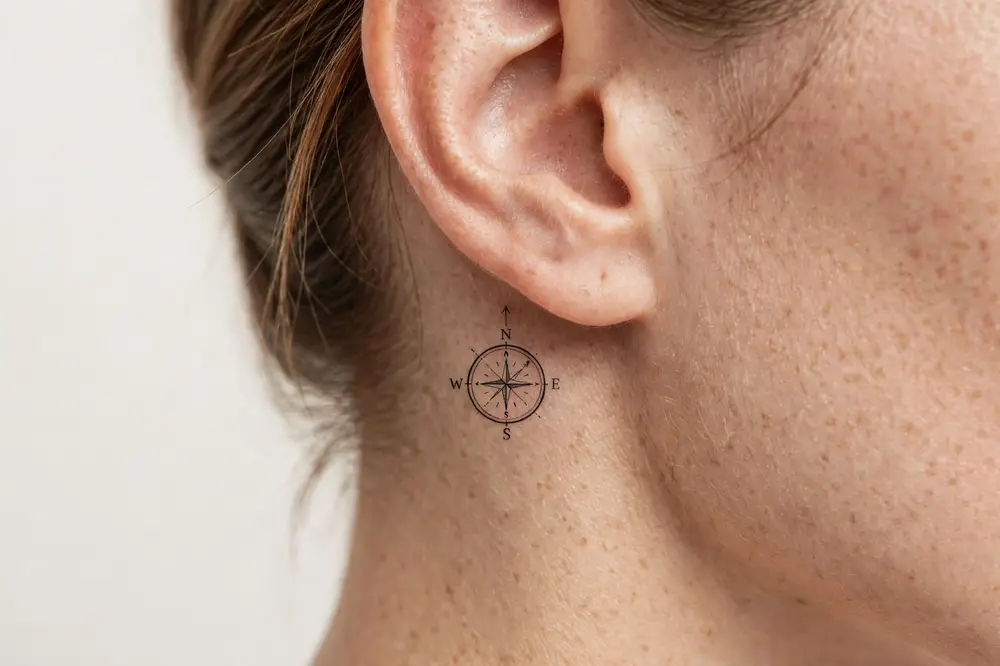
A tiny compass tucked behind the ear — the smallest placement on this list, and one of the most personal, because almost nobody sees it unless you show them. Pain: 7/10 — thin skin, bone right underneath. Downside: it fades faster than most placements, thanks to sun and hair products.
13. Geometric Compass Tattoo
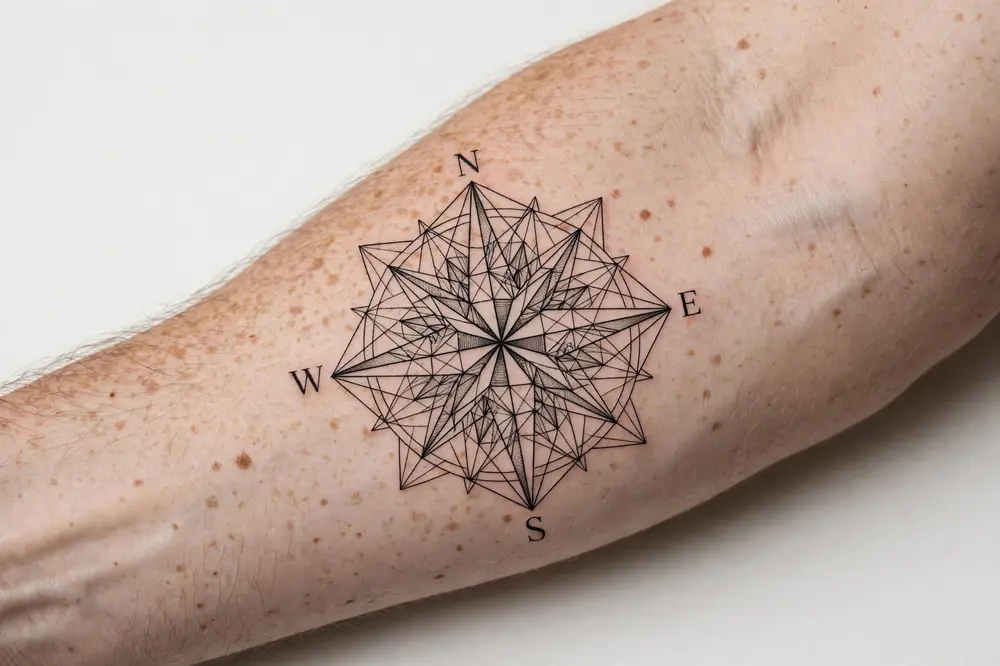
The compass rebuilt from triangles, polygons and perfectly straight lines — part navigation tool, part blueprint, for people who love precision. Pain: 4/10 on the forearm. Downside: geometric lines show every wobble, so pick an artist whose linework is genuinely clean.
14. Dotwork Compass Tattoo
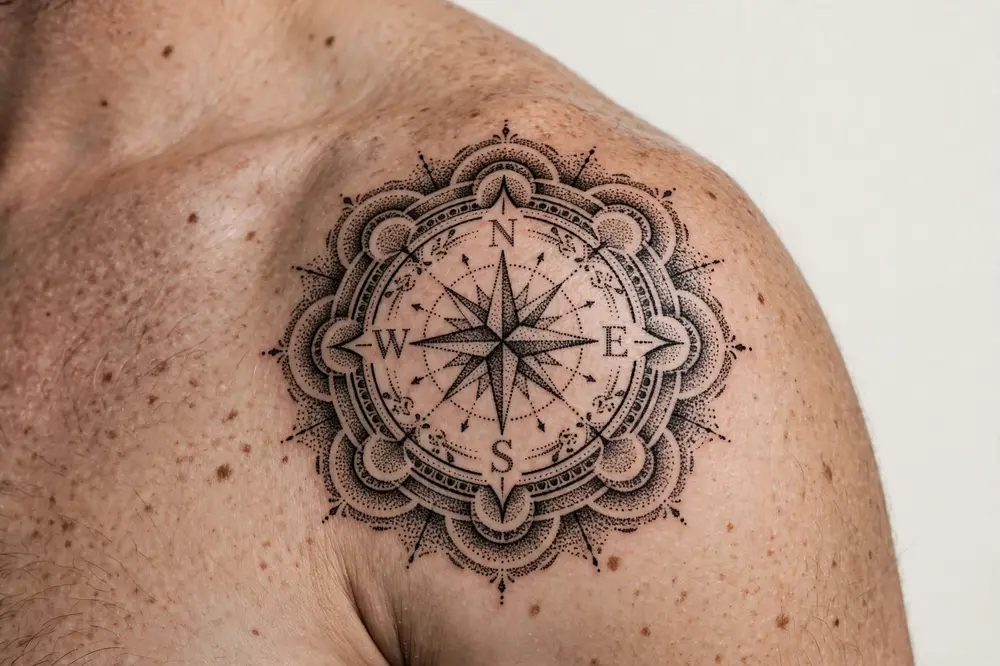
Thousands of tiny dots build the compass’s dial, shading and shadow — no solid fills, just patient pointillism, with a soft, almost printed quality. Pain: 5/10 on the shoulder. Downside: slow work, so the sitting runs longer than a lined piece the same size.
15. Single-Needle Compass Tattoo
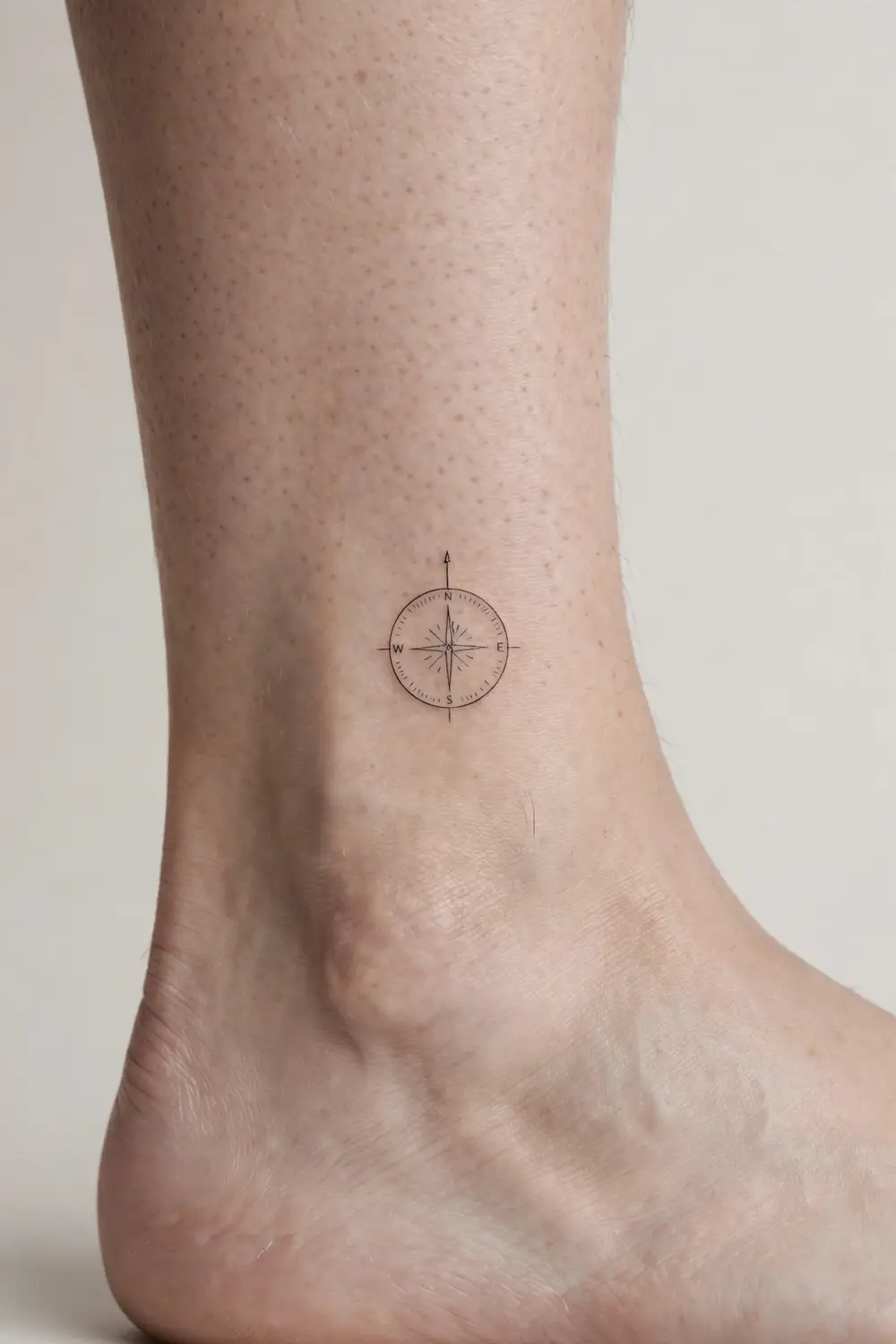
Stripped back to a needle, a circle and four points — the most stripped-down compass you can get, done with a single needle for the finest possible line. Pain: 4/10 on the ankle. Downside: the most likely design on this list to need a touch-up, so ask the touch-up policy before you book.
16. Micro Compass Tattoo
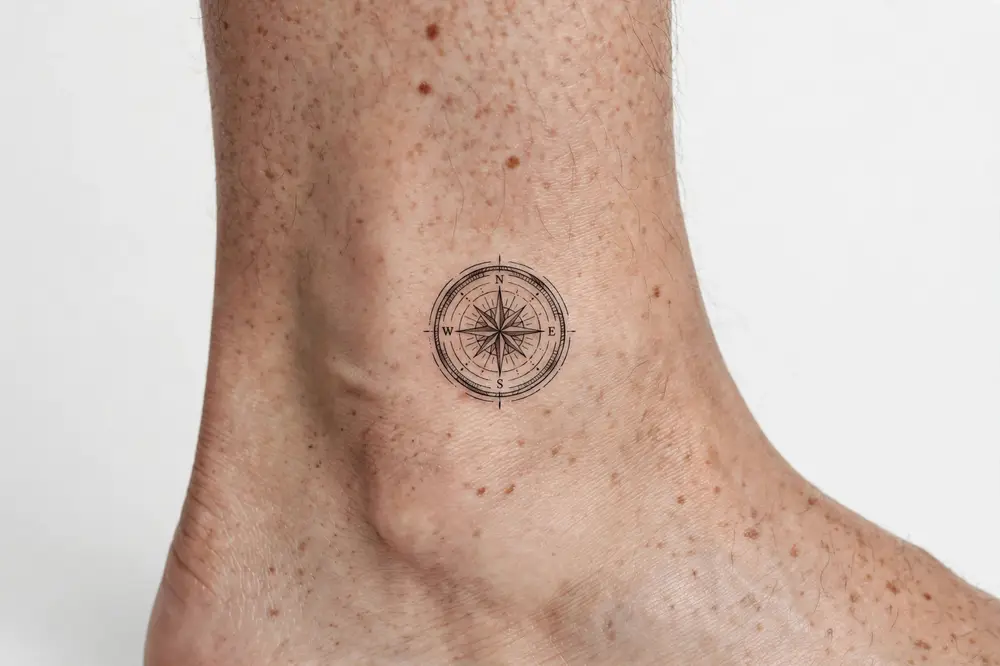
A compass the size of a fingertip on the ankle — small enough to hide under a sock, detailed enough to make people lean in, and a great first tattoo if you are nervous. Pain: 5/10 on the ankle. Downside: keep the design simple or it will soften into a dot.
Chapter 3 — Compass Tattoos With Other Symbols
A compass is a team player: pair it with another symbol and the meaning doubles. These eight pairings are the ones artists get asked for most.
17. Compass and Rose Tattoo
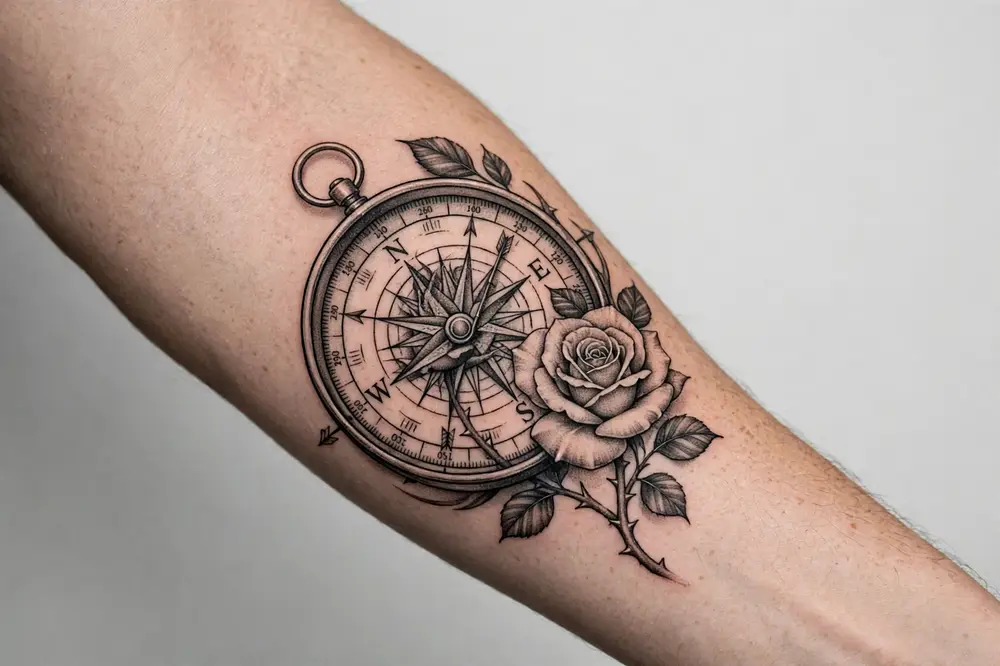
The oldest pairing on the list — the compass rose was already called a rose long before anyone tattooed a flower into one. The flower softens the geometry, which is why it is the most common compass pairing of all. Pain: 4/10 on the forearm. Downside: leave space between the petals and the bezel, or the two shapes blur into one blob after a decade.
18. Compass and Mountains Tattoo
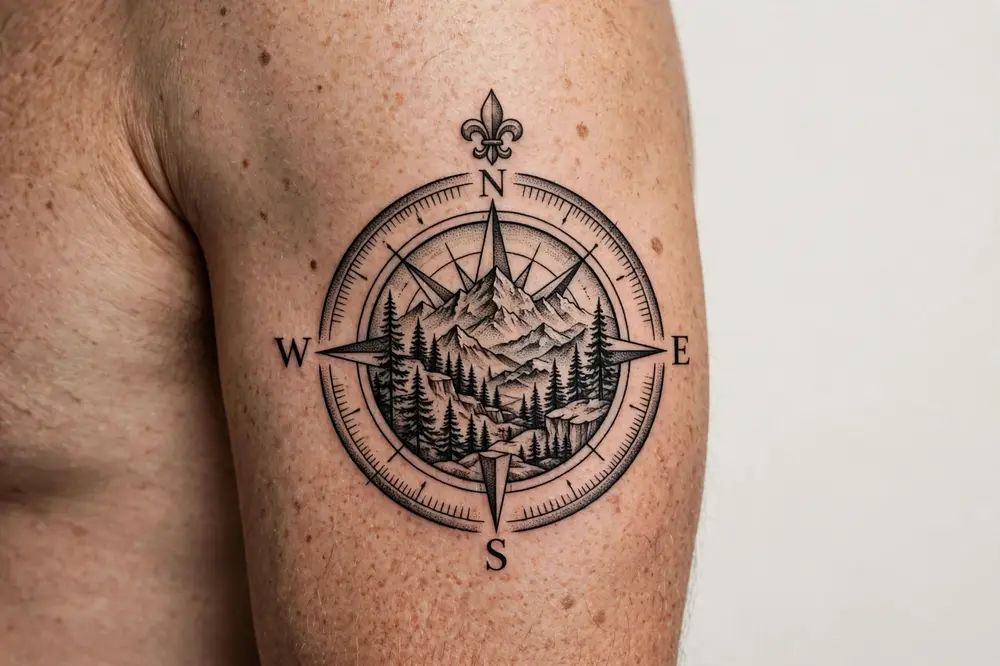
A landscape inside the compass face — mountains, pines, a horizon line — the modern take on the explorer tattoo, suiting black and grey work well. Pain: 5/10 on the upper arm. Downside: keep the horizon simple; fine landscape detail inside a small circle is the first thing to blur.
19. Compass and Map Tattoo
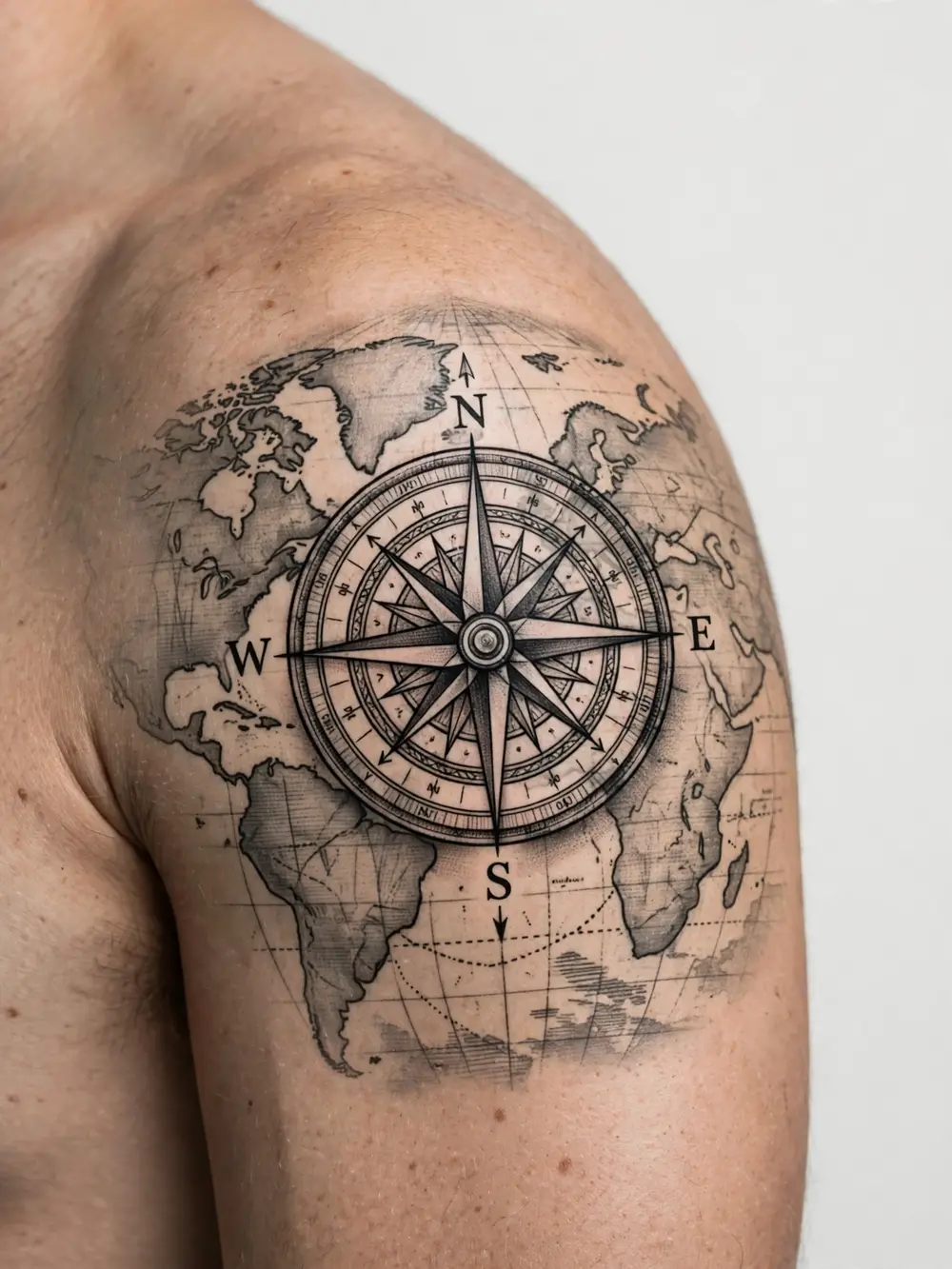
Layer the compass over a faded map or nautical chart and you get texture and depth for very little extra linework — the map fills space cheaply. Pain: 5/10 on the shoulder. Downside: the map lines must stay lighter than the compass, or the dial gets lost in the background.
20. Compass and Clock Tattoo
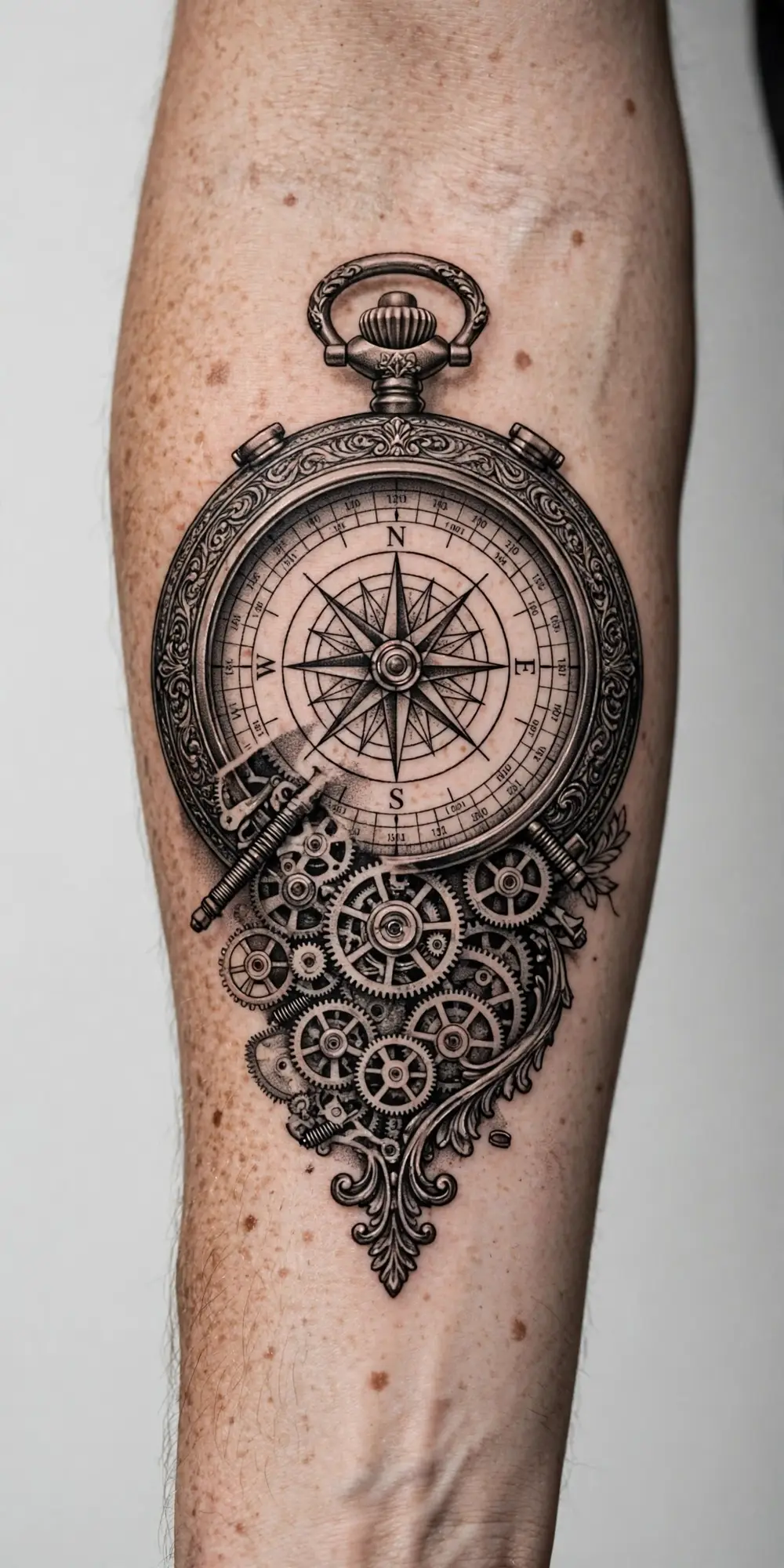
Direction plus time — the compass and the pocket watch together say “I know where I am going, and I know my time matters.” It is on the nose, but it looks good. Pain: 4/10 on the forearm. Downside: two circular dials side by side can look repetitive; ask the artist to merge them into one composition.
21. Compass and Arrow Tattoo
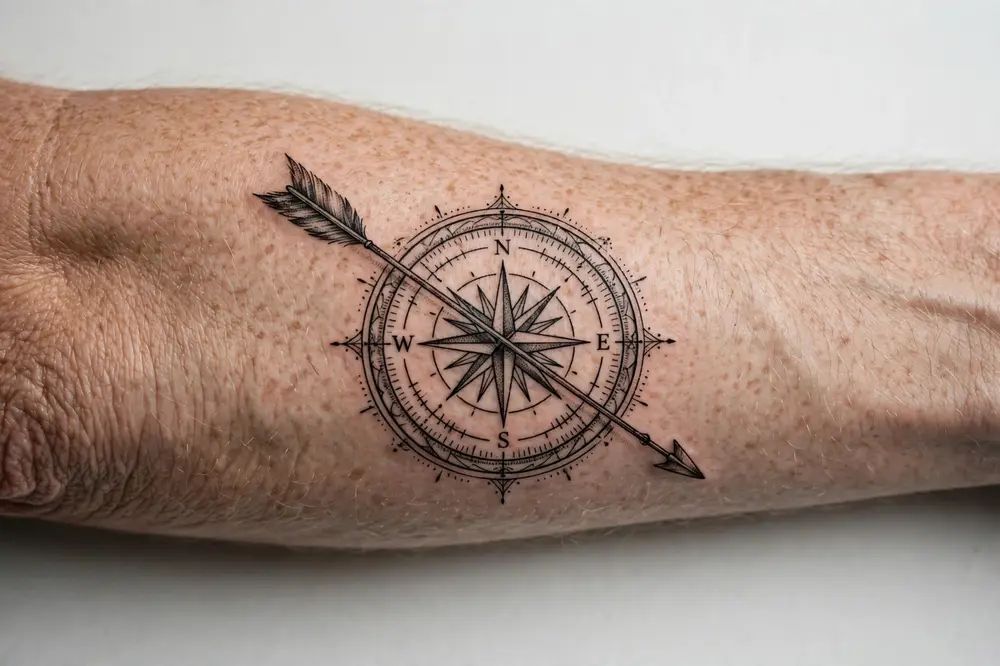
The compass guides your path, the arrow adds determination — direction plus forward motion, in one clean image, suiting the forearm where the arrow runs with the bone. Pain: 4/10 on the forearm. Downside: a long straight arrow shows every wobble, so this one lives or dies on the artist’s steadiness.
22. Compass and Wolf Tattoo
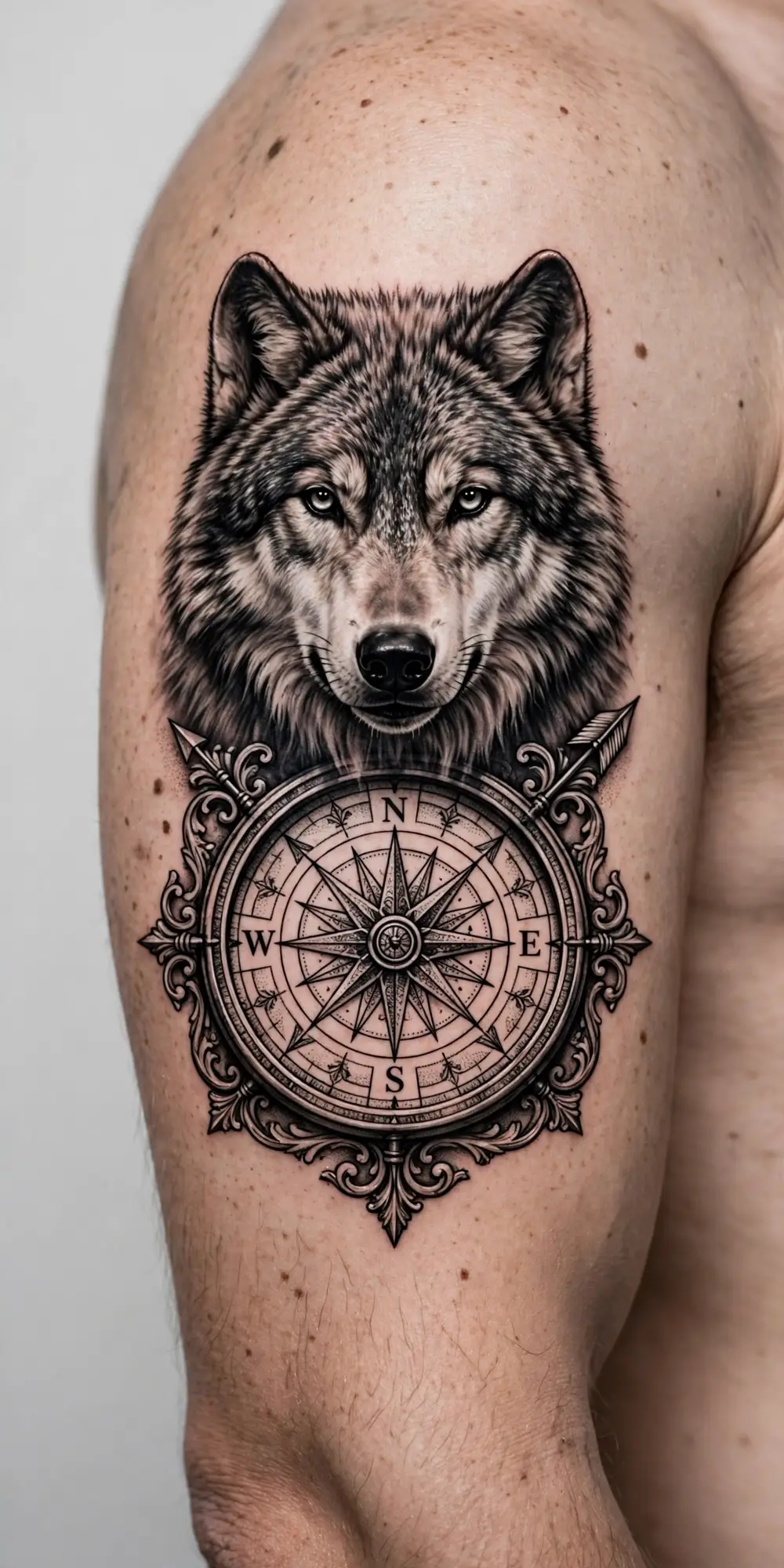
The wolf brings instinct and loyalty; the compass brings direction. Together they read as trusting your own sense of where to go — make the wolf the subject and the compass the background, or put the wolf’s head inside the ring. Pain: 5/10 on the upper arm. Downside: this pairing needs size; on a small canvas you are cropping the wolf to a head study.
23. Compass and Owl Tattoo
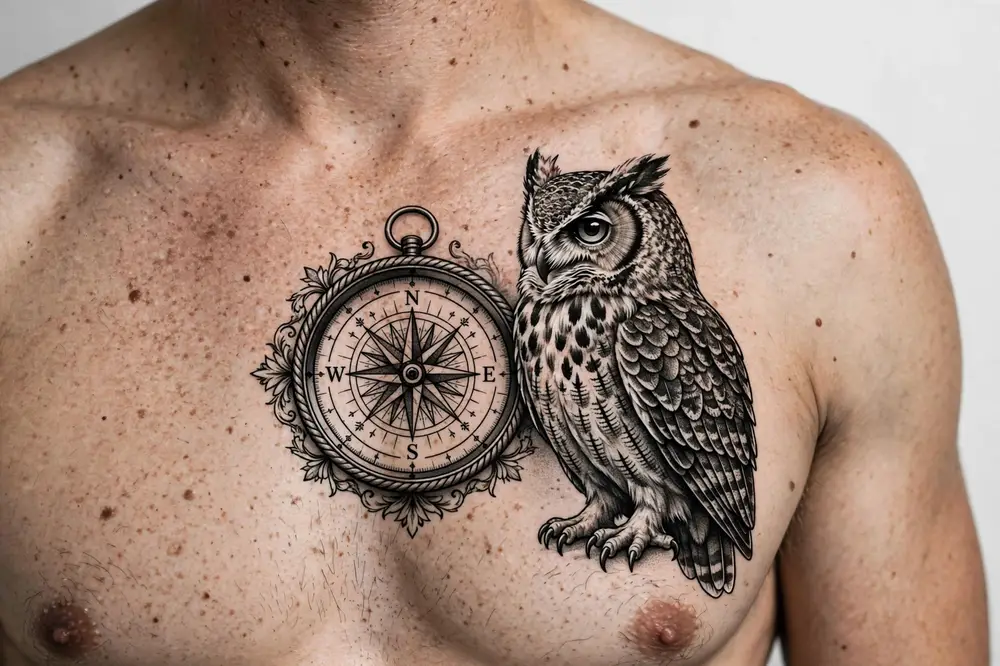
Owls are protectors, and the compass means protection too — together they say you are watched over by loved ones who have passed, or by your own better judgement. The chest suits it, where the owl can spread its wings. Pain: 6/10 on the chest. Downside: feather detail blurs at small sizes, so give the owl room.
24. Compass and Snake Tattoo
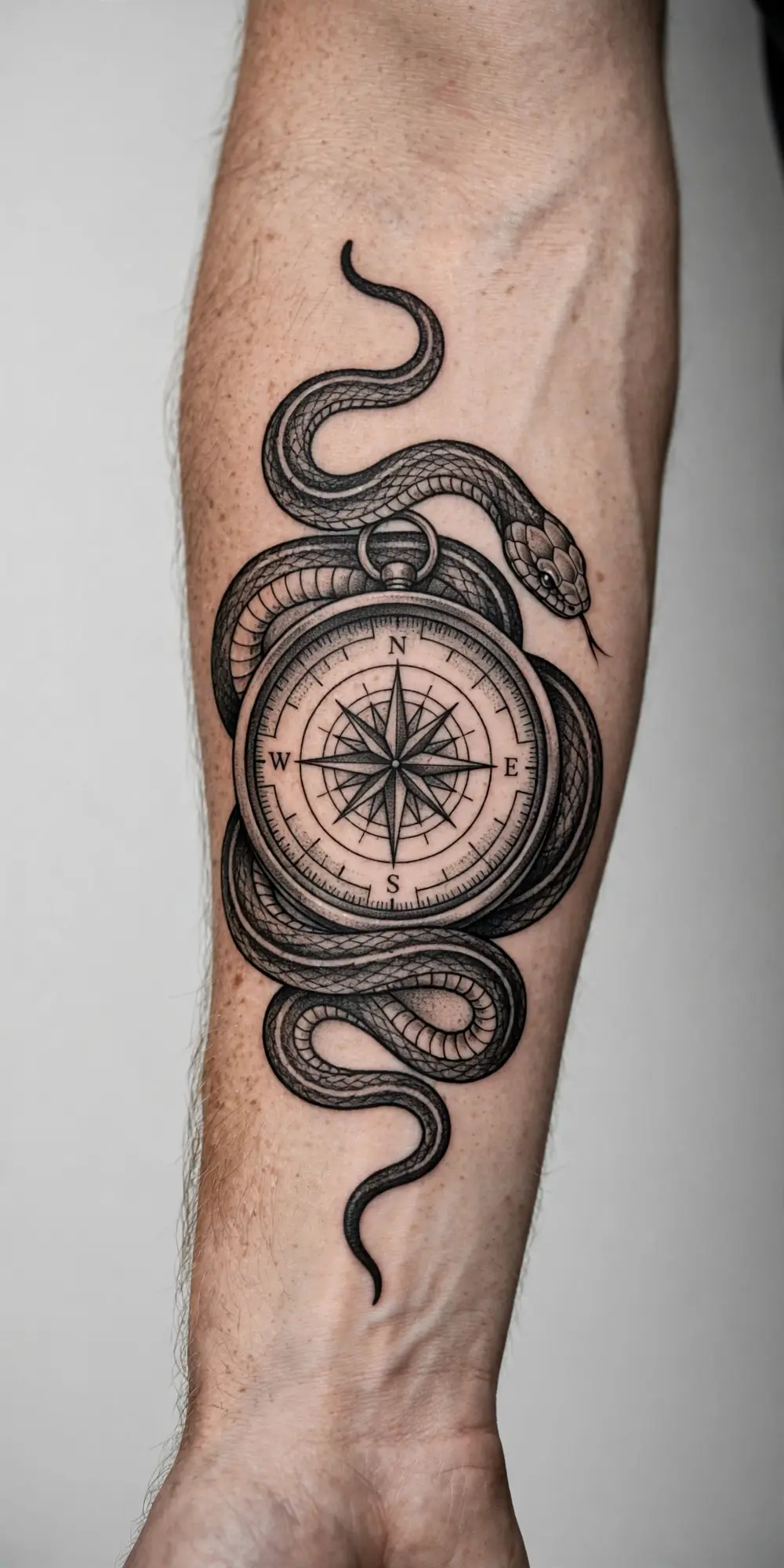
A snake wrapping the compass solves a real design problem: the snake’s body gives the artist a flowing line around the body’s curves, while the compass supplies the fixed circular anchor — transformation held to a direction. Pain: 4/10 on the forearm. Downside: the snake must follow the arm’s contours, or it will look pasted on. For more serpent work, see our 25 snake tattoo ideas.
Chapter 4 — Bold, Colour & Statement Compass Tattoos
When you want the compass to be the loudest thing in the room — big, colourful, built to last.
25. Neo-Traditional Compass Tattoo
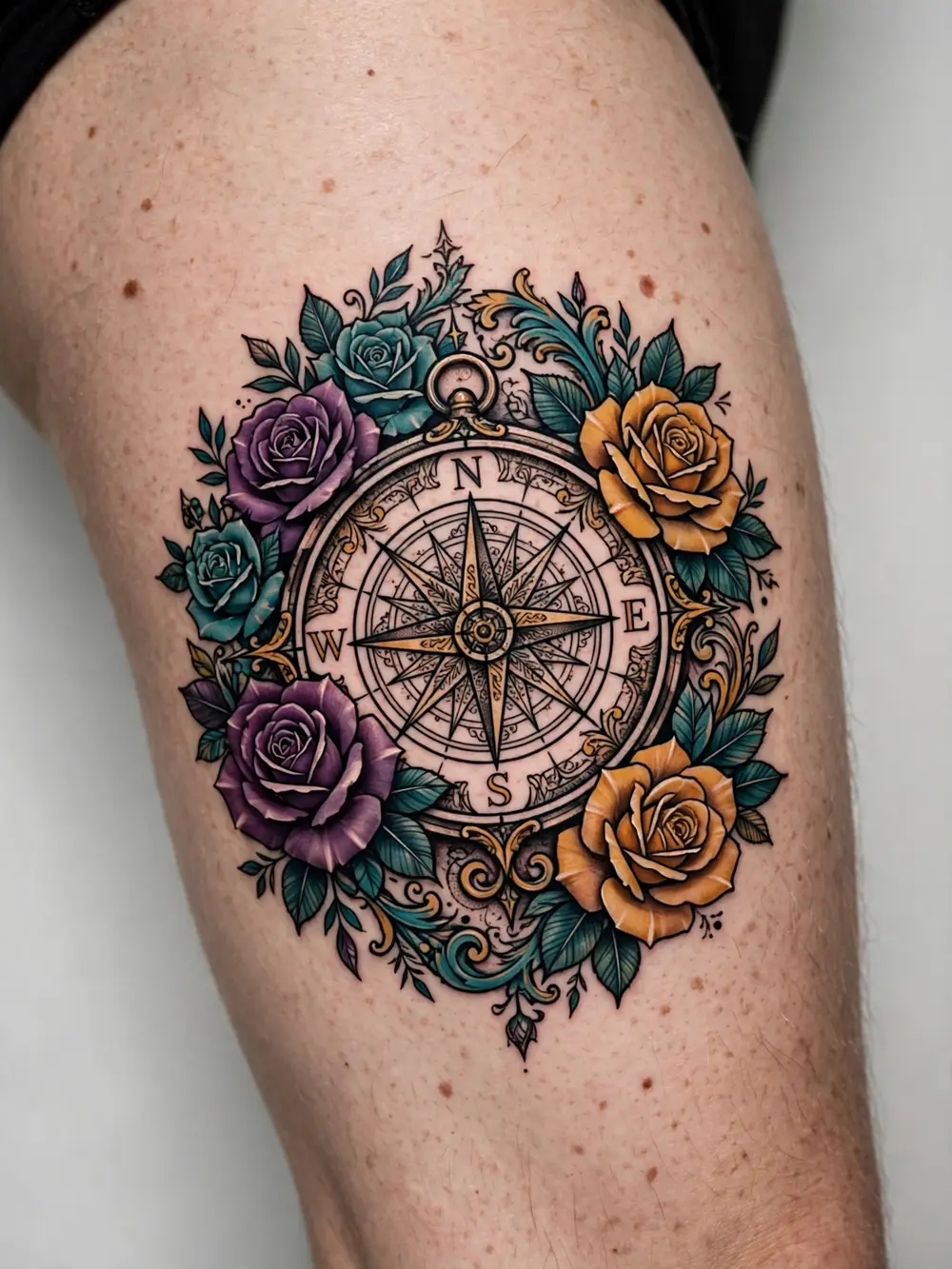
The plain sailor compass rebuilt with heavy outlines, jewel-tone colour and art nouveau ornament — teal, ochre, plum, forest green — the best ageing colour style on this list, thanks to the bold frame. Pain: 5/10 on the thigh. Downside: it needs at least four inches; squeeze it smaller and the outlines eat the interior detail.
26. Watercolor Compass Tattoo
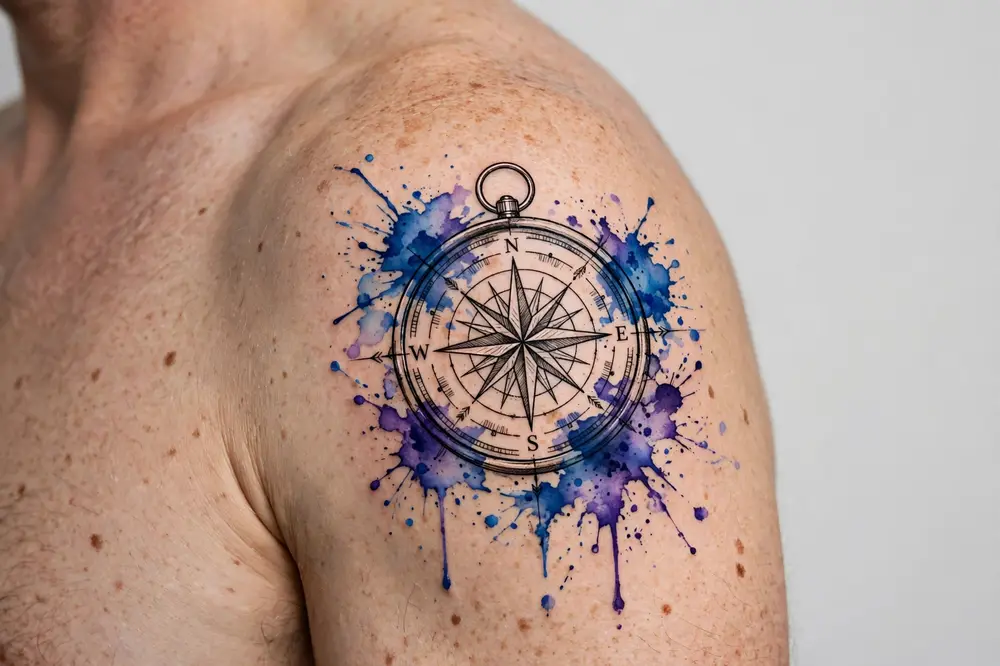
A black compass outline splashed with watercolour blues, purples and pinks, like ink dropped in water — the most artistic compass on this list, and the one that fades fastest. Pain: 5/10 on the shoulder. Downside: expect a touch-up every few years, and keep it out of the sun. See our 40 watercolor tattoo ideas for more of this style.
27. Blackwork Compass Tattoo
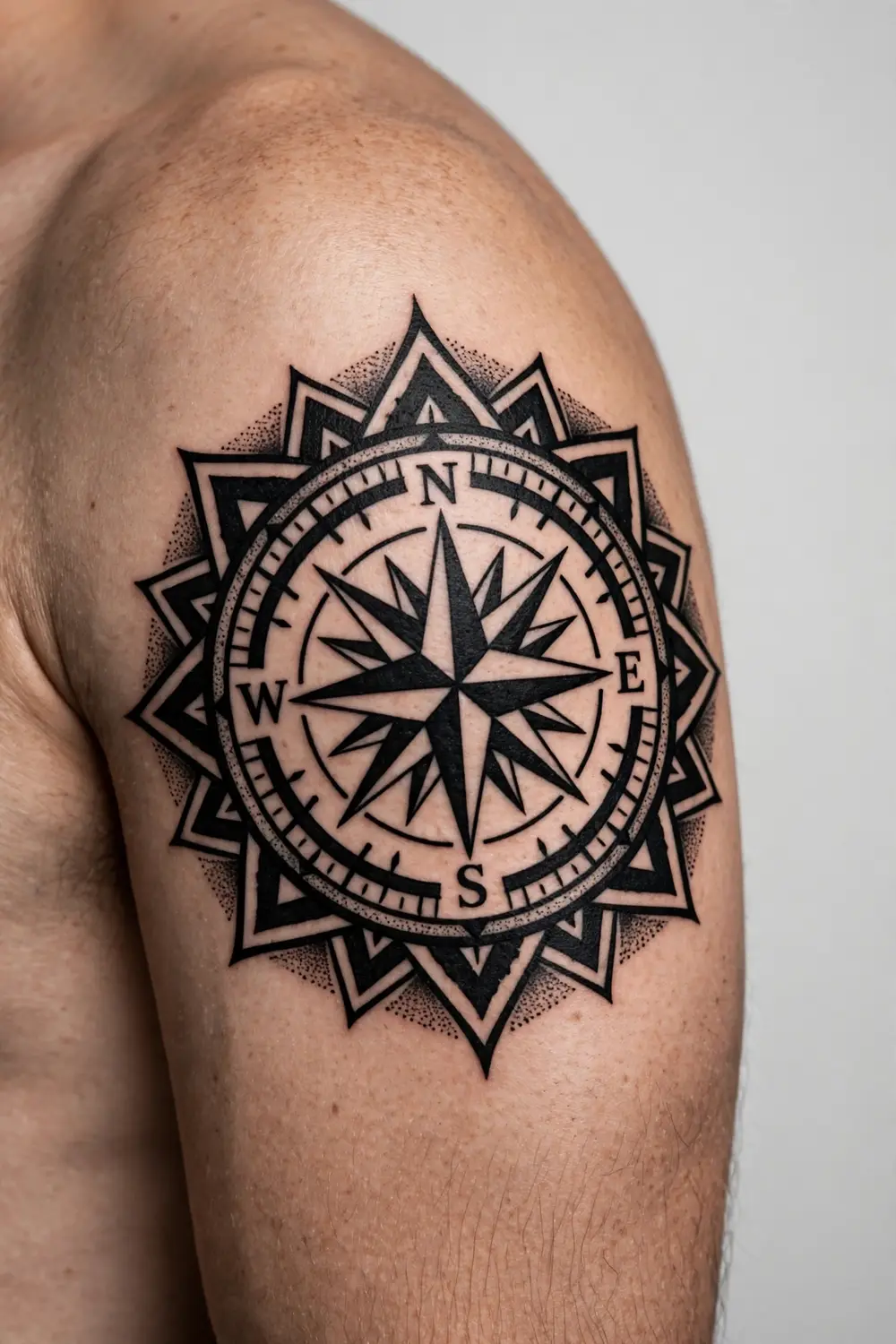
Solid, heavy black ink with almost no shading — the compass reduced to pure silhouette and power, the highest-contrast option on this list, and blackwork holds up better than any other style over decades. Pain: 5/10 on the upper arm. Downside: large areas of solid black packing feel more wearing than line work, so the sitting is a long one.
28. Realistic Compass Tattoo
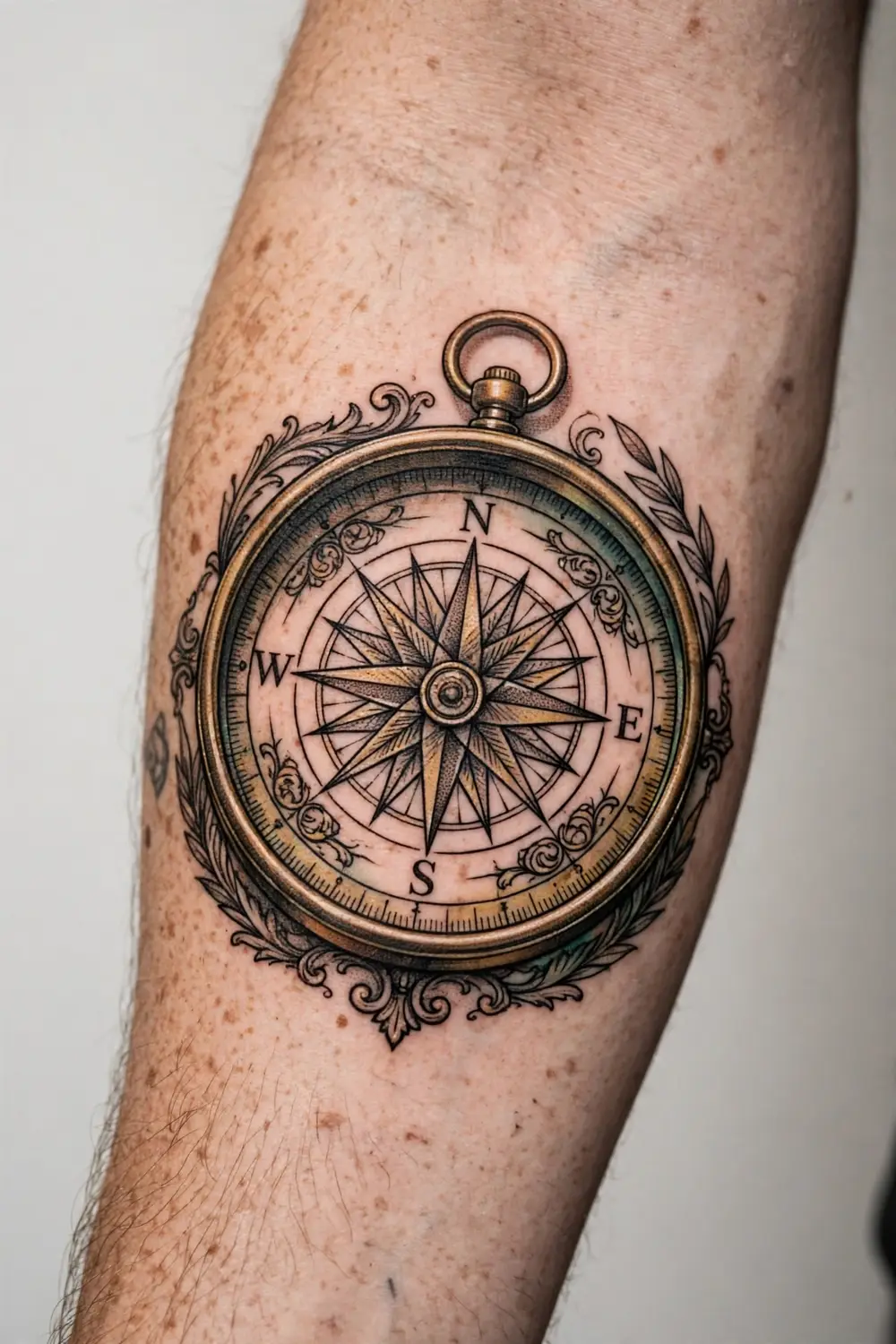
A photorealistic antique brass compass, shaded so carefully it looks like a real object sitting on your skin — it needs a genuinely skilled realism artist, and 4–6 hours or more. Pain: 4/10 on the outer forearm. Downside: it needs real size — under four inches, the engraved detail turns to grey mush.
29. Compass and Coordinates Tattoo
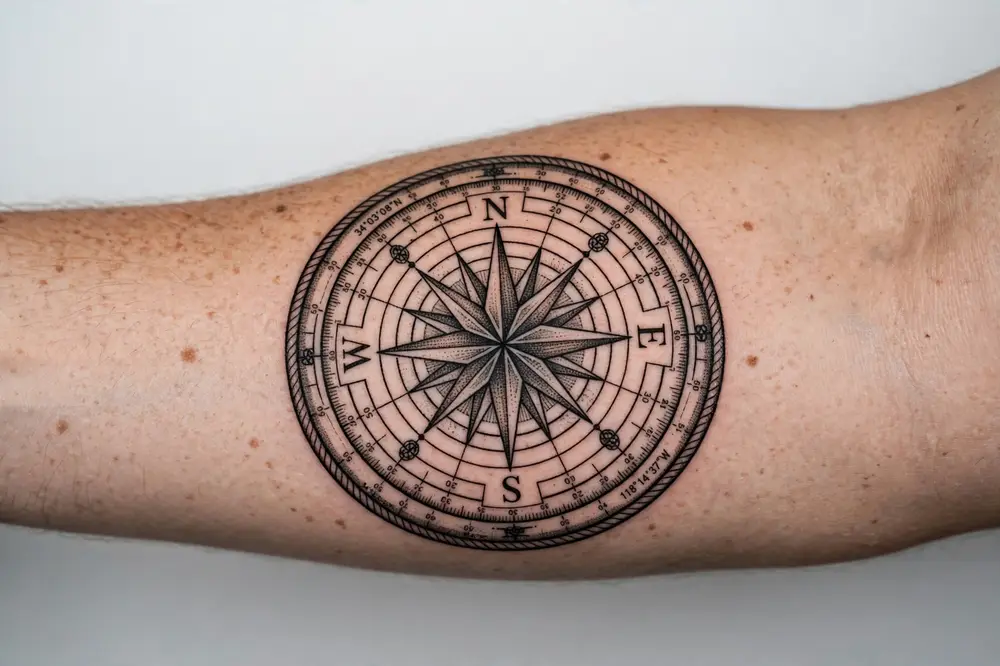
Replace the cardinal points with the latitude and longitude of a meaningful place — the single most common compass personalisation, adding meaning without visual clutter. A hometown, a first meeting place, a summit. Pain: 4/10 on the forearm. Downside: check the numbers twice with your artist — digits are the most frequently misspelled part of any tattoo.
30. Compass Chest Piece Tattoo
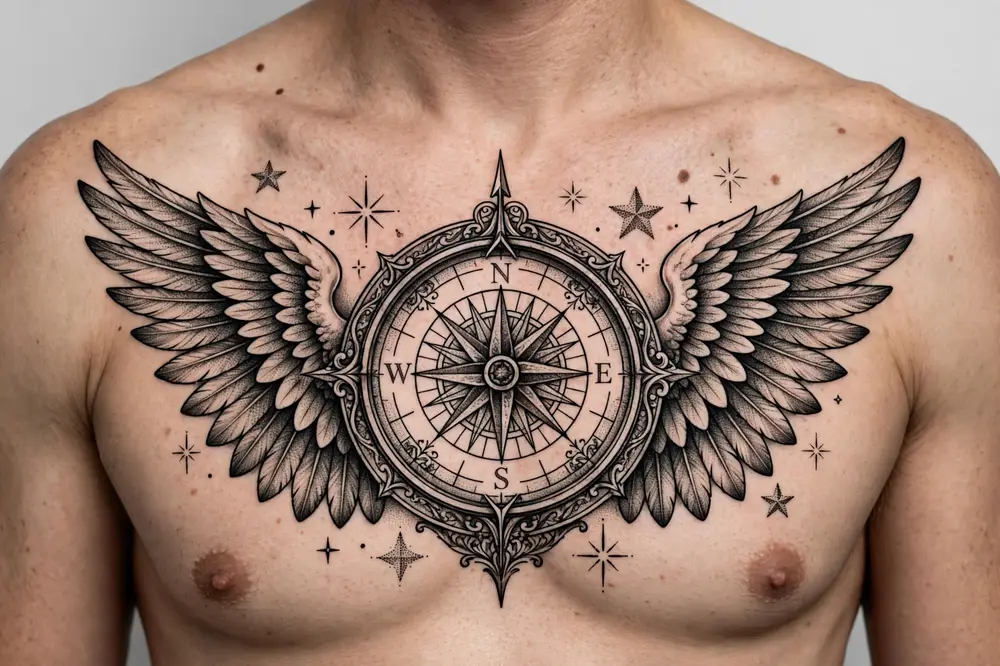
A big ornate compass centred on the chest, often with wings or stars spreading across the collarbones — heart-led direction, worn where it matters most. Pain: 7/10 on the chest — the sternum and collarbone are genuinely tough sittings. Downside: a statement piece with no hiding it in a t-shirt; be sure before you book.
31. Compass Sleeve Tattoo
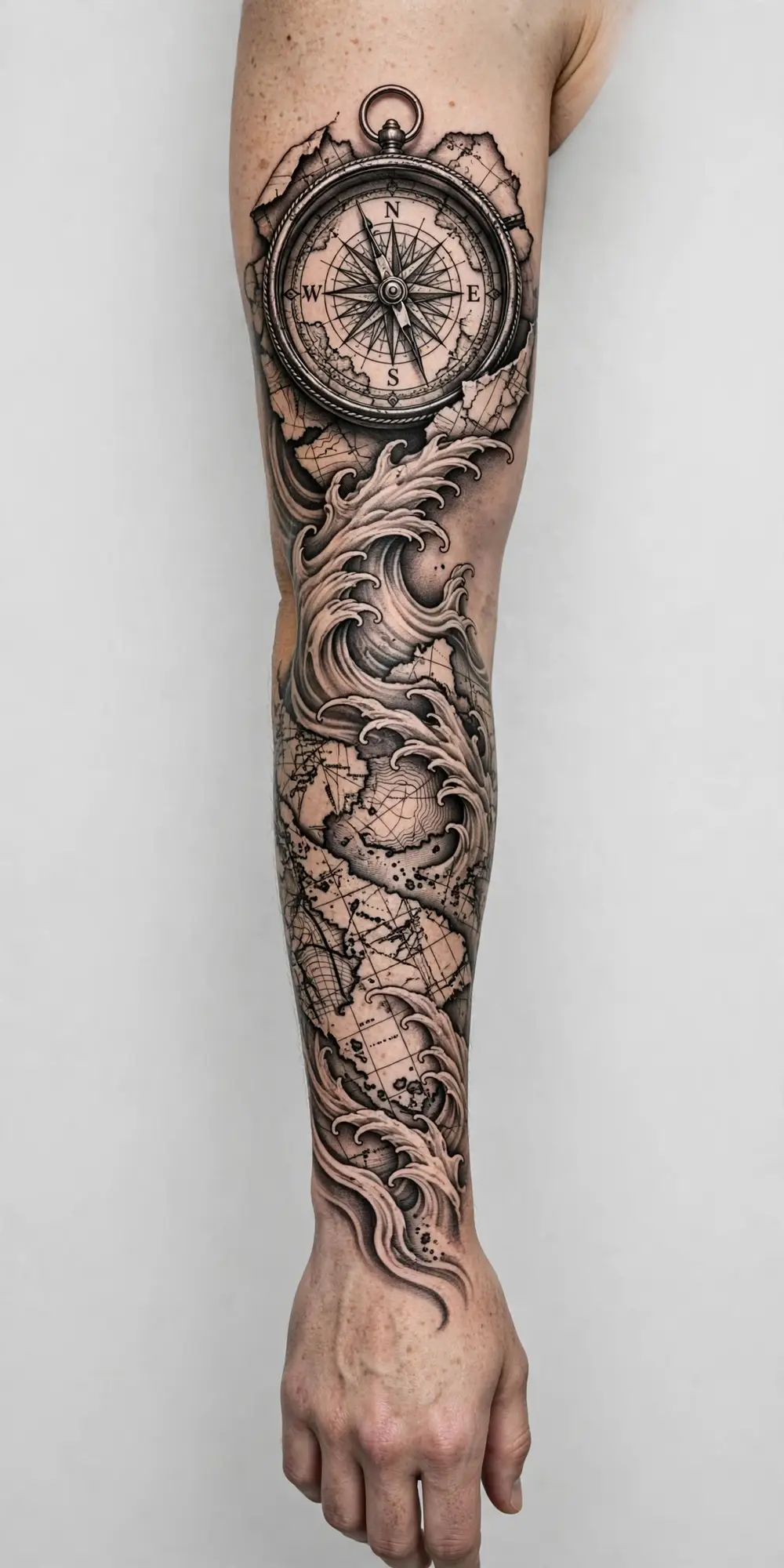
The compass makes an unusually good sleeve anchor: a strong circular focal point, with waves, maps or stars filling around it. Settle the compass first, then design outward — sleeves built the other way round end up with the compass squeezed into a gap. Pain: 5/10 on the outer arm (worse on the inner arm). Downside: a sleeve is a multi-session commitment, and a compass that wraps too far around the arm reads as an oval from most angles.
32. Compass Back Piece Tattoo
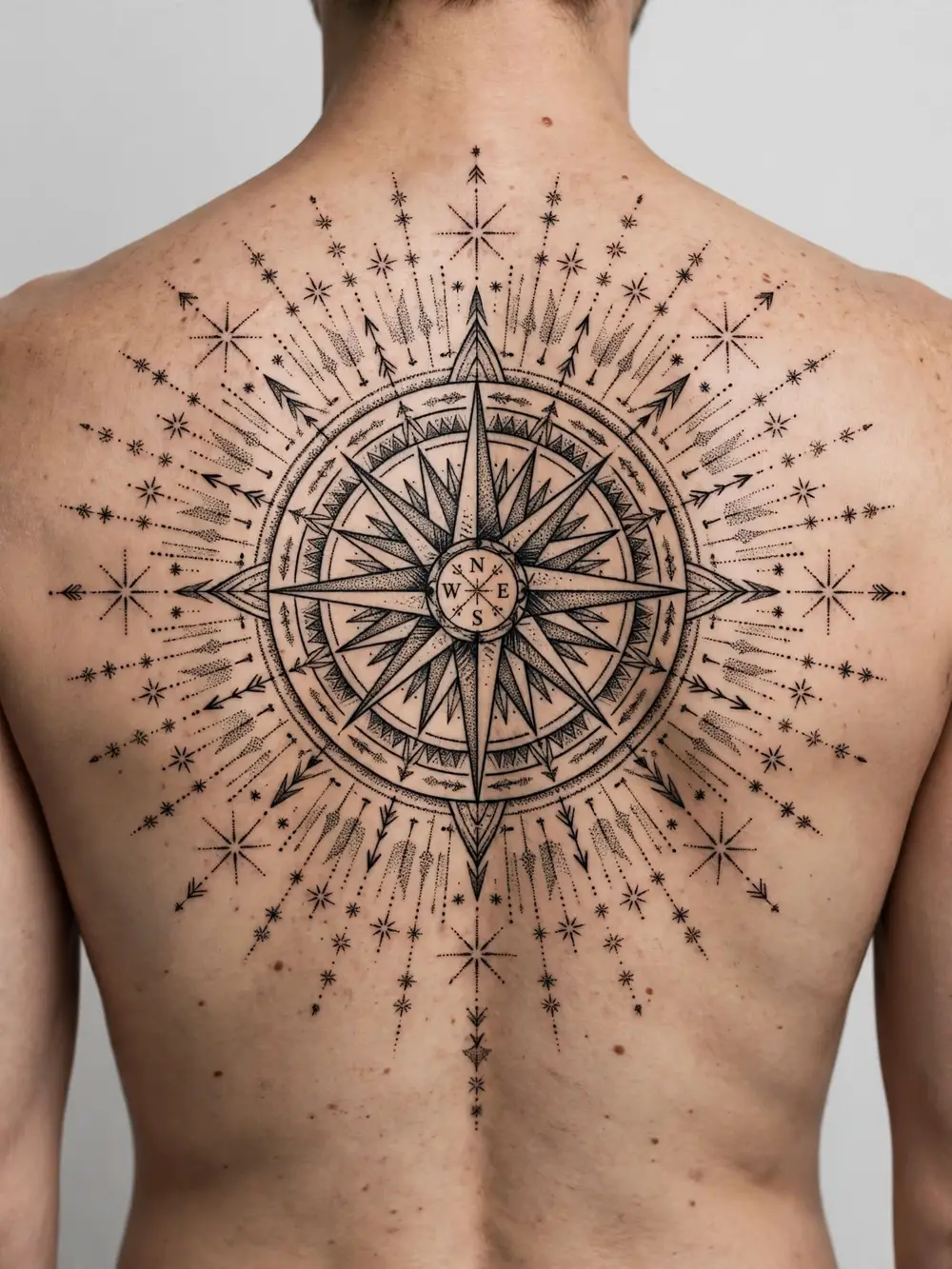
The back is the only placement that gives you a genuinely symmetrical canvas, and a compass is one of the few subjects that actually needs one — centred between the shoulder blades, the cardinal points line up with the spine. Pain: 6/10 on the upper back, 8/10 near the spine. Downside: a longer sitting, and a hard area to see healing on — plan for help with aftercare in week one. For more big-canvas work, see our 35 back tattoo ideas.
Chapter 5 — Meaningful & Personal Compass Tattoos
The ones people get for a reason they can name — a person, a promise, a turning point.
33. Vegvisir (Viking Compass) Tattoo
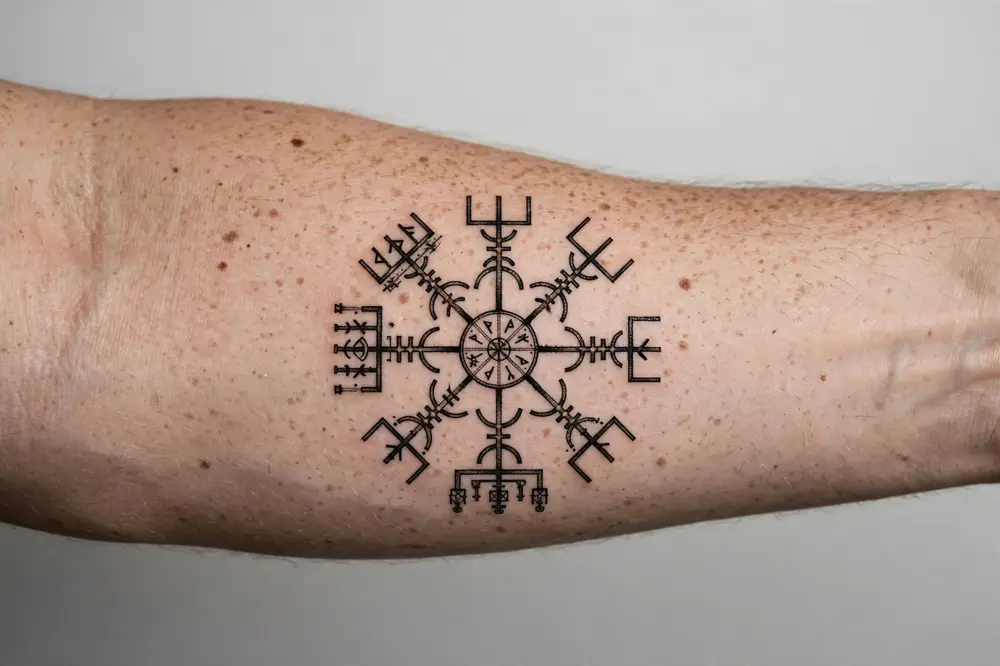
The Norse wayfinder: eight rune staves radiating from a centre, promising you will never lose your way, even in a storm — with the honest history (19th-century Icelandic, not Viking-age) behind it. Pain: 4/10 on the forearm. Downside: the staves must be crisp and evenly spaced, or the symbol loses its symmetry.
34. Broken Compass Tattoo
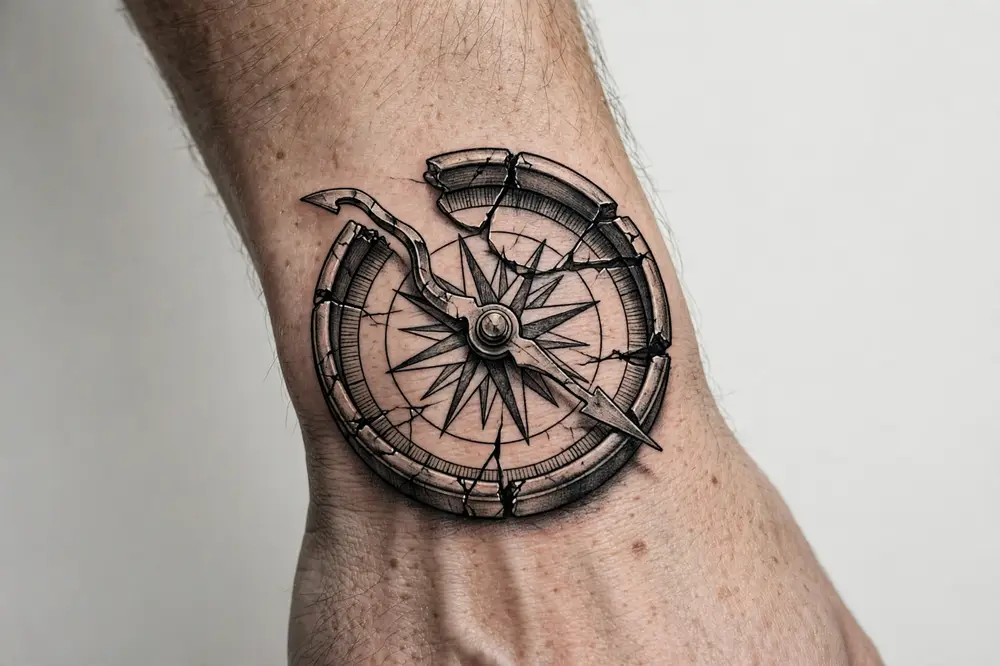
A cracked bezel, a bent needle, a dial that has stopped pretending everything is fine. It marks a period of being lost — and, for most wearers, the fact that they found their way again. Pain: 5/10 on the wrist. Downside: a broken compass reads as a mistake if the artist is not careful, so the damage must look deliberate.
35. Compass and Heart Tattoo
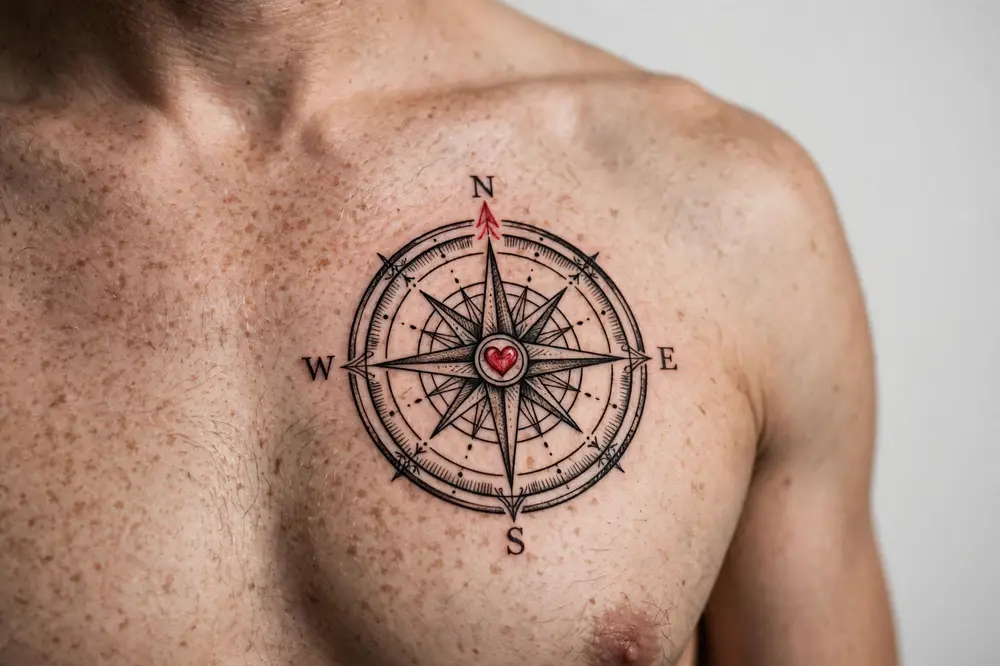
A small heart at the centre of the dial — love as your true north, for couples, parents, or anyone whose direction in life is a person. Pain: 6/10 on the chest. Downside: keep the heart small and central, or it overpowers the compass and the design reads as a heart tattoo with decoration.
36. Compass and Family Quote Tattoo
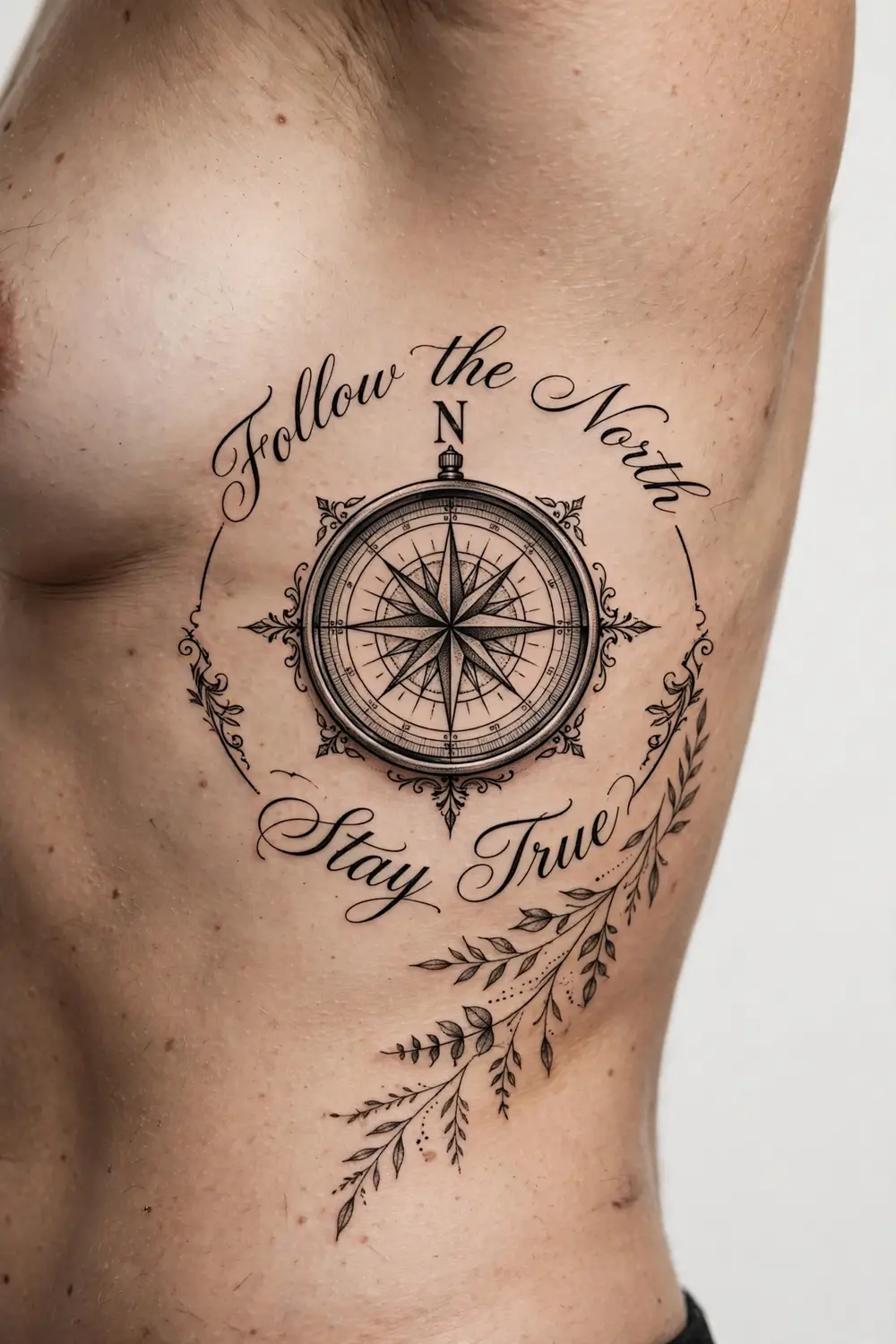
A compass with a line of script curving around it — “home is not a place, it’s the people,” or a line only your family would recognise — on the ribs, where the script follows the body’s curve. Pain: 9/10 on the ribs, one of the hardest placements on this list. Downside: script must be big enough to stay readable; tiny cursive blurs first.
37. Compass and Constellation Tattoo
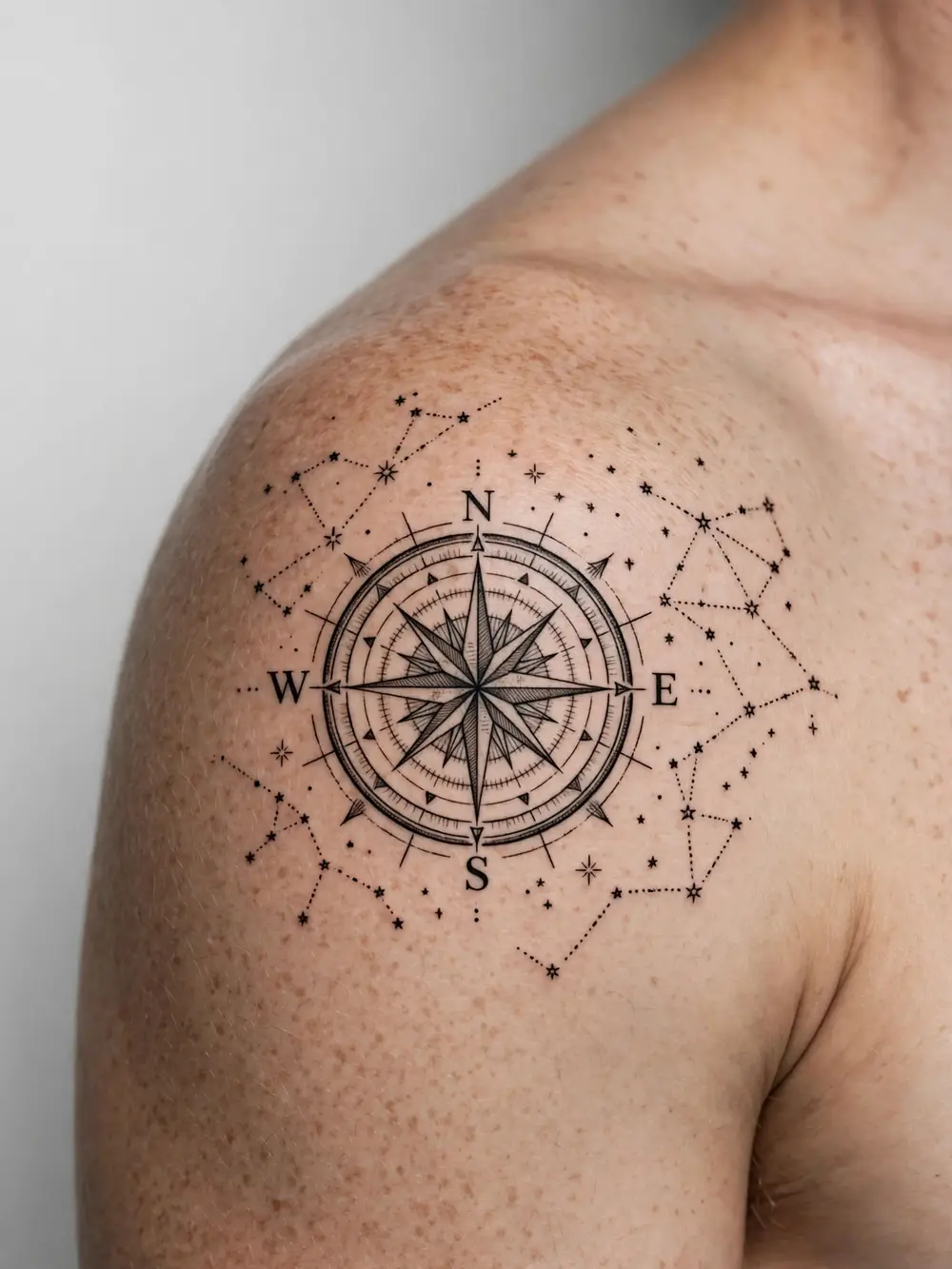
A compass surrounded by stars and dotted constellation lines — your birth constellation, or the sky on the night something changed — suiting the shoulder, where the stars scatter naturally. Pain: 5/10 on the shoulder. Downside: constellation dots need spacing, not clustering, or they merge into a smudge.
38. Compass and Feather Tattoo
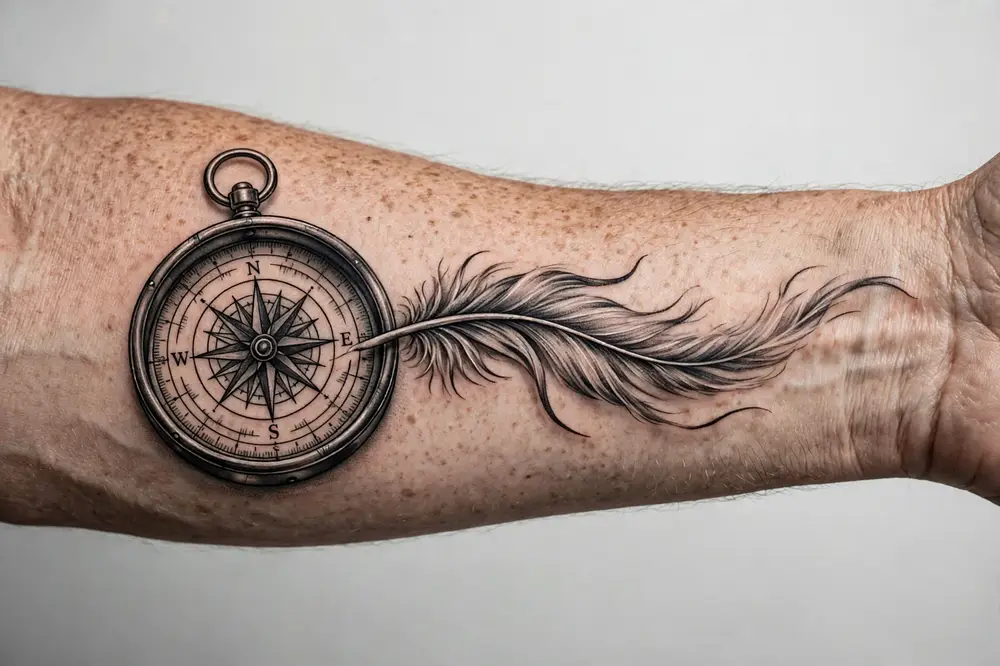
A soft feather flowing from the compass dial — freedom with a direction, lightness with a plan — suiting the forearm, where the feather follows the arm’s line. Pain: 4/10 on the forearm. Downside: feather barbs are fine detail; keep them bold enough to survive ten years of skin.
39. Compass and Infinity Tattoo
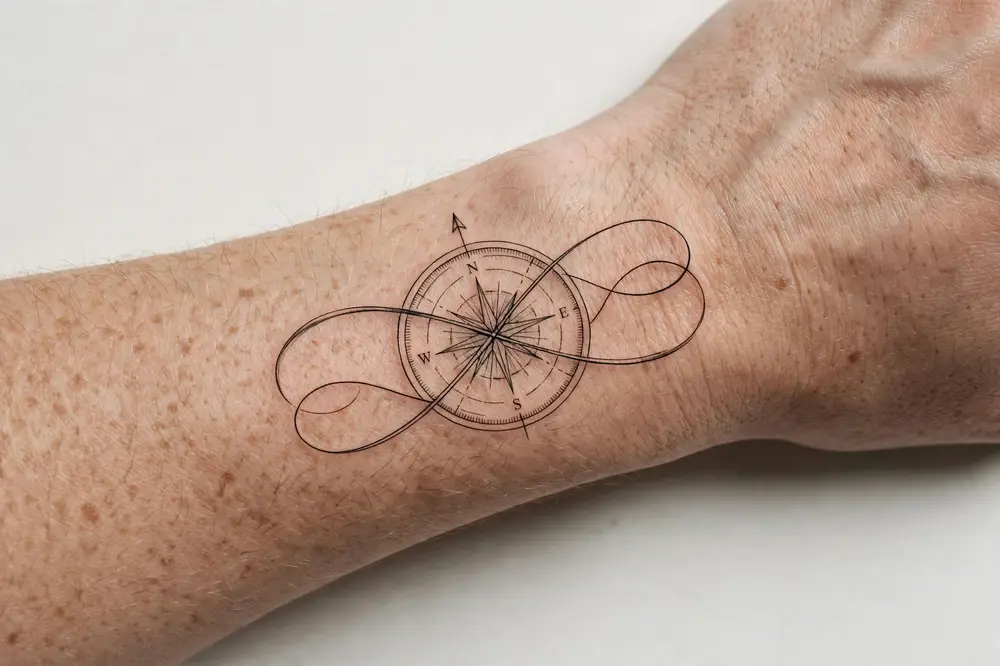
An infinity loop flowing through a small compass — a forever kind of direction, worn on the wrist where you see it every day — for couples and close friends who want a shared symbol without matching exactly. Pain: 5/10 on the wrist. Downside: the loop’s crossing point is the first place to blur, so keep the line weight even.
40. Couple’s Matching Compass Tattoo
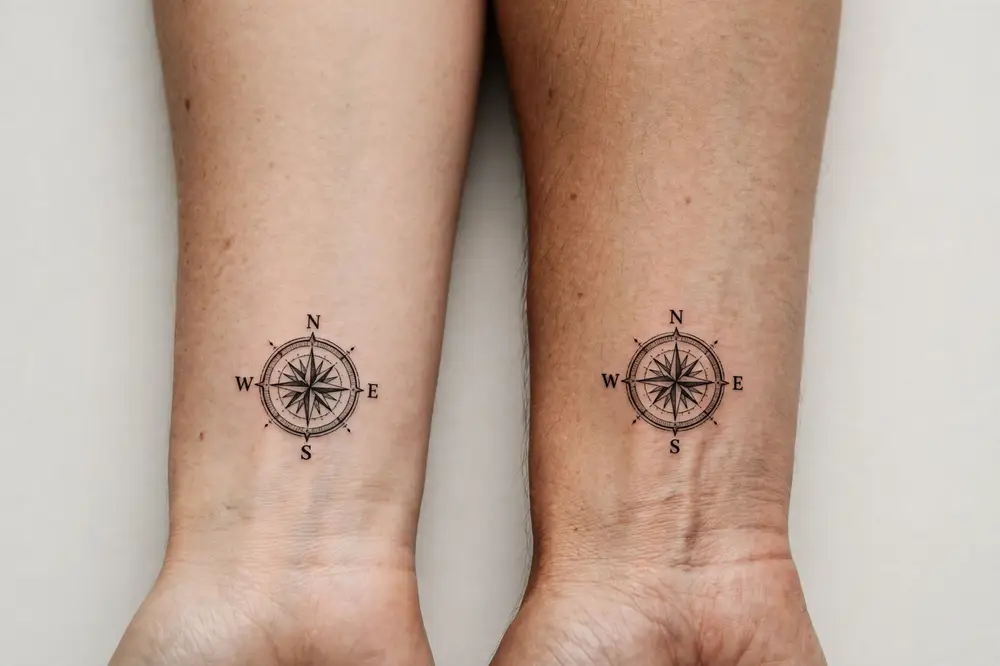
Two identical small compasses, one on each person’s arm — a couple’s symbol of guidance, loyalty, and staying true to one another, even at a distance. Some couples point their needles at each other; others both point north. Pain: 4/10 on the forearm. Downside: agree on the exact design together, in the same session, or “matching” becomes “similar” — and that difference shows.
Which Compass Tattoo Style Is Right for You?
The style you pick decides the size, the price, the sitting time and how the tattoo looks in ten years.
| Style | Smallest size that works | Typical sitting | How it ages | Best for |
|---|---|---|---|---|
| Fine line / minimalist | 2–3 inches | 30–90 minutes | Softens fastest; expect a touch-up in a few years | Inner forearm, wrist, behind the ear |
| Black & grey realism | 4–5 inches | 4–6 hours, often two sittings | Holds well if the shading has real contrast | Outer arm, calf, chest |
| Neo-traditional | 4 inches | 4–7 hours | Ages the best of the colour styles, thanks to bold outlines | Thigh, upper arm, shoulder |
| Geometric / dotwork | 3–4 inches | 2–5 hours | Dot fields can blur; line-heavy versions hold up better | Forearm, sternum, upper back |
| American traditional | 3 inches | 2–4 hours | Excellent — the style was designed to last | Anywhere; especially chest and upper arm |
| Watercolor | 4 inches | 3–5 hours | Fades fastest; needs sun care and touch-ups | Shoulder, thigh, upper arm |
The rule underneath the table: the more detail a compass has, the bigger it needs to be. An engraved bezel at two inches becomes a grey circle within a few years — simplify the design instead of shrinking it.
Compass Tattoo Pain — What Each Placement Feels Like
The design itself does not change the pain much — the placement does. Here is how the most popular compass placements actually feel, on the usual 1–10 scale. For the full body map, see our tattoo pain chart.
| Placement | Pain rating | Why it feels that way |
|---|---|---|
| Outer forearm | 4/10 | Fleshy, flat, easy to sit through — the classic first-tattoo spot |
| Inner forearm | 3/10 | Softer skin, fewer nerve endings than the wrist |
| Upper arm / shoulder | 5/10 | Comfortable for most people; the shoulder cap is the easiest large area |
| Thigh | 4/10 | One of the least painful large areas; great for big colour work |
| Calf | 5/10 | Manageable, though the shin bone nearby is sharper |
| Wrist | 5/10 | Bonier than it looks; the needle passes close to tendons |
| Chest | 6–7/10 | Thin skin over bone near the sternum and collarbone |
| Back (upper) | 6/10 | Broad and flat, but long sittings wear you down |
| Behind the ear | 7/10 | Thin skin, bone right underneath, and the buzzing is loud |
| Ribs | 9/10 | Almost no padding, and every breath moves the skin |
| Ankle / foot | 6/10 | Bony and sensitive; shoes rub it while it heals |
| Sternum | 8/10 | Right on the bone, with very little fat to cushion it |
Two things make any compass sitting easier: eat beforehand, and do not book a huge piece as your first tattoo — a small wrist compass is a 45-minute introduction.
How Much Does a Compass Tattoo Cost?
Compass tattoo prices depend on size, detail and the artist’s hourly rate — most US shops charge $100–$250 per hour, with a shop minimum of $50–$100. For the full breakdown, see our tattoo prices guide.
| Design | Typical price (US) | Typical time |
|---|---|---|
| Tiny / micro compass (1–2 in) | $50–$150 | 30–60 minutes |
| Small minimalist / fine line (2–3 in) | $100–$250 | 45–90 minutes |
| Medium compass (3–5 in) | $200–$500 | 2–4 hours |
| Large detailed compass (5–8 in) | $400–$900 | 4–7 hours, sometimes two sittings |
| Realistic / neo-traditional colour piece | $500–$1,200+ | 5–9 hours, often split |
| Compass sleeve or back piece | $1,500–$3,000+ | Multiple sessions over weeks |
Three cost truths worth knowing. First, choosing an artist by price is the most common regret in tattooing — paying more for the right artist is cheaper than a cover-up or laser removal later. Second, colour costs more than black and grey, in the chair and in touch-ups. Third, ask about the touch-up policy before you pay: many artists include one free touch-up within the first year, and fine line and watercolor compasses need it most.
Compass Tattoo Placement Guide
| Placement | Pros | Cons |
|---|---|---|
| Forearm | Flat, readable, easy to show or cover | The most common spot — less unique |
| Wrist | Always visible to you; great for small designs | Bony, fades faster, hard to hide at work |
| Chest | Bold, heart-led meaning; big canvas | Painful near the sternum; hard to check healing |
| Shoulder | Easy large canvas; ages well | Less visible to you day to day |
| Back | The only truly symmetrical canvas | You cannot see it healing; needs help with aftercare |
| Thigh | Least painful large area; easy to hide | Rarely seen unless you show it |
| Ribs | Follows the body’s curve beautifully | 9/10 pain; script and detail blur faster here |
| Behind the ear | Tiny, personal, easy to hide | 7/10 pain; fades fast from sun and hair products |
| Ankle | Discreet, charming at small sizes | Shoes rub it while healing; detail softens |
| Calf | Good for vertical designs with waves or maps | The shin edge is sharper than the calf centre |
A practical note on circles: bodies are curved, so a compass that wraps around the arm reads as an oval from most angles. Ask to see the stencil on your actual arm before the needle comes out.
Healing Time — What to Expect
A compass tattoo heals like any other tattoo of its size. Small minimalist pieces feel normal within a few days; large colour pieces take longer. The full routine is in our tattoo aftercare guide.
- Days 1–3: Soreness, mild swelling, a little plasma and ink weeping — all normal. Keep the wrap on for the time your artist says, then wash gently.
- Days 3–7: Itching starts, and the top layer begins to flake. Do not scratch and do not pick — picking pulls ink out with the scab.
- Days 7–14: Most flaking finishes; the tattoo looks slightly dull or cloudy as the new skin settles — the “milky” stage, and it passes.
- Weeks 2–6: The surface looks healed, but the deeper skin is still settling; keep moisturising and keep it out of the sun. Large blackwork or realism may take up to 8 weeks to settle completely.
Sun is the compass tattoo’s worst enemy after healing — ultraviolet light fades ink, and fine line and watercolor fade first. Sunscreen on healed ink is not optional if you want it to look the same in ten years.
Aftercare Essentials
Aftercare is where most avoidable problems come from. Keep it clean, keep it moisturised, keep it out of direct sun, and do not soak it.
- Wash gently, twice a day, with lukewarm water and fragrance-free soap. Pat dry — never rub. A fragrance-free lotion is the safest moisturiser for healing skin.
- Thin layers of moisturiser only. Too much lotion suffocates the tattoo; a pea-sized amount is enough for a forearm piece.
- No soaking for 2–3 weeks. No baths, no swimming pools, no hot tubs, no sea. Showers are fine.
- No sun, no gym sweat, no tight clothing over the fresh tattoo for the first two weeks.
- Watch for warning signs. Spreading redness, swelling that gets worse after the first few days, discharge, or a fever means contacting your artist and seeing a doctor — an infection is something to have looked at in person. The FDA’s tattoo safety guidance and the American Academy of Dermatology both publish what to watch for, including reactions that can appear months or even years later.
Common Mistakes to Avoid
- Going too small for the detail. The mistake artists see most. An engraved compass at two inches becomes a grey circle within a few years. Simplify the design instead of shrinking it.
- Ignoring body curvature. Circles turn into ovals on curved arms. Always check the stencil on your body first.
- Choosing the artist by price. A cheap compass from the wrong artist costs more to fix than a good one costs to get. Ask to see healed photos, not just fresh ones — healed work is where you judge linework.
- Copying someone else’s tattoo exactly. Bring references, not a finished design. Artists do better work when they are drawing rather than copying, and most will decline to replicate another artist’s piece.
- Skipping the aftercare. Sun, soaking and scratching in the first two weeks do more damage than a bad artist does. The first fortnight decides the next decade.
- Forgetting the coordinates check. If your compass carries coordinates, a date or a name, check every digit twice with your artist. Digits are the most frequently misspelled part of any tattoo.
Compass Tattoo FAQ
What does a compass tattoo mean?
A compass tattoo most commonly means direction, guidance, protection and finding your way home. The needle always returns to north, so it is worn as a reminder of a goal, a hometown, or a person who keeps you steady. It can also mean independence, adventure, good luck for travellers — and, with a broken compass, a period of being lost and finding your way again.
Is a compass tattoo good luck?
Yes — in most traditions the compass is a protective talisman, not a curse. Sailors wore compass tattoos for centuries as a good-luck charm that would bring them home safely through storms, and the Vegvísir carries the same promise in its manuscript: you will never lose your way, even when the way is not known.
How much does a compass tattoo cost?
A small minimalist compass costs roughly $50–$150, a medium 3–5 inch compass $200–$500, and a large realistic or colour piece $500–$1,200 or more. A full compass sleeve or back piece can run $1,500–$3,000+ across multiple sessions. Most US shops charge $100–$250 per hour with a $50–$100 shop minimum.
How painful is a compass tattoo?
It depends on placement, not the design. The outer forearm rates about 4/10 and the thigh about 4/10 — both good first-tattoo spots. The wrist is 5/10, the chest 6–7/10, behind the ear 7/10, and the ribs 9/10, one of the most painful placements on the body.
Where is the best placement for a compass tattoo?
The forearm is the most popular — flat, readable, and easy to show or cover. The shoulder and thigh suit large colour pieces, the wrist and behind the ear suit tiny minimalist ones, and the back is the only placement that gives a compass a truly symmetrical canvas. Never squeeze a detailed compass into a small space.
What is the Viking compass tattoo?
The Vegvísir, often called the Viking compass or wayfinder, is an eight-staved symbol from a 19th-century Icelandic manuscript, the Huld manuscript — not from the Viking age itself, despite the popular label. Its caption promises the bearer will never lose their way in storms or bad weather, even when the way is not known.
Do compass tattoos fade fast?
It depends on the style. American traditional and blackwork compasses age the best, thanks to bold outlines and solid ink. Fine line, minimalist and watercolor compasses soften and fade fastest — expect a touch-up within a few years — and any compass fades faster in the sun, so sunscreen on healed ink matters.
How long does a compass tattoo take to heal?
Small compass tattoos feel normal within a few days and finish surface healing in 2–3 weeks. Large colour or blackwork pieces take 4–6 weeks to heal fully, and up to 8 weeks for the deeper skin to settle. Keep it clean, moisturised, out of the sun and out of water for the first 2–3 weeks.
Quick Summary
- A compass tattoo means direction, guidance, protection and finding your way home — the needle always returns to north.
- 40 designs in this guide, from classic nautical and American traditional to minimalist fine line, Vegvisir and matching couple’s compasses — every one with its own image.
- Best first-tattoo placements: outer forearm (4/10) and thigh (4/10). Hardest: ribs (9/10) and sternum (8/10).
- Cost: $50–$150 for a tiny compass, $200–$500 for a medium piece, $500–$1,200+ for large realistic or colour work.
- Ageing: bold traditional and blackwork last longest; fine line and watercolor need touch-ups.
- The golden rule: never shrink a detailed compass — simplify the design instead, and always check the stencil on your body before the needle comes out.
- Aftercare decides the next decade: wash gently, moisturise thinly, no soaking or sun for 2–3 weeks.
About the Author
Sara Mitchell — Tattoo Ideas Editor at Borcd Panda. Sara researches and curates tattoo designs, meanings and care guides for Borcd Panda readers, comparing styles, placements and artists’ advice so you can walk into the chair knowing exactly what you want.
References
- Smithsonian National Air and Space Museum — Time and Navigation: History of the Magnetic Compass. timeandnavigation.si.edu/
- U.S. Food and Drug Administration — “Think Before You Ink: Tattoo Safety.” www.fda.gov/consumers/consumer-updates/think-you-ink-tattoo-safety
- American Academy of Dermatology — “Inked for Life: How Tattoos Age With Your Skin.” www.americanacademyofdermatology.org/how-tattoos-age-with-your-skin-dermatologist-guide/
- Encyclopaedia Britannica — “Compass.” www.britannica.com/technology/compass-navigational-instrument
- TattooBuild — “Compass Tattoo Designs Inspirations.” tattoobuild.com/compass-tattoo-designs-inspirations/
- Tatt Magazine — “Compass Tattoos: Meanings, Tattoo Styles & Tattoo Ideas.” tattmag.com/compass-tattoo/
Which one is your favorite?