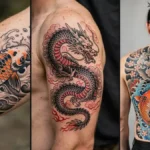
Japanese tattoos do not decorate the body. They tell a story across it — a koi fighting upstream, a dragon wrapped in wind, a cherry blossom falling before it ever fully opens. That is why, four hundred years after irezumi took shape in Edo-period Japan, it is still the style people save up for, travel for, and plan for years in advance.
But Japanese tattooing also has rules, and breaking them quietly is easy: a koi swimming the wrong way, a flower out of season, a symbol whose meaning you never checked. This guide gives you 40 Japanese tattoo ideas — every one with its own design, meaning, best placement and honest downside — plus the pain, cost and healing truth behind the style, so the story you wear is one you actually understand.
Quick Answer
Japanese tattoos (irezumi) are large, flowing designs built from mythical creatures, flowers and spirits, each carrying a specific meaning. Koi mean perseverance, dragons mean wisdom and protection, and cherry blossom means beauty that does not last. A small motif costs $150–$400, a sleeve $3,000–$8,000, and a full bodysuit $20,000–$60,000+ over several years. Pain ranges from 4/10 on the forearm to 9/10 on the ribs and spine.
What Is Irezumi, Really?
Irezumi (literally “inserting ink”) is the traditional Japanese art of tattooing. It developed during the Edo period (1603–1868), alongside ukiyo-e woodblock prints — and you can still see that print heritage in every design today: bold outlines, flat areas of saturated colour, and backgrounds of wind, water and clouds that flow with the body instead of sitting on it like a sticker.
Two things make irezumi different from most Western tattooing. First, scale: a traditional piece is planned as a whole composition — a back, a sleeve, a full bodysuit — not a collection of separate tattoos. Second, background: the waves, wind bars and clouds (known as gakubori) are not filler. They connect the motifs, carry the eye around the body, and make the design read as one living picture. A dragon without its wind looks unfinished; a koi without its water loses half its meaning.
The traditional application method is tebori (“carved by hand”): a bamboo-handled tool with a row of needles, worked by hand rather than machine. Tebori is slower — roughly twice the time of machine work — and it costs more, but many collectors say it gives a softer, more saturated colour. Modern Japanese-style artists often use machines for outlines and keep hand techniques for shading, so ask your artist which method they use before you book.
Traditional layouts have names worth knowing. Soshinbori is the full-body suit, covering arms, legs, back and chest as one canvas. Munewari is a full suit with an open strip down the centre of the chest and belly, so the tattoo stayed hidden under an open kimono. You do not need a bodysuit to wear Japanese style — most people start with a single motif — but knowing the layout tradition helps you plan a piece that can grow.
One honest note before the gallery: Japanese tattoos carry cultural weight, and some of it is serious. In Japan, visible tattoos are still banned in many onsen (hot springs) and some gyms because of old associations with organised crime, and a few symbols are directly tied to yakuza membership. Choosing a motif because you understand it — not just because it looks fierce — is the baseline of respect, and this guide flags the symbols to handle with extra care. For the broader style landscape, see our guide to tattoo styles explained.
Classic Irezumi Icons
These are the creatures that built the style. If you only know eight Japanese designs, know these eight — and know what each one actually means before you commit.
1. Koi Swimming Upstream
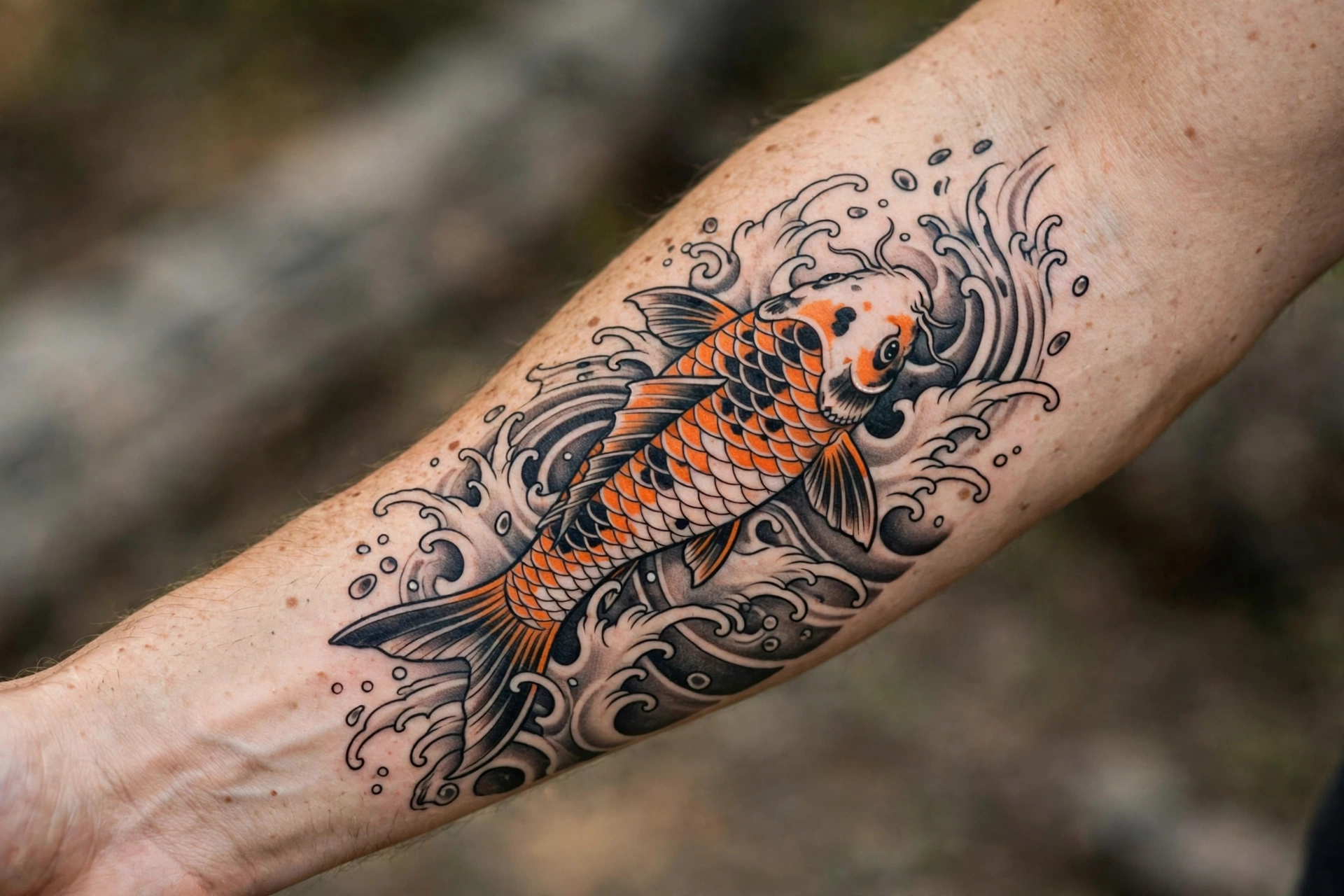
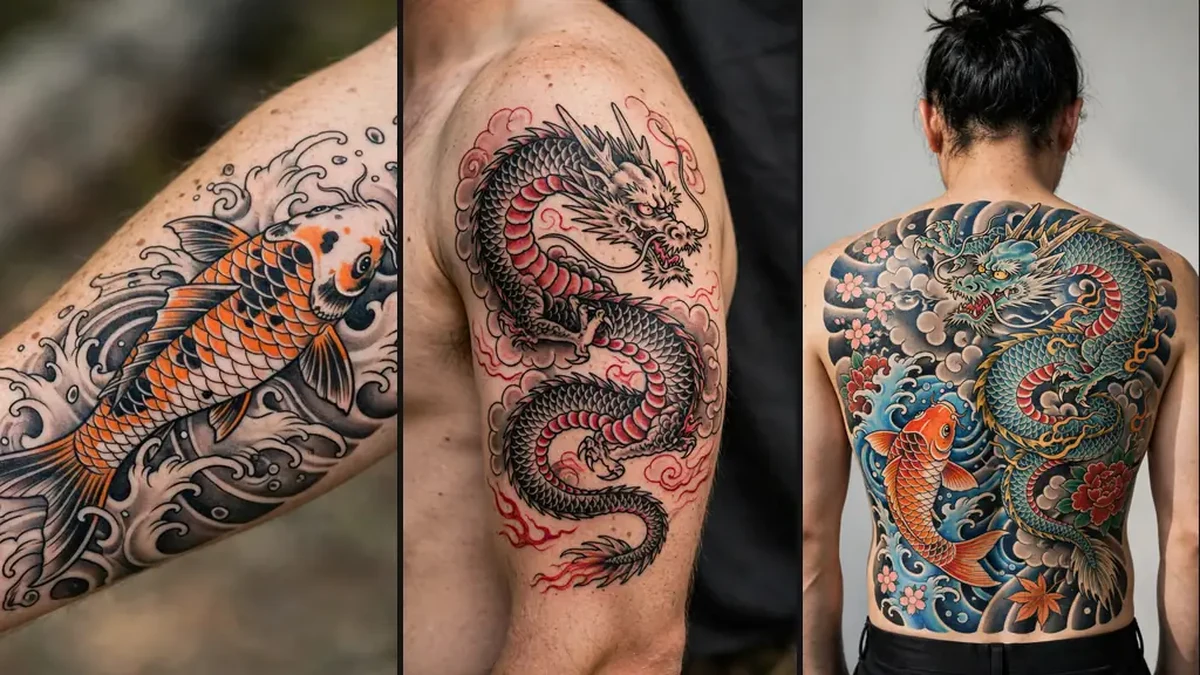
The koi is the heart of irezumi: a fish that swims against the current and, in legend, climbs the Dragon Gate waterfall to become a dragon. It means perseverance, ambition and transformation through hardship. Direction matters enormously here — a koi swimming upward carries the full meaning, while one swimming down reads as weaker, even defeated. Best placement: forearm, thigh or a full sleeve where the fish can travel. Honest downside: a small, cramped koi loses the flowing water that makes it work, so give it room.
2. Japanese Dragon (Ryu)
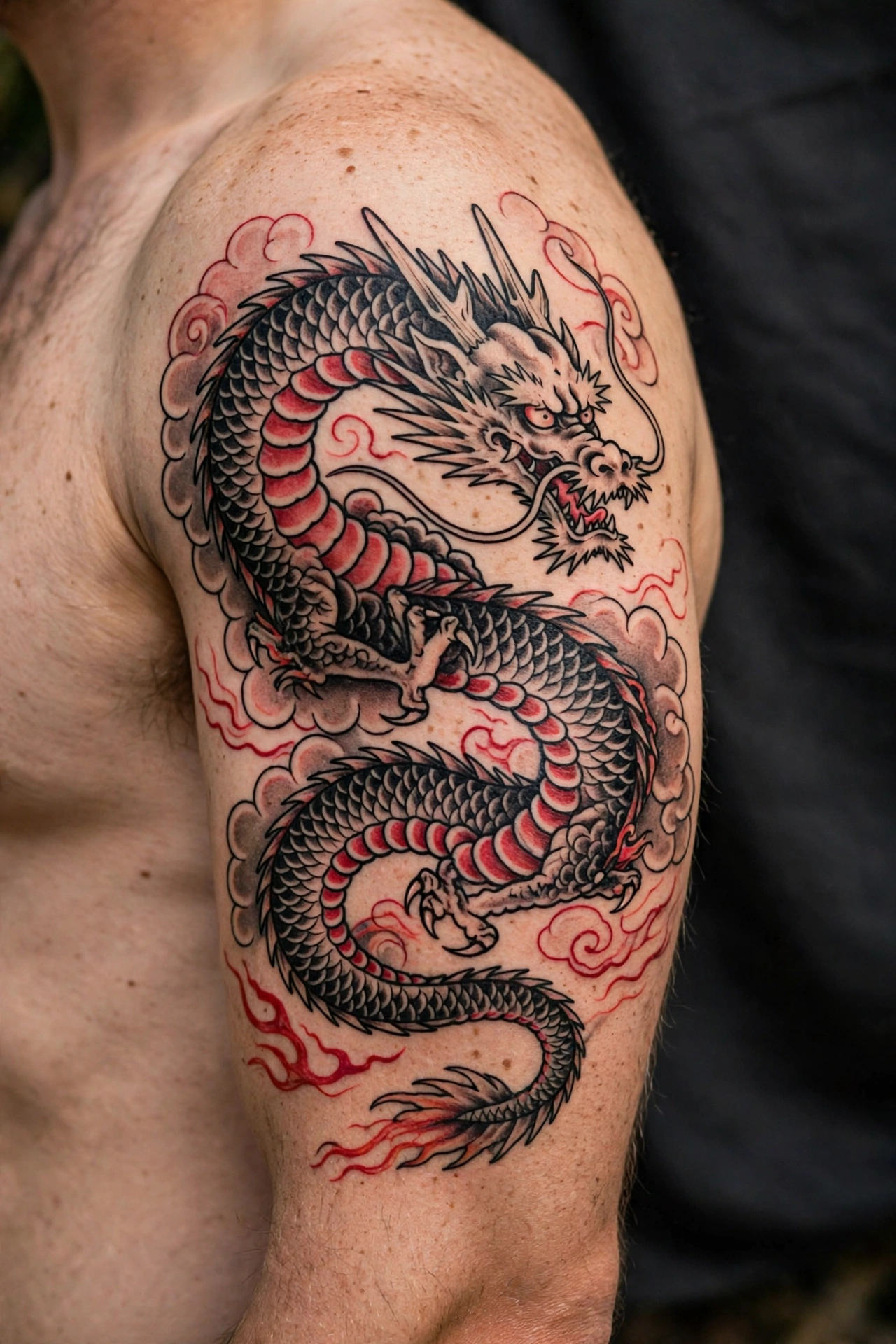
Unlike Western dragons, the Japanese ryu is a benevolent water deity — a symbol of wisdom, noble strength, protection and generosity, often shown holding a wish-fulfilling jewel. It is not a monster to fear; it is a force that masters nature. Best placement: back or full sleeve, where the long body can coil through clouds. Honest downside: a dragon squeezed onto a tiny patch looks like a doodle, and a good one needs multiple sessions. See also our dragon tattoo ideas for more dragon meanings.
3. Tiger (Tora)
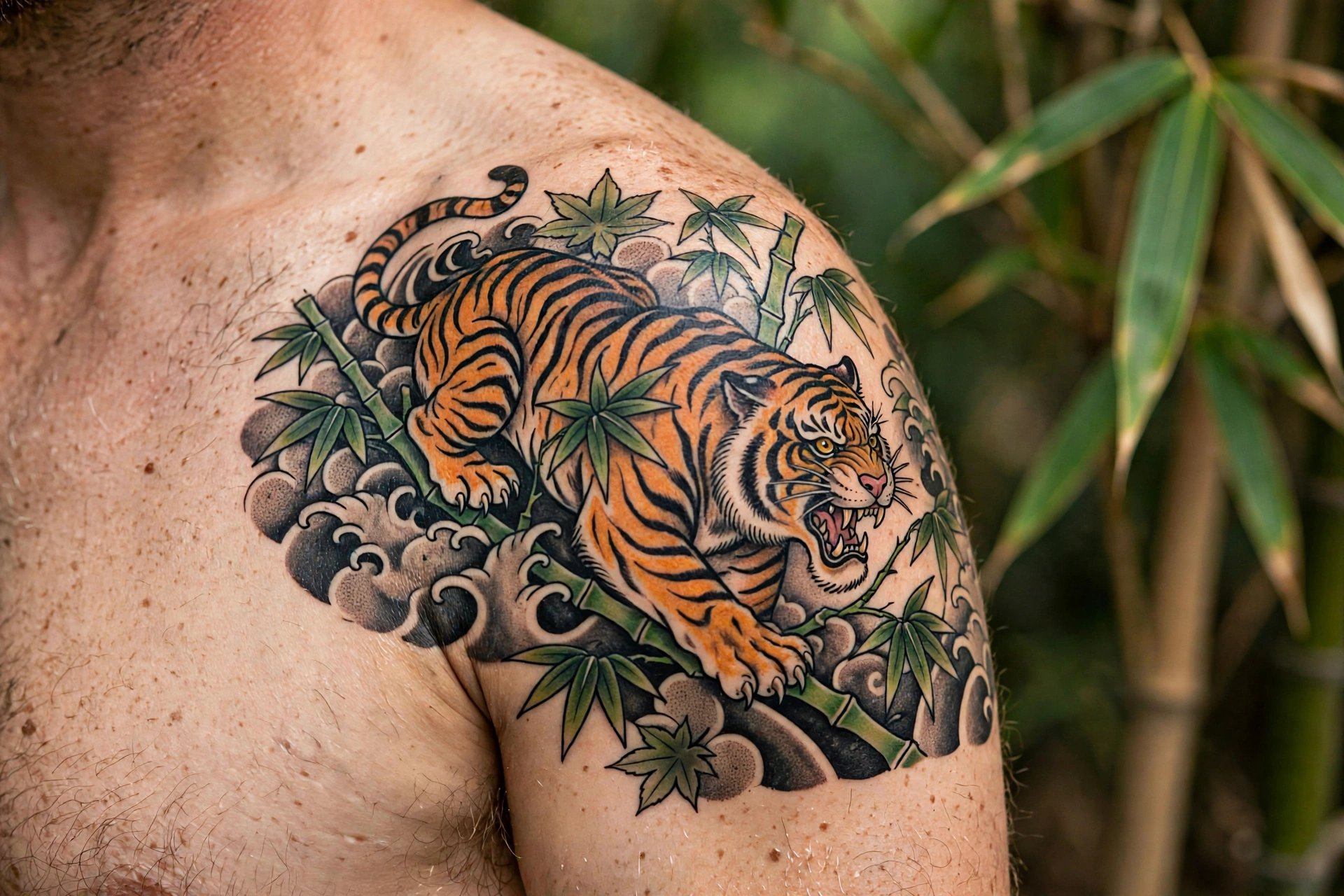
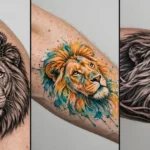
The tiger means courage and strength, and in Japanese folklore it controls the wind and protects against bad luck, evil spirits and disease. Tigers pair naturally with bamboo and wind bars, which give the design its movement. Best placement: shoulder, thigh or back. Honest downside: tiger stripes done too small blur into a muddy patch within a few years — bold stripes are not optional in this style.
4. Phoenix (Hou-ou)
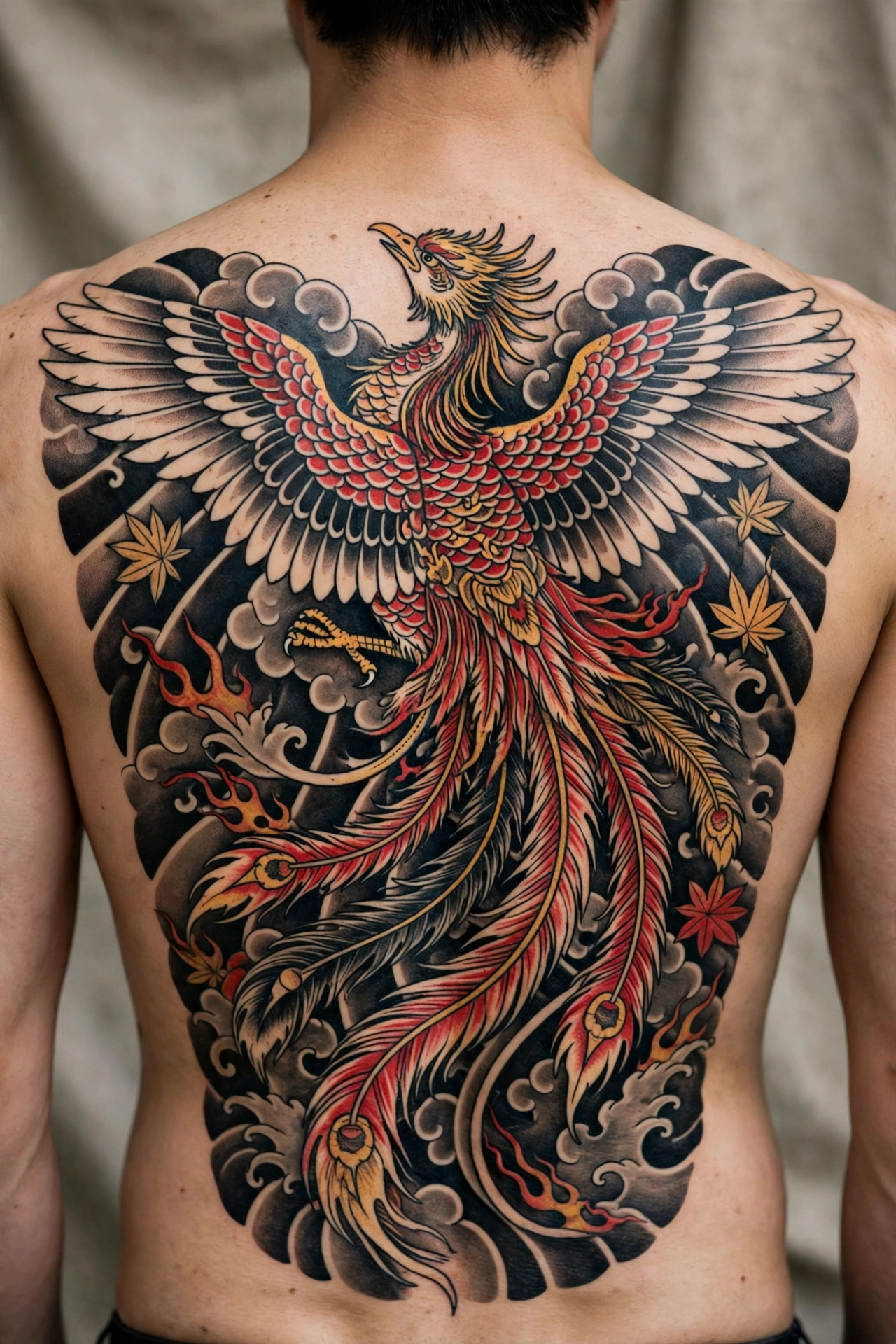
The hou-ou is no ordinary phoenix. In Japanese tradition it descends to earth only in times of peace and prosperity, and it stands for rebirth, justice, grace and divine favour. Its long, flowing tail feathers make it one of the most beautiful large-scale designs in the style. Best placement: full back, where the tail can sweep across the whole canvas. Honest downside: this is a multi-session, high-cost commitment, and a small phoenix loses the tail that defines it.
5. Oni Mask
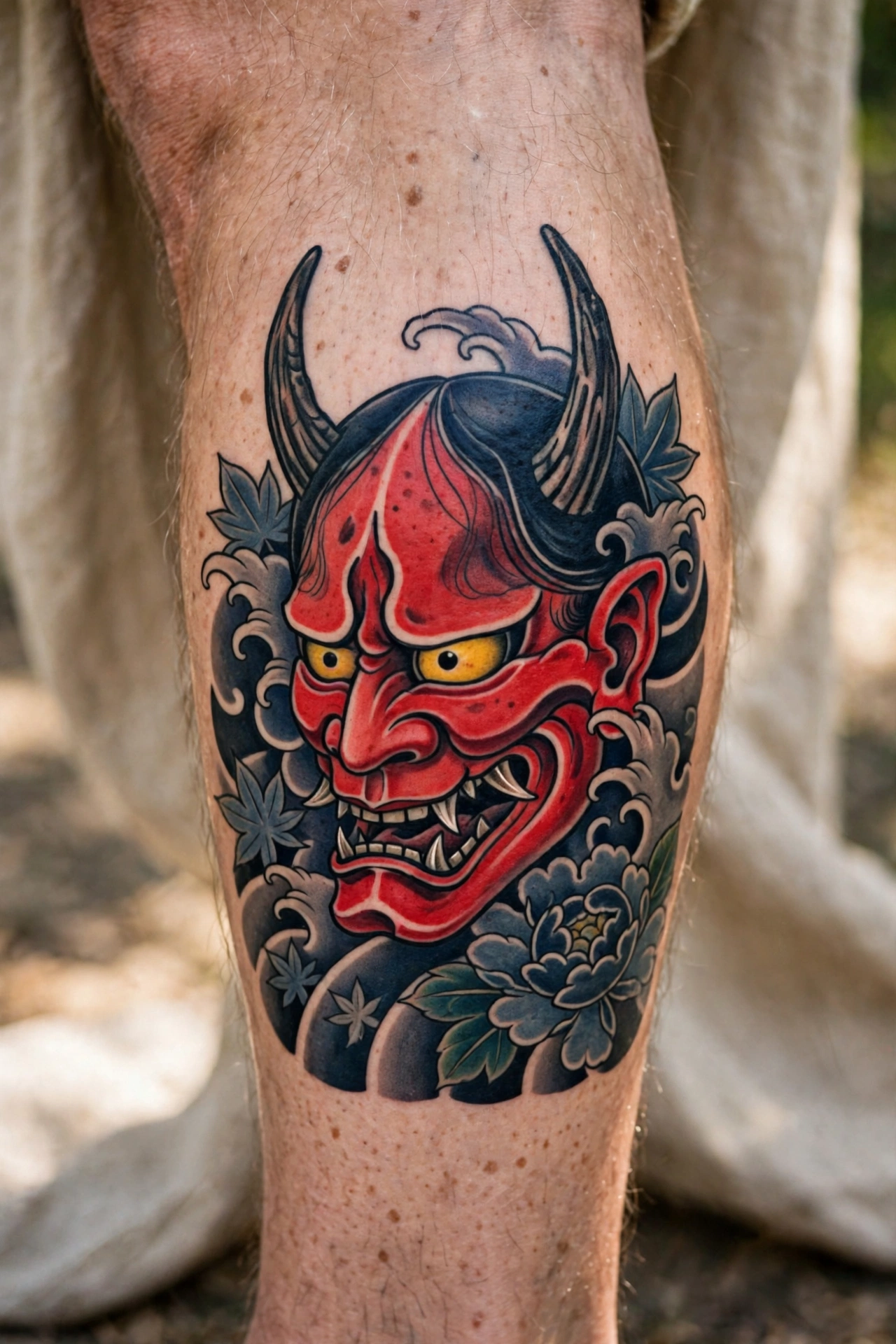
Oni are demons — but in tattoo tradition they are guardians as much as monsters, worn to ward off evil spirits and bad luck. A snarling oni face, horns and fangs included, is a protection piece dressed as a threat. Best placement: calf, thigh or chest panel. Honest downside: an oni reads as aggressive to strangers, so think about workplace visibility before putting one on a forearm.
6. Hannya Mask
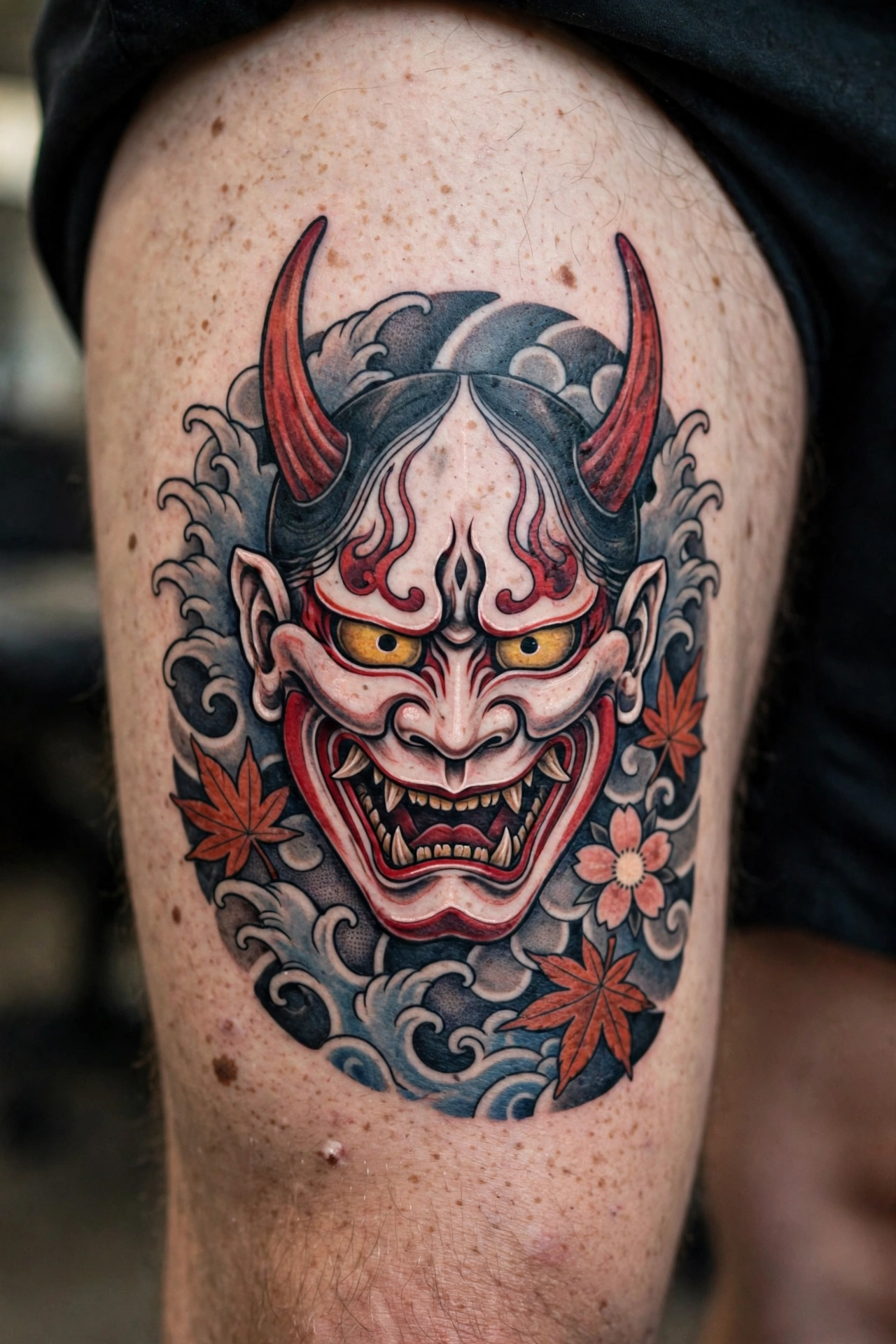
The hannya is the face of a woman transformed by jealousy and heartbreak in Noh theatre — horns, fangs and a grin that is somehow both furious and sad. As a tattoo it is a reminder to master your dark emotions rather than be ruled by them, and it is also worn as protection against evil. Best placement: thigh, back or upper arm with cherry blossom or maple to soften the composition. Honest downside: its meaning is often misunderstood, so expect questions — and do not pair it with symbols you have not researched.
7. White Snake (Hebi)
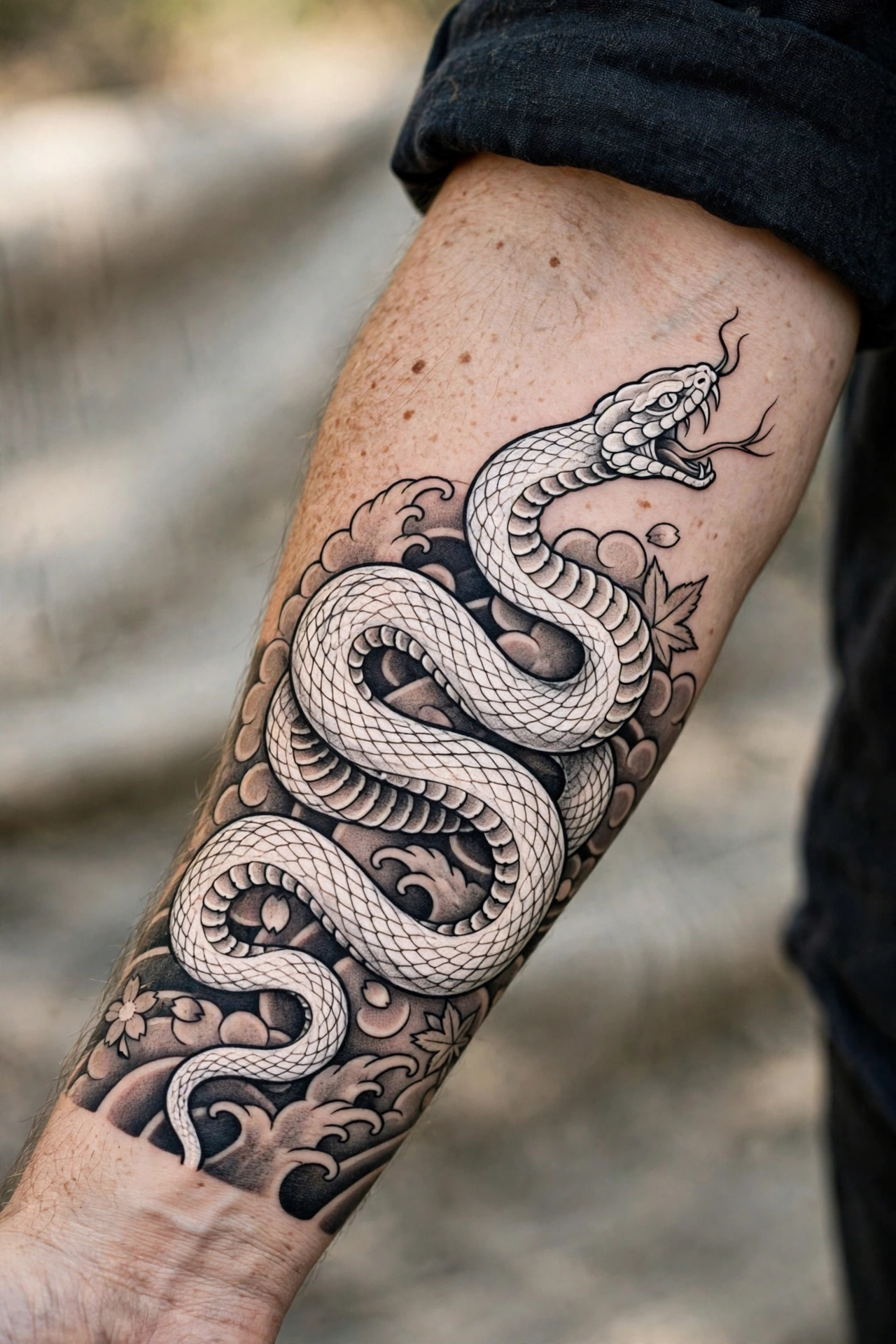
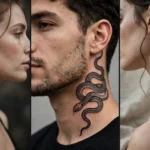
Snakes in Japanese tradition are protectors: they ward off disaster, bad fortune and disease, and they stand for wisdom and rebirth through shedding their skin. A white snake carries extra luck symbolism. Best placement: forearm or calf, where the coil can wrap naturally. Honest downside: snake scales need crisp, consistent detail — cheap linework here ages badly. More snake meanings live in our snake tattoo guide.
8. Red-Crowned Crane (Tsuru)
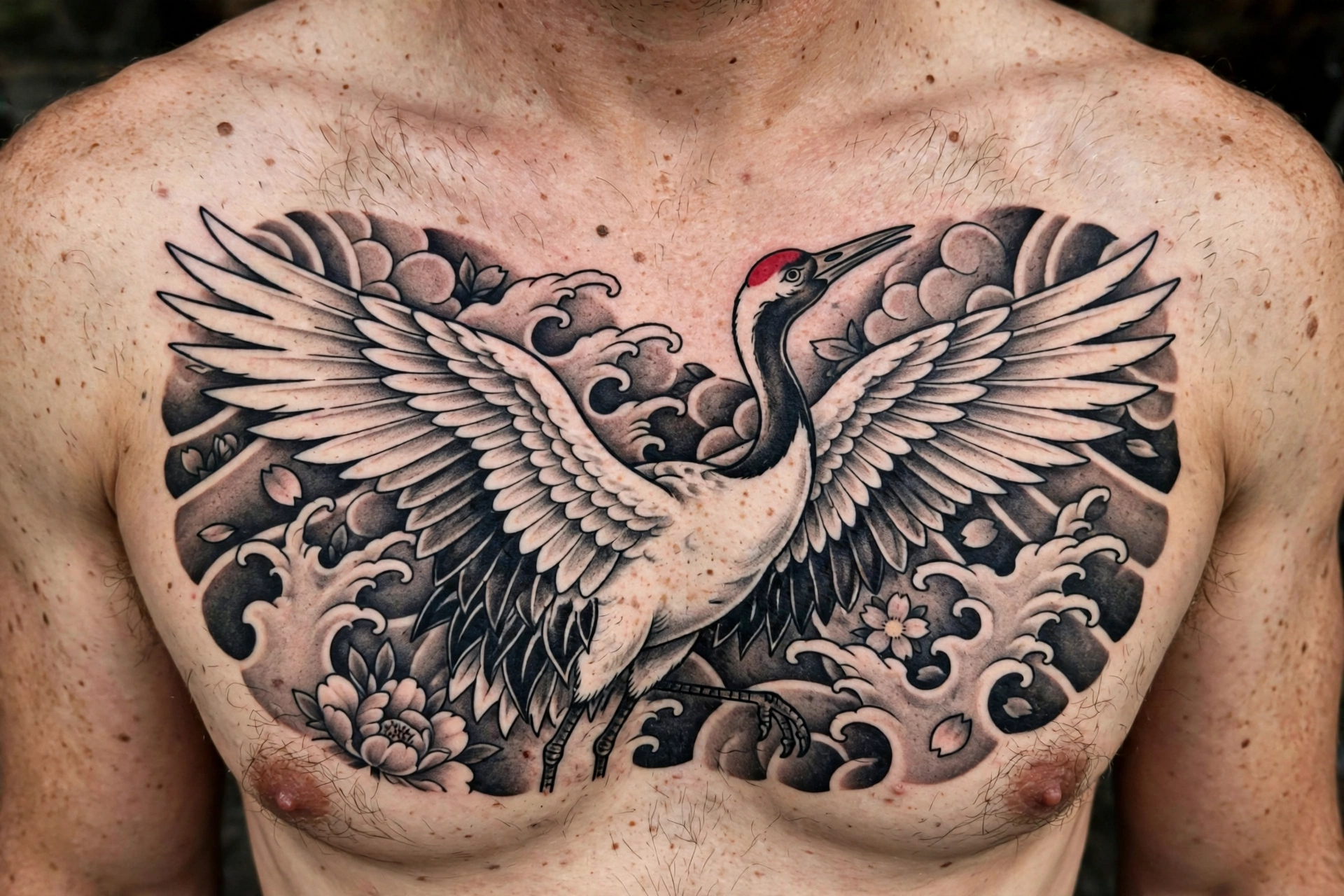
The crane means long life, good fortune and fidelity — cranes mate for life, and in Japan they are a classic symbol of happiness. The red crown against white feathers makes it instantly recognisable and quietly elegant rather than loud. Best placement: chest, back or thigh. Honest downside: white ink and pale shading fade fastest, so plan a touch-up every few years if you want the crane to stay bright.
Nature and the Seasons
Japanese tattooing follows the seasons strictly. Flowers are not interchangeable decoration — each one belongs to a time of year, and traditional pairing rules match creatures to their season. Get the season right and the whole composition sings.
9. Cherry Blossom Branch (Sakura)
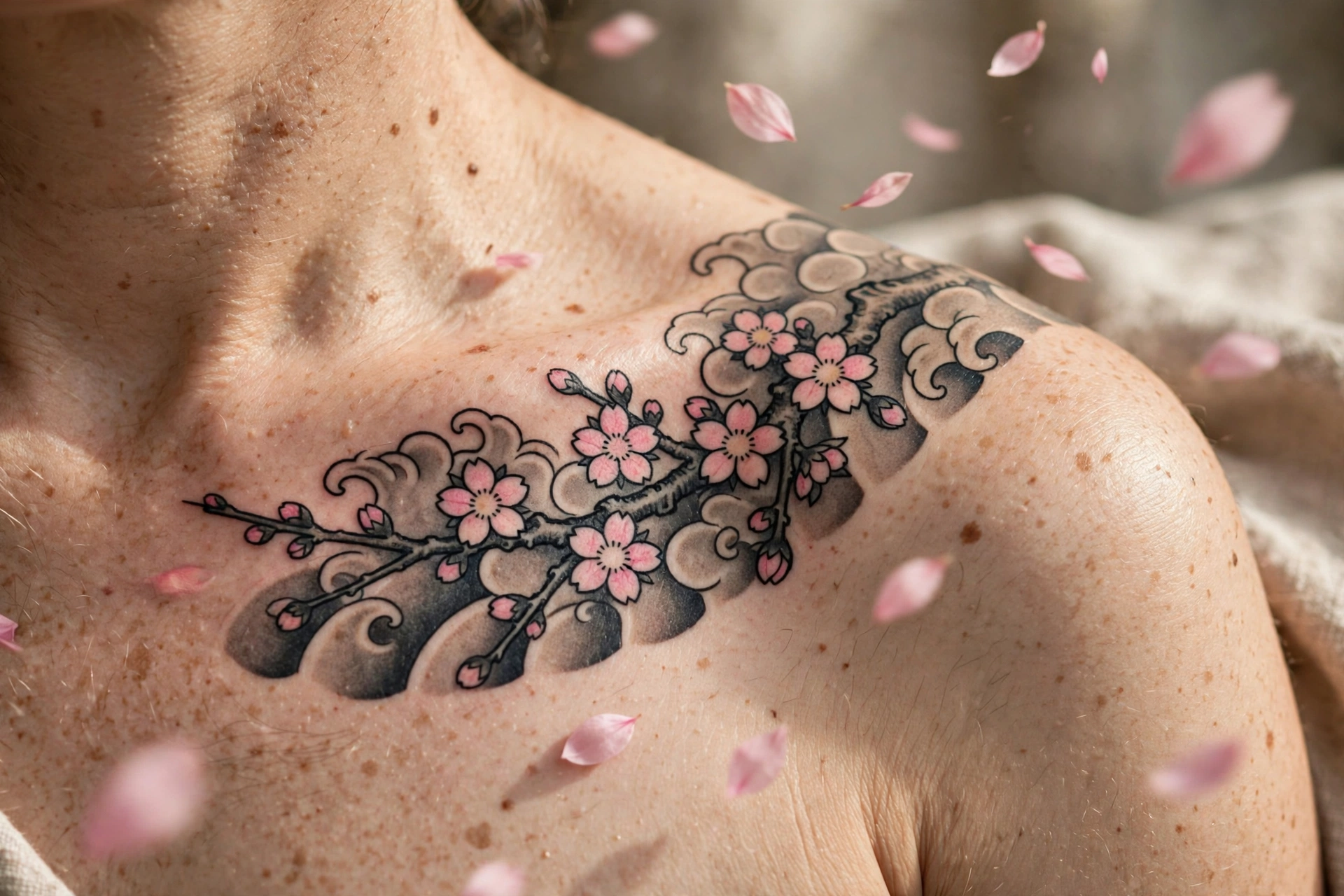
Sakura is the most famous Japanese flower for a reason: it blooms brilliantly and falls within days, so it means beauty, the fleeting nature of life, and living fully in the moment. Falling petals are part of the design, not an accident. Best placement: collarbone, shoulder or flowing down an arm. Honest downside: delicate pink petals fade faster than bold colours, so keep it out of constant sun and expect touch-ups.
10. Red Maple Leaves (Momiji)
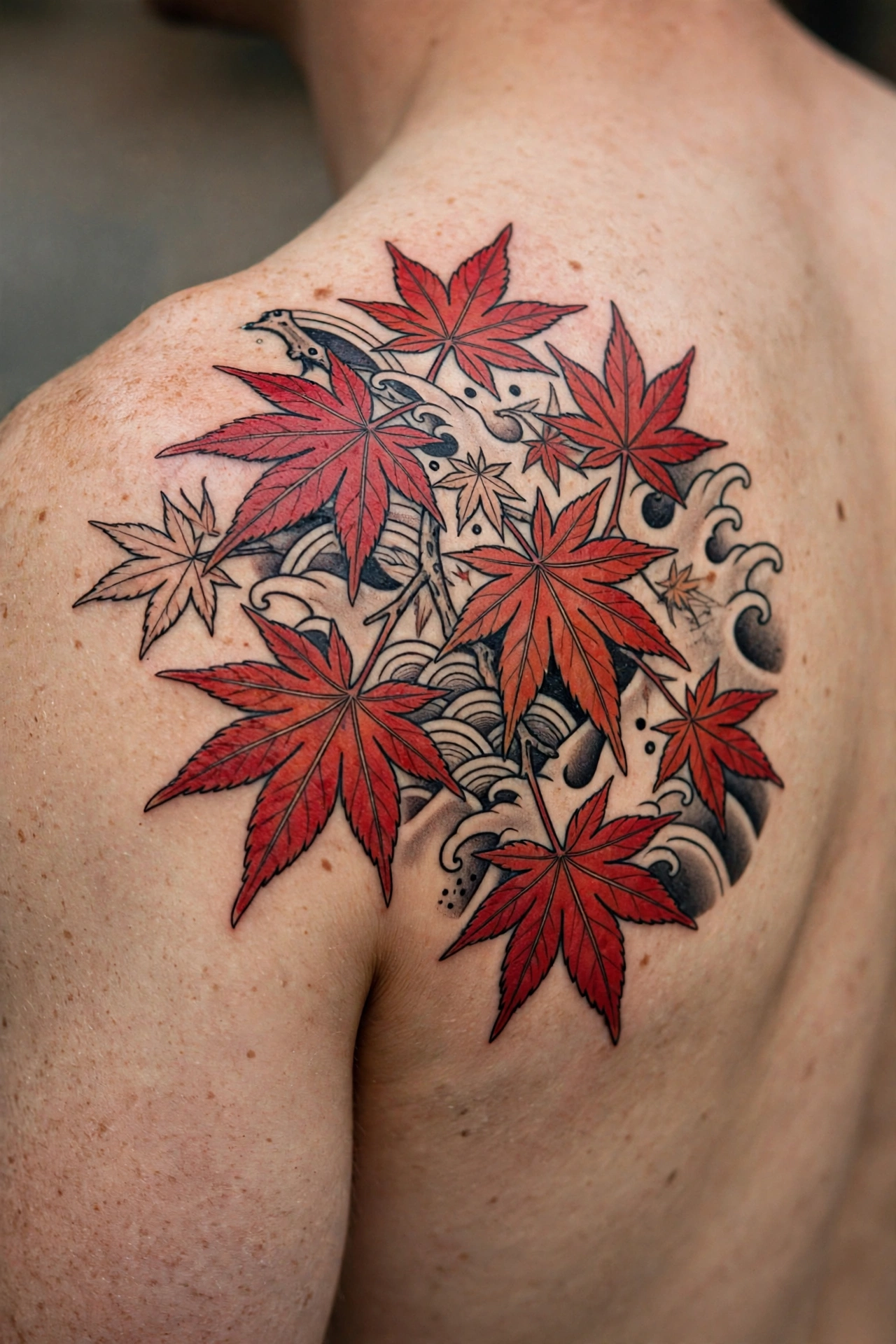
Momiji, the autumn maple, means the passing of time and the beauty of change — the Japanese tradition of leaf-viewing exists precisely because autumn is brief. Red maple pairs beautifully with darker creatures like oni or hannya, balancing their menace with colour. Best placement: shoulder blade, thigh or as background scattered through a sleeve. Honest downside: scattered leaves without a main motif can look unfinished, so anchor them to a creature or branch.
11. Peony (Botan)
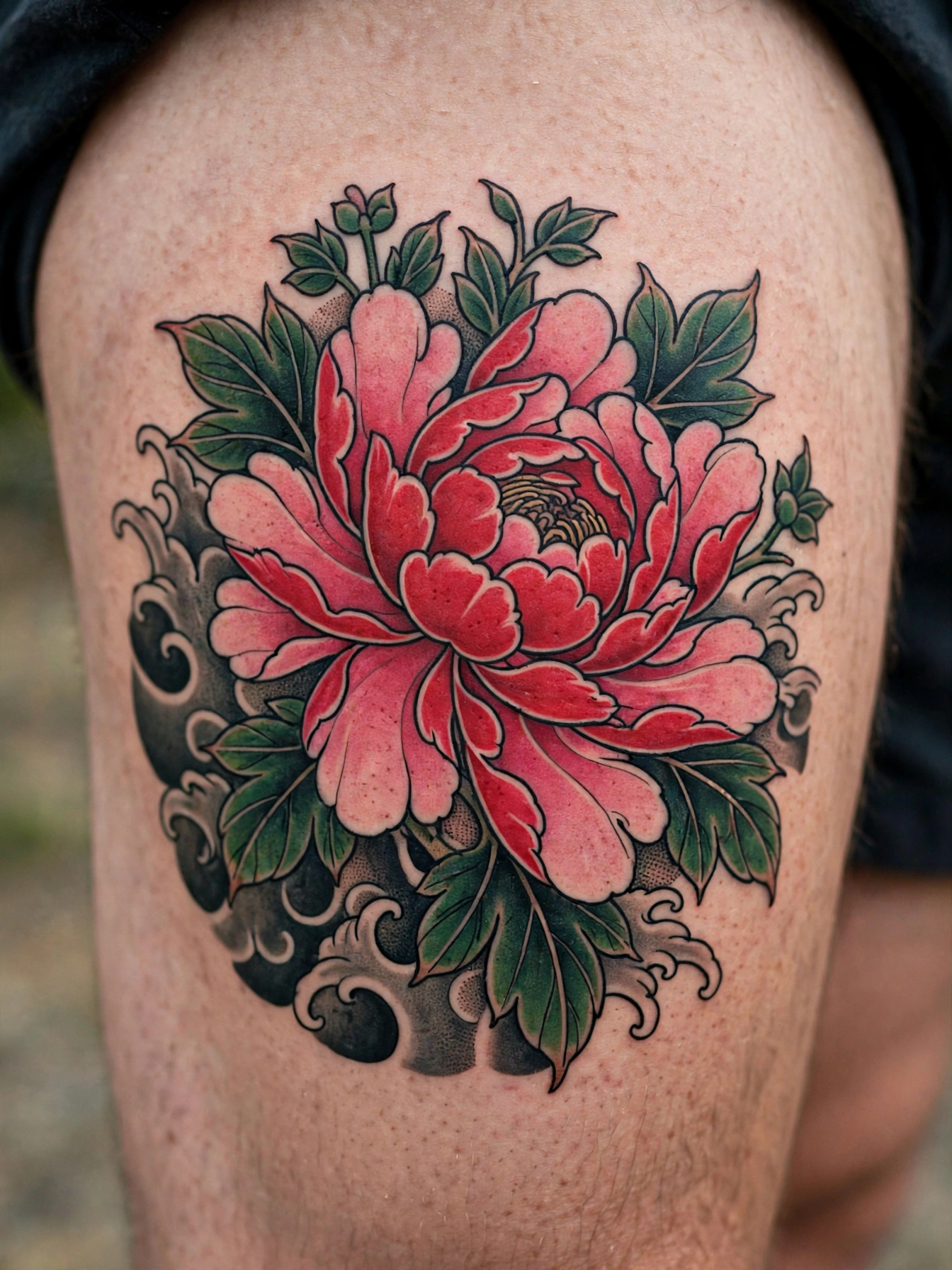
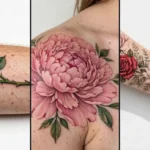
The peony is called the “king of flowers” in irezumi, and it signals wealth, good fortune, honour and high rank. Its layered petals give artists room to show off colour blending, and it is the classic companion flower for lions, tigers and snakes. Best placement: thigh, shoulder or chest. Honest downside: a peony without layered shading looks flat — this flower lives or dies on its shading.
12. Lotus (Hasu)
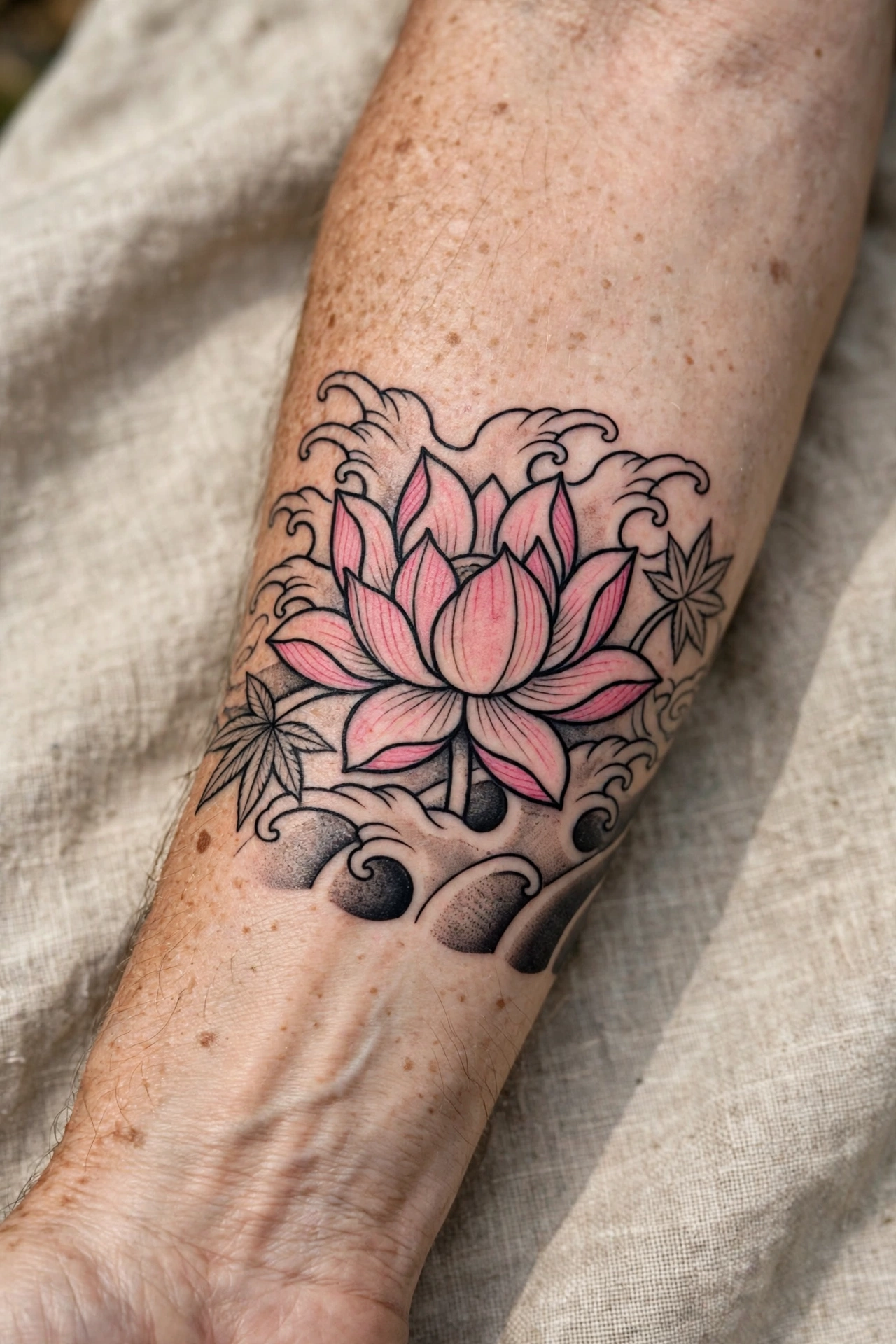
The lotus rises clean from muddy water, so it means purity, enlightenment and beauty emerging from dark places. In Japanese work it is often paired with koi, since both belong to the water. Best placement: forearm, thigh or back. Honest downside: pink lotus shading fades in sun, and a lotus drawn too small loses the petal layers that carry its meaning. See our lotus tattoo ideas for more lotus meanings.
13. Chrysanthemum (Kiku)
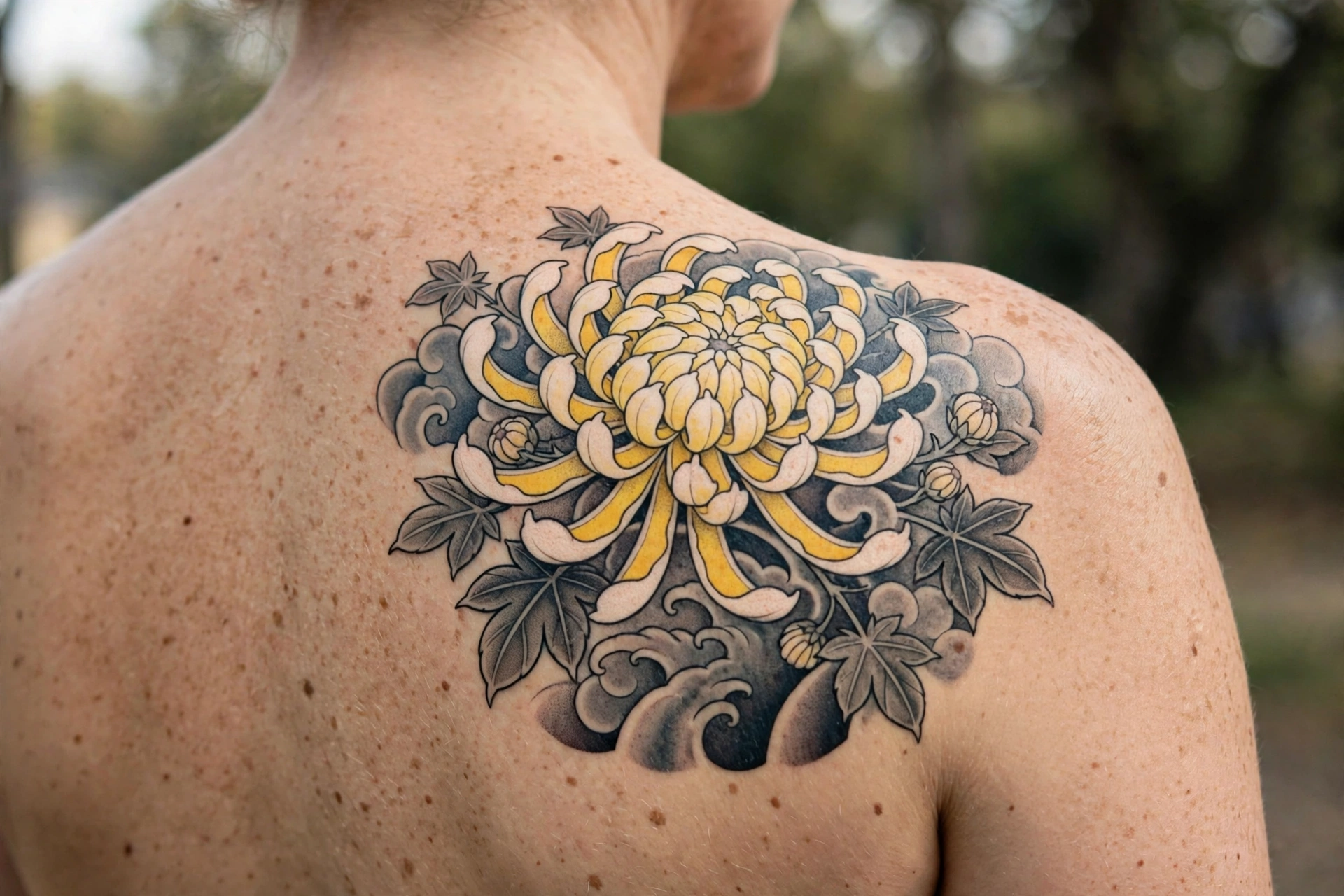
The chrysanthemum is the symbol of the Japanese imperial family, so it carries weight no other flower in the style does: longevity, nobility and perfection. Its many tight petals make it a superb large filler flower, and it traditionally belongs to autumn. Best placement: back, shoulder or thigh. Honest downside: the dense petal work takes time and money, and a rushed kiku blurs into a shapeless blob as it ages.
14. Bamboo Stalk
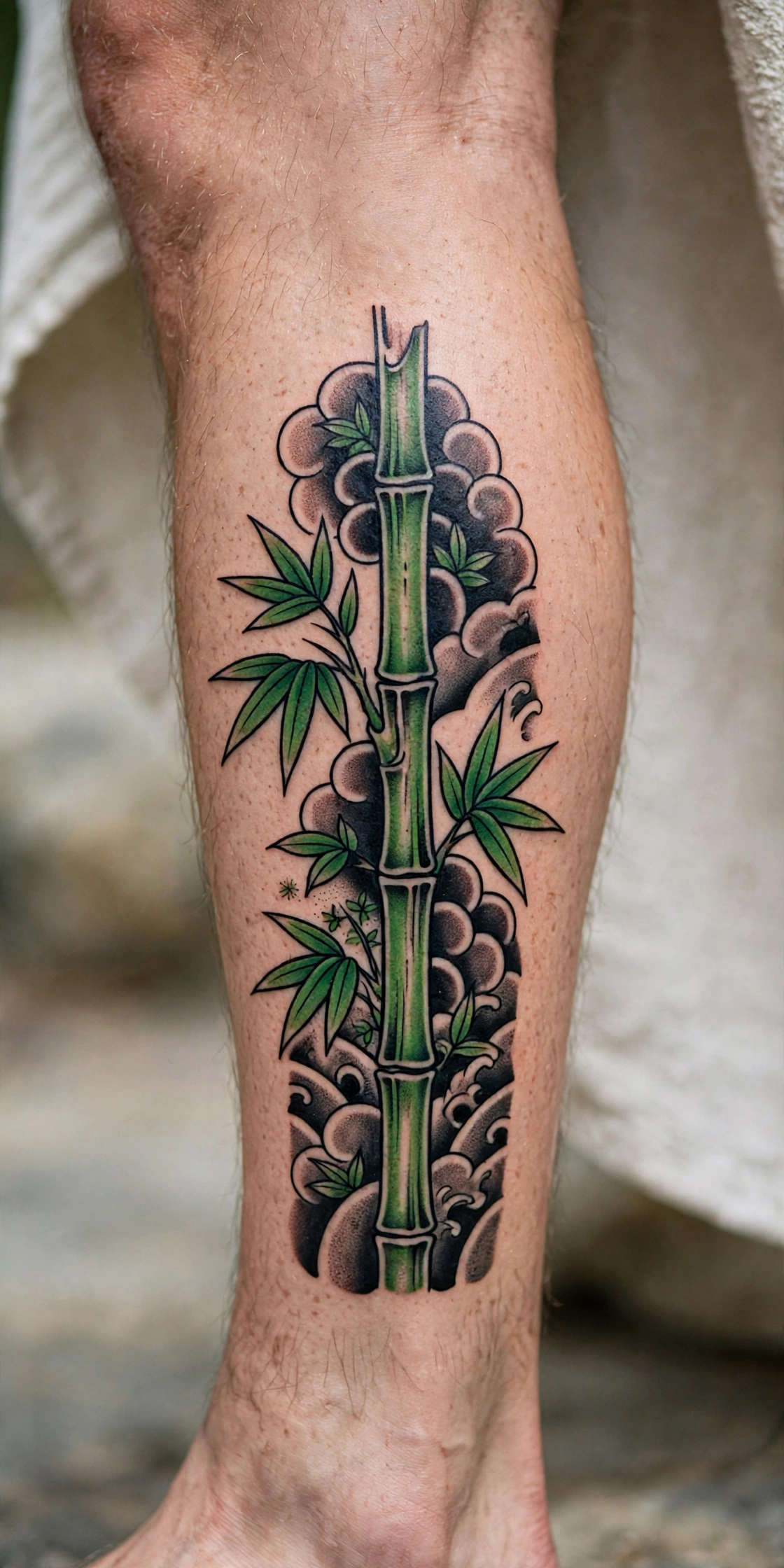
Bamboo means resilience and flexibility — it bends in the storm instead of breaking — and it is the natural companion of the tiger, which is said to move through bamboo groves. A vertical bamboo stalk follows the body’s lines beautifully. Best placement: calf, forearm or spine. Honest downside: a single straight stalk can look plain on its own, so it works best as part of a larger scene with leaves and wind.
15. Great Wave Band (Seigaiha)
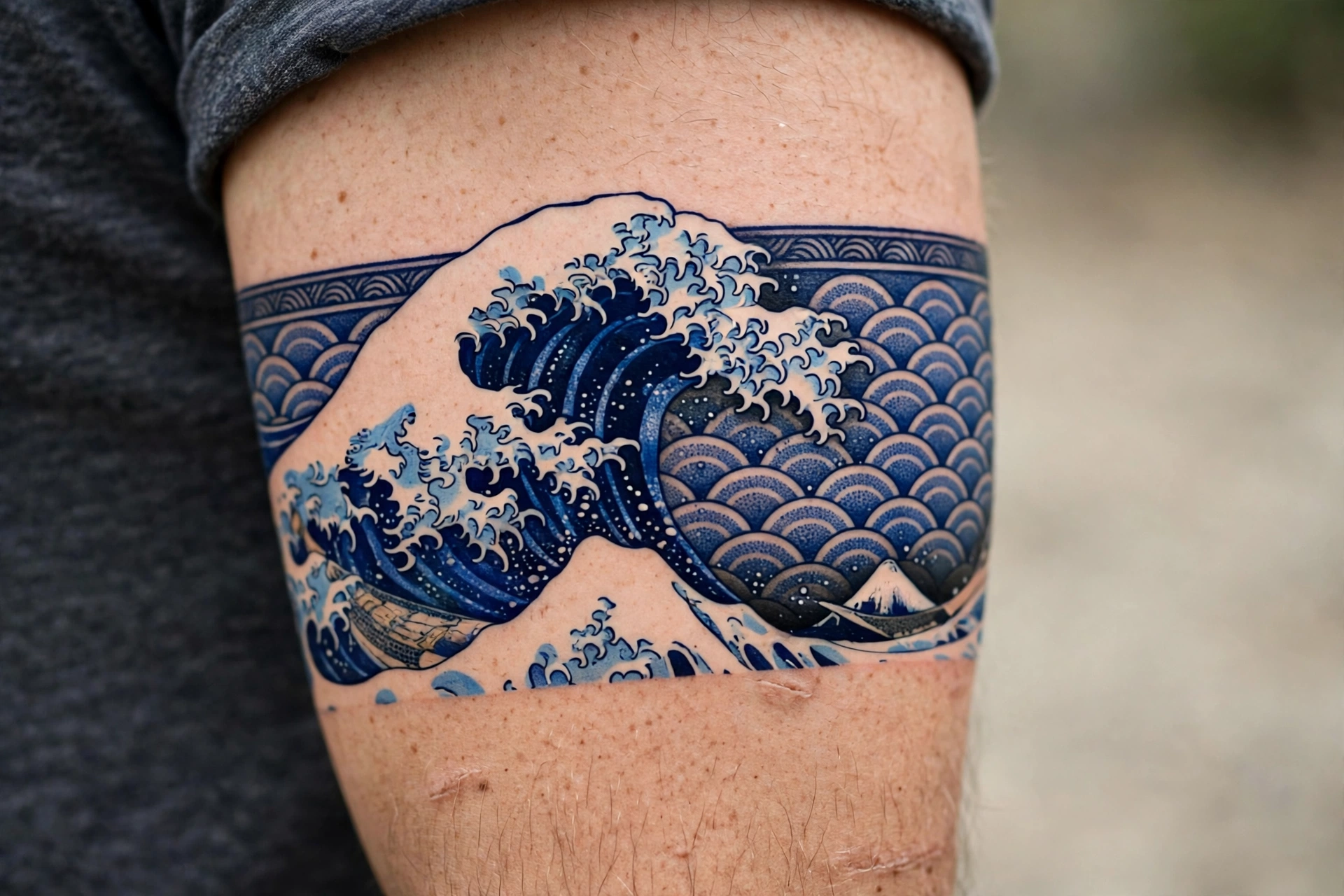
The great wave is the background that became a star: layered blue waves, borrowed from Hokusai’s famous print, mean power, change and the unstoppable force of nature. As a band it wraps the arm or leg in pure movement. Best placement: upper arm band or leg band. Honest downside: wave bands distort if they are not mapped to how your arm moves, so the stencil test matters more here than almost anywhere else.
16. Mount Fuji With Rising Sun
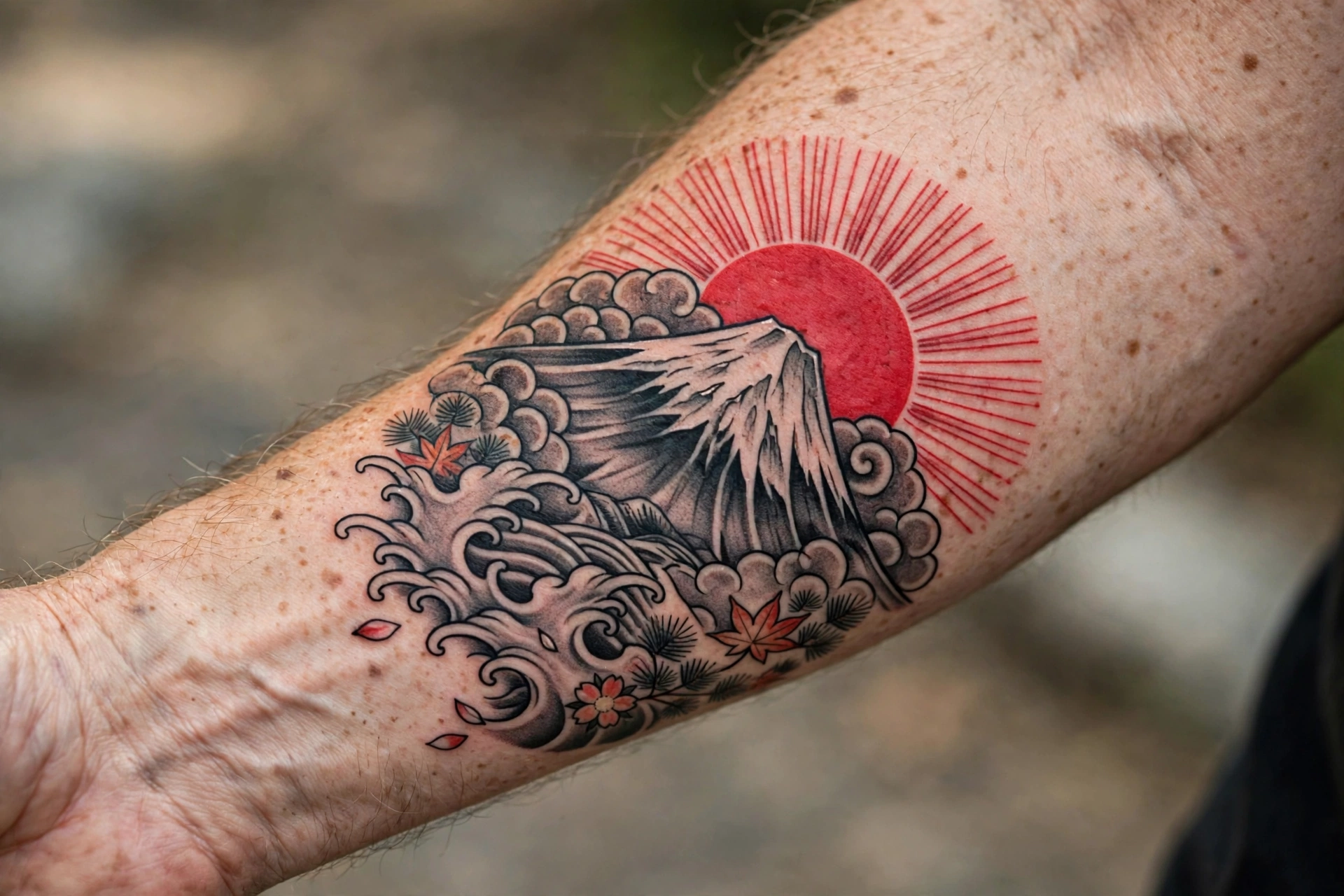
Fuji is endurance, Japan itself, and a goal worth climbing toward — the mountain that appears in art again and again because it never changes while everything around it does. Paired with a red rising sun, it becomes a compact emblem of hope and national pride. Best placement: forearm, calf or shoulder. Honest downside: the red sun fades faster than the blue mountain, so the two colours will age at different speeds.
17. Full Moon With Clouds
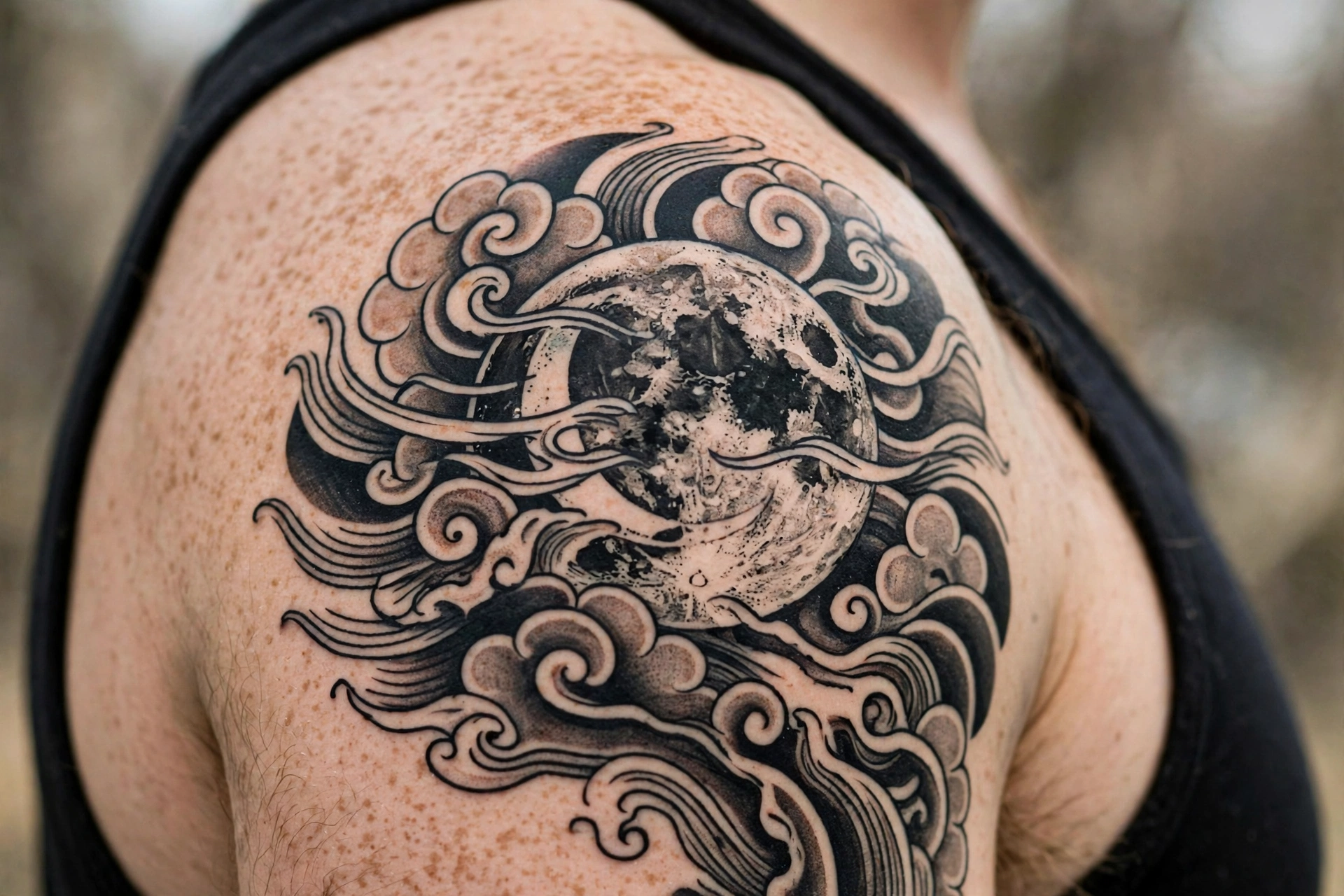
The moon means change, cycles and the quiet side of nature — the counterpart to the sun’s boldness. In Japanese compositions it often floats behind a creature or a branch, half-hidden by wind clouds, which gives the whole piece depth. Best placement: shoulder, back or chest. Honest downside: a pale moon on pale skin can wash out, so the cloud shading around it does the real work.
Symbols and Spirits
This is where Japanese tattooing gets personal — and where research matters most. Every spirit and symbol below carries a story; choose the one whose story is actually yours.
18. Daruma Doll
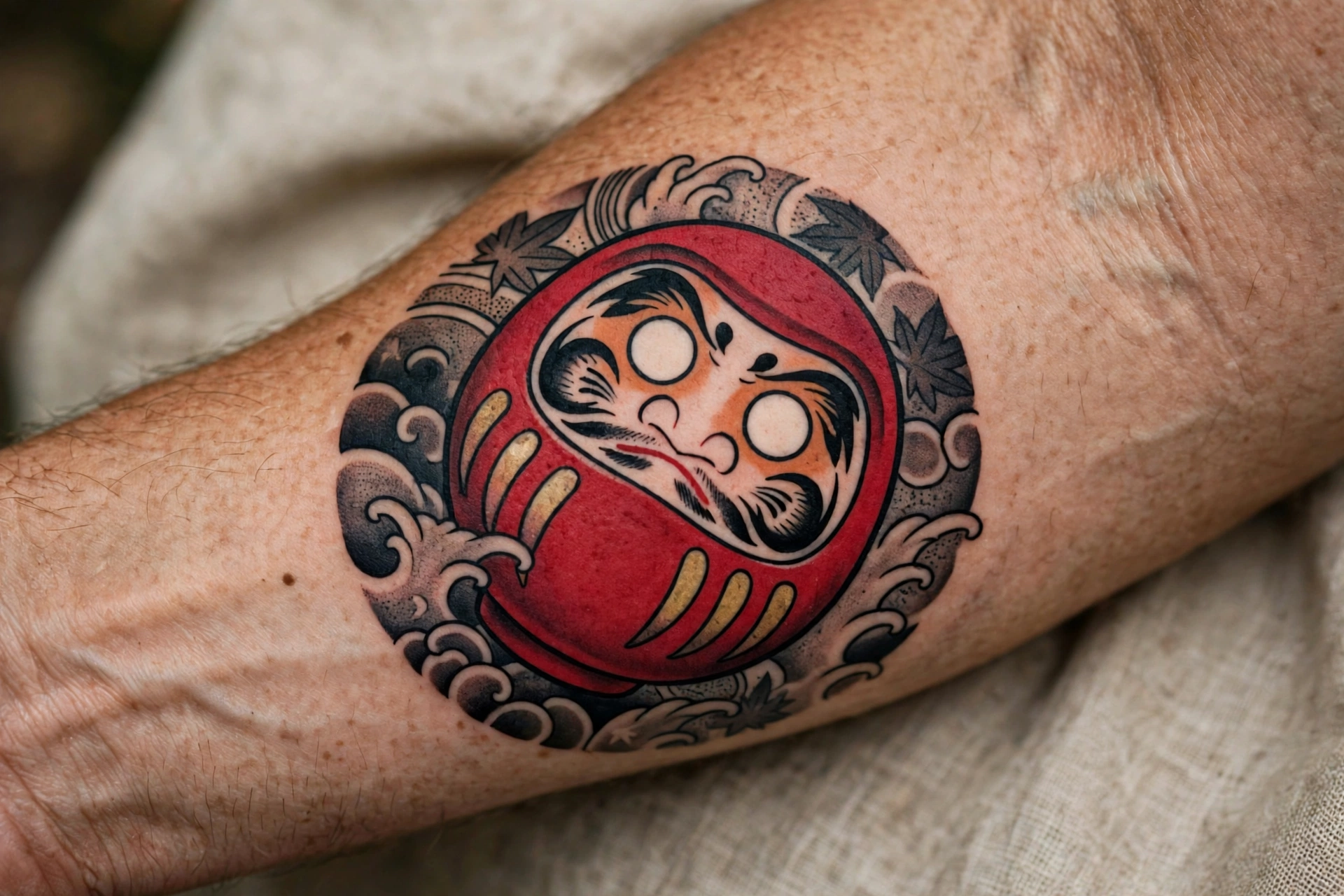
The daruma is a round, legless doll modelled on the monk Bodhidharma, and it is a goal-setting talisman: you paint one eye when you set a goal and the other when you achieve it. It means perseverance — “fall down seven times, get up eight.” Best placement: forearm or calf. Honest downside: a daruma with both eyes painted before you have earned them misses the entire point, so many collectors leave one eye blank on purpose.
19. Maneki-Neko (Lucky Cat)
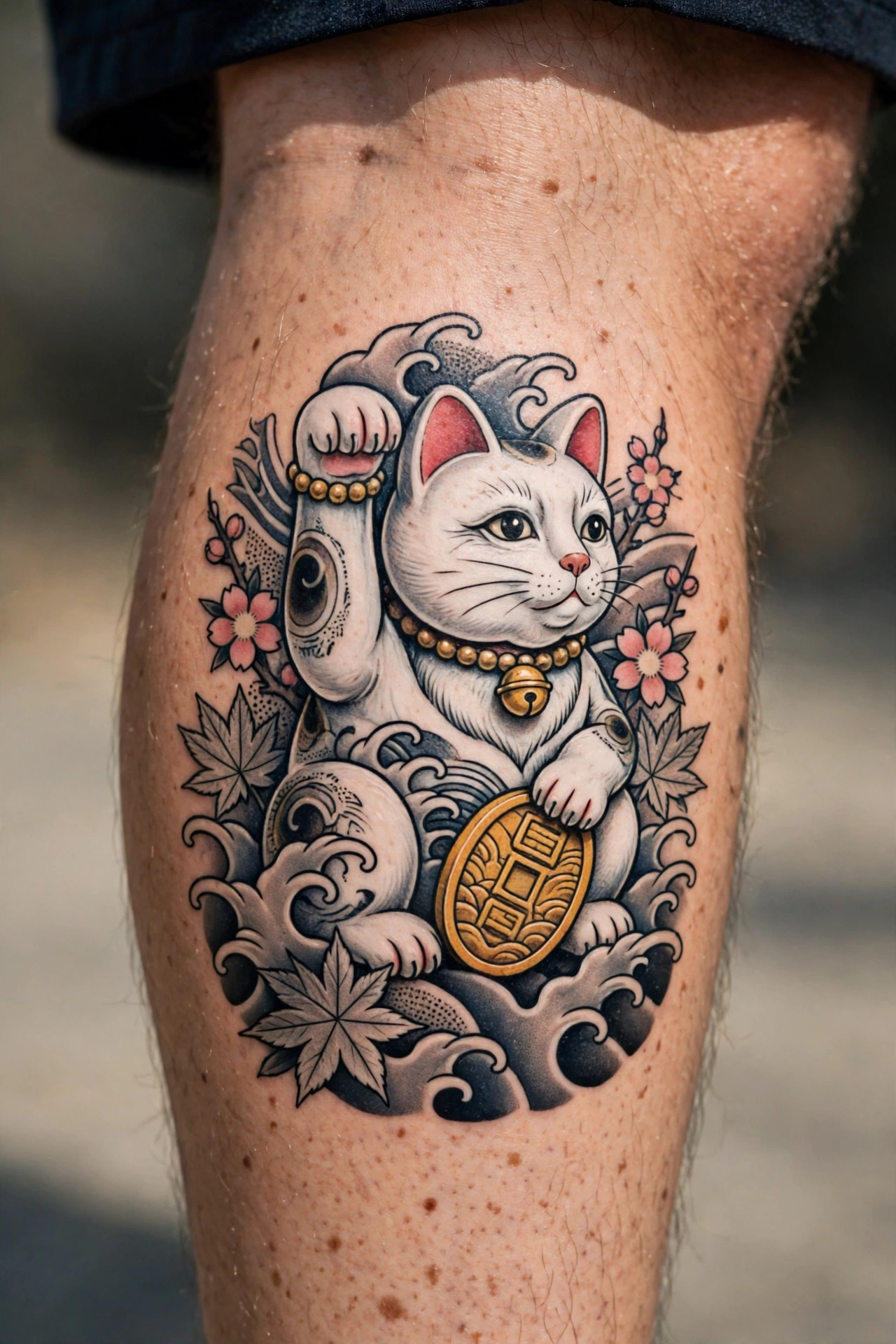
The beckoning cat, paw raised, is Japan’s most cheerful luck symbol: it invites prosperity, customers and good fortune into homes and businesses. In tattoo form it is playful where most irezumi is serious, which is exactly why people love it. Best placement: calf, forearm or thigh. Honest downside: the charm depends on crisp small details — coin, collar, bell — so do not shrink it below palm size.
20. Nine-Tailed Fox (Kitsune)
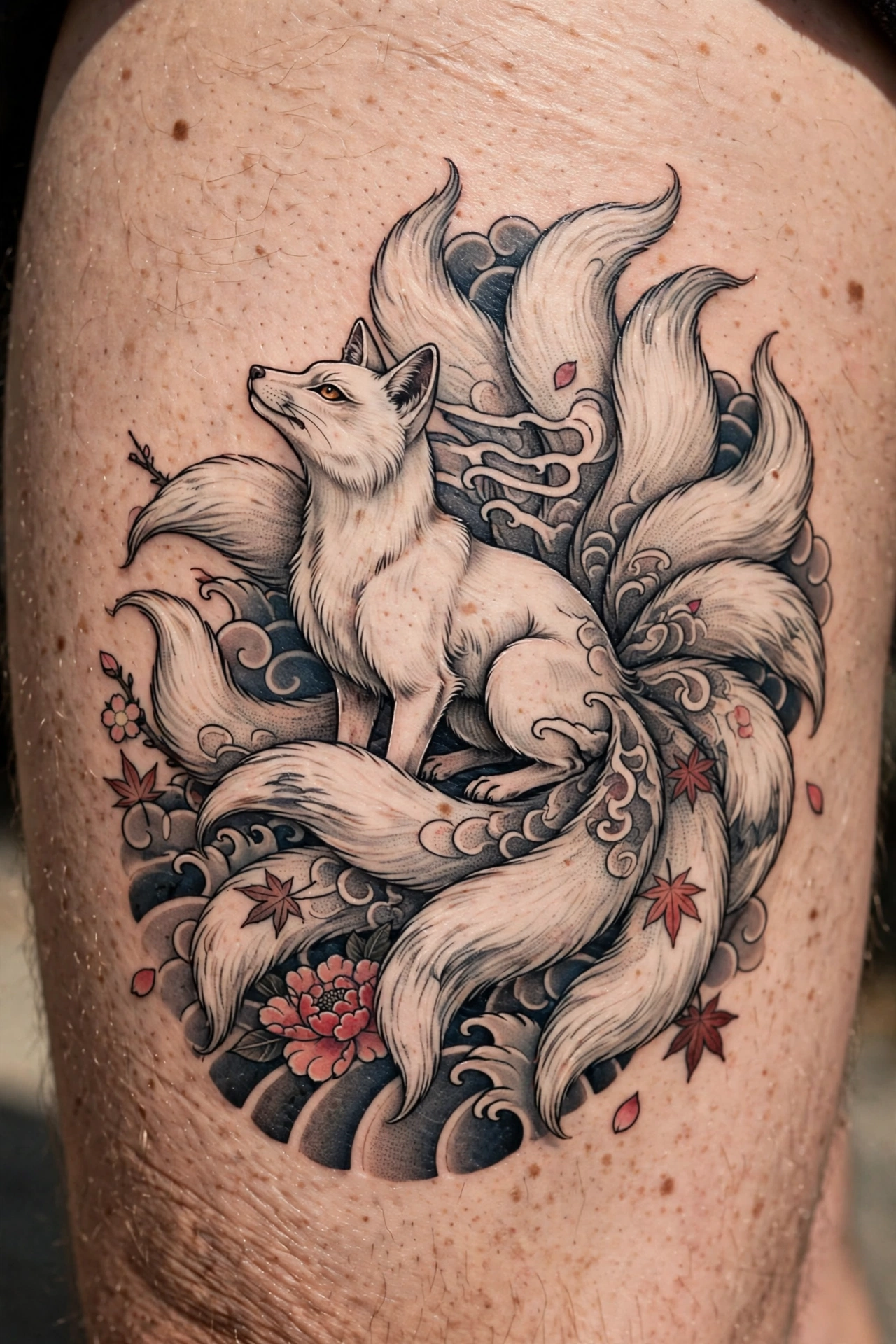
Kitsune are fox spirits of cunning, intelligence and protection, growing more tails — up to nine — as they grow older and wiser. A nine-tailed kitsune is therefore a symbol of great age, power and magical protection. Best placement: thigh or back, where nine tails have room to flow. Honest downside: nine tails need space, and a cramped kitsune turns into a tangle of lines.
21. Tengu Mask
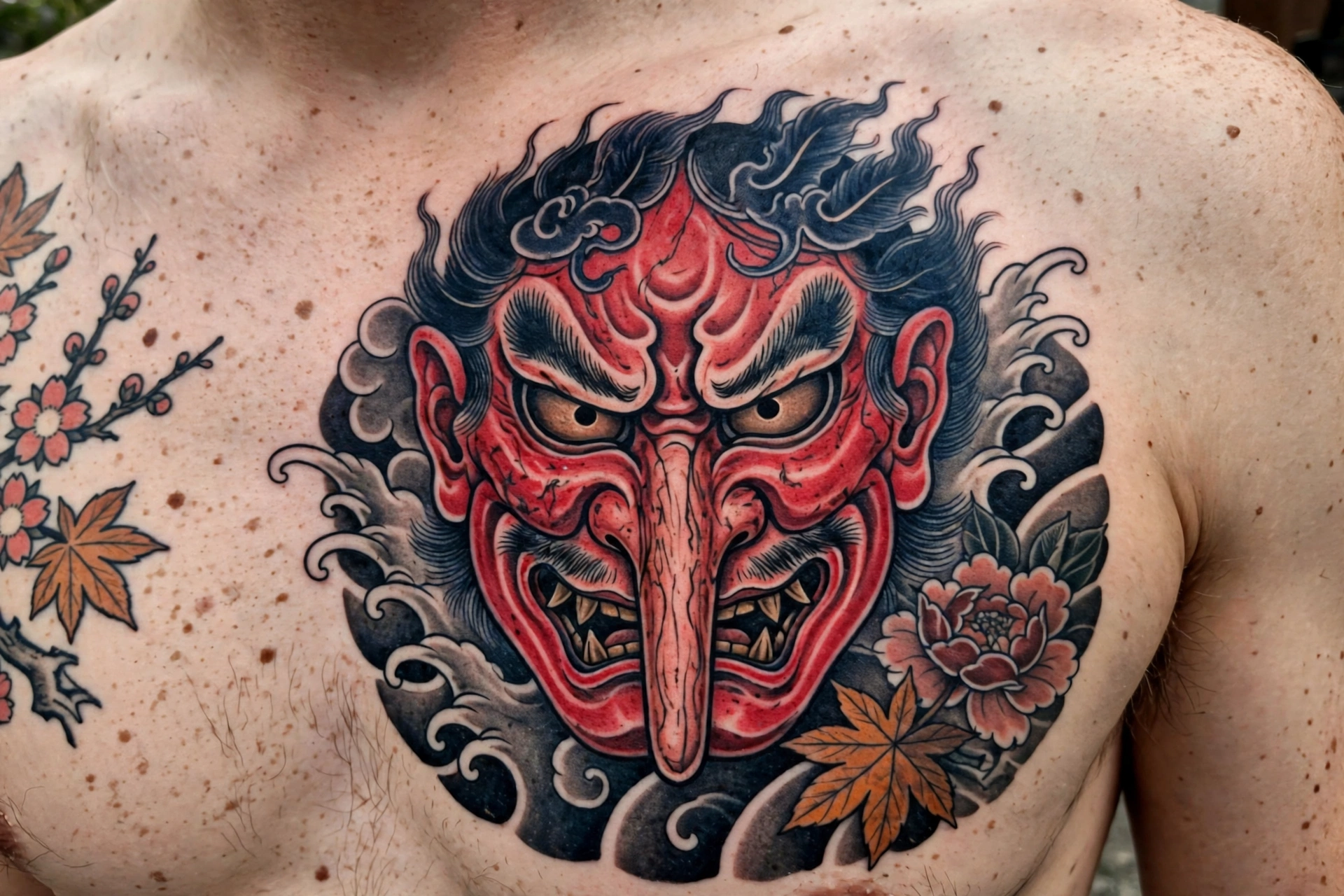
Tengu are mountain spirits with long noses (or beaks), masters of martial arts and protectors of forests and mountains. A tengu mask means martial skill, discipline and a wild, untameable spirit. Best placement: chest panel or thigh. Honest downside: the long nose makes this a hard design to place on narrow areas — it needs width or it looks squashed.
22. Samurai Warrior
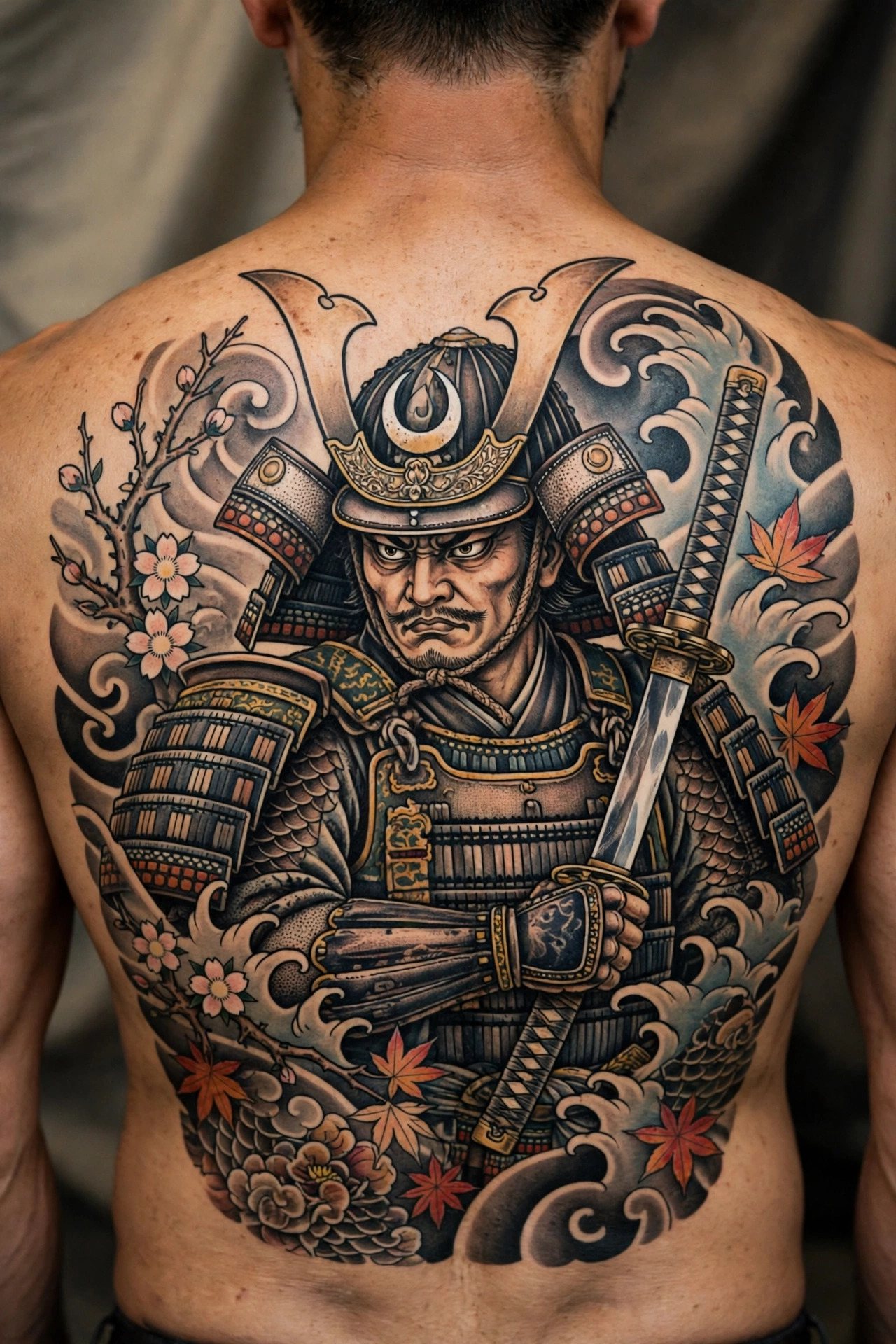
The samurai stands for honour, loyalty, discipline and courage under pressure — the bushido code in human form. A samurai portrait, armour and all, is one of the grandest single-subject Japanese tattoos. Best placement: full back or thigh. Honest downside: armour detail is unforgiving; this is a specialist piece, and a generalist’s samurai often looks like a costume rather than a warrior. The yakuza connection to warrior imagery is covered in our yakuza tattoo guide — read it before choosing warrior motifs.
23. Geisha Portrait
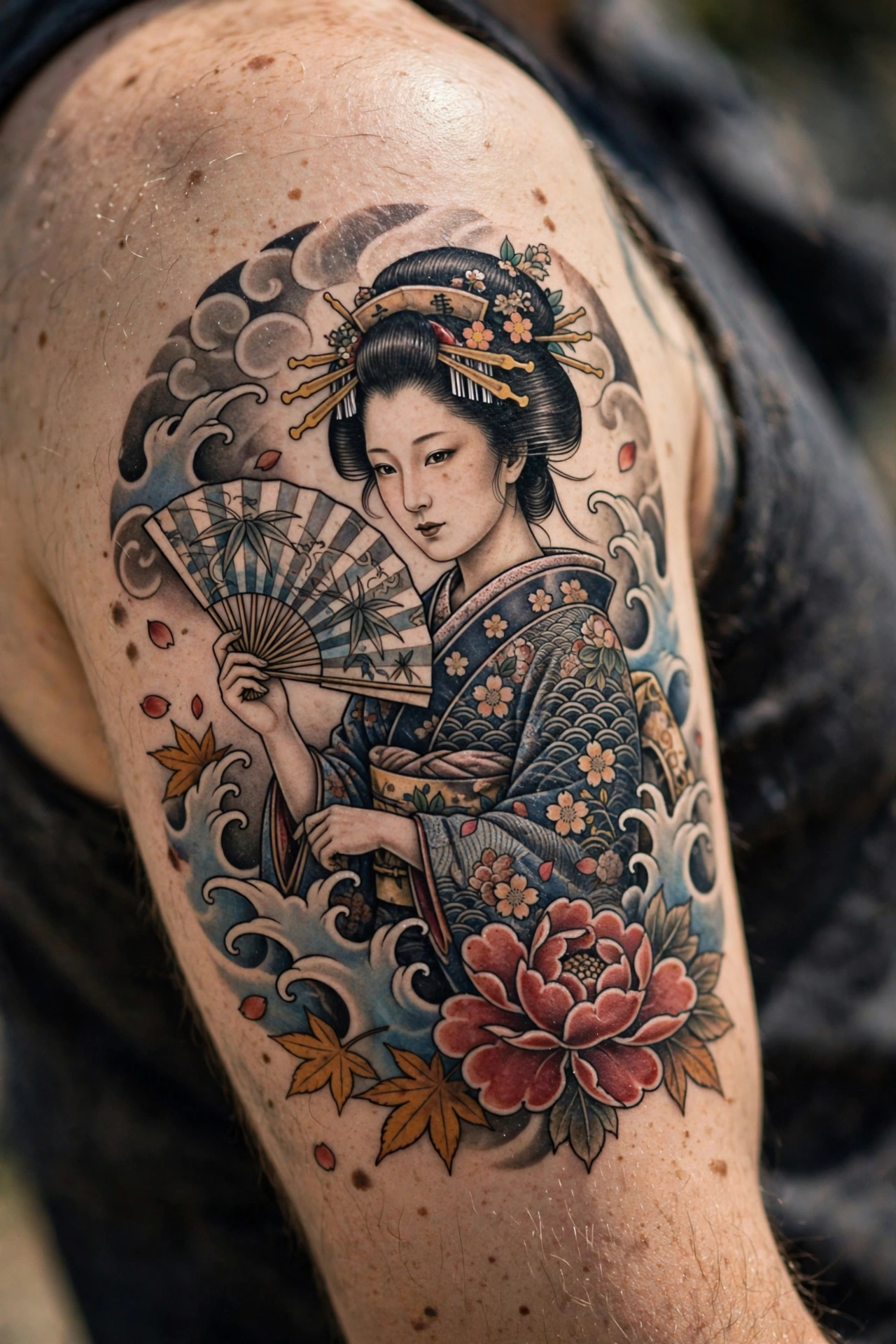
The geisha means beauty, art, grace and refined strength — a woman trained in music, dance and conversation, not the stereotype outsiders often attach to her. In tattoo form she is usually shown with a fan, kimono patterns and flowers. Best placement: upper arm or thigh. Honest downside: geisha faces are hard to get right, and a face that is slightly off will bother you every day, so choose your portrait artist carefully.
24. Katana With Sakura
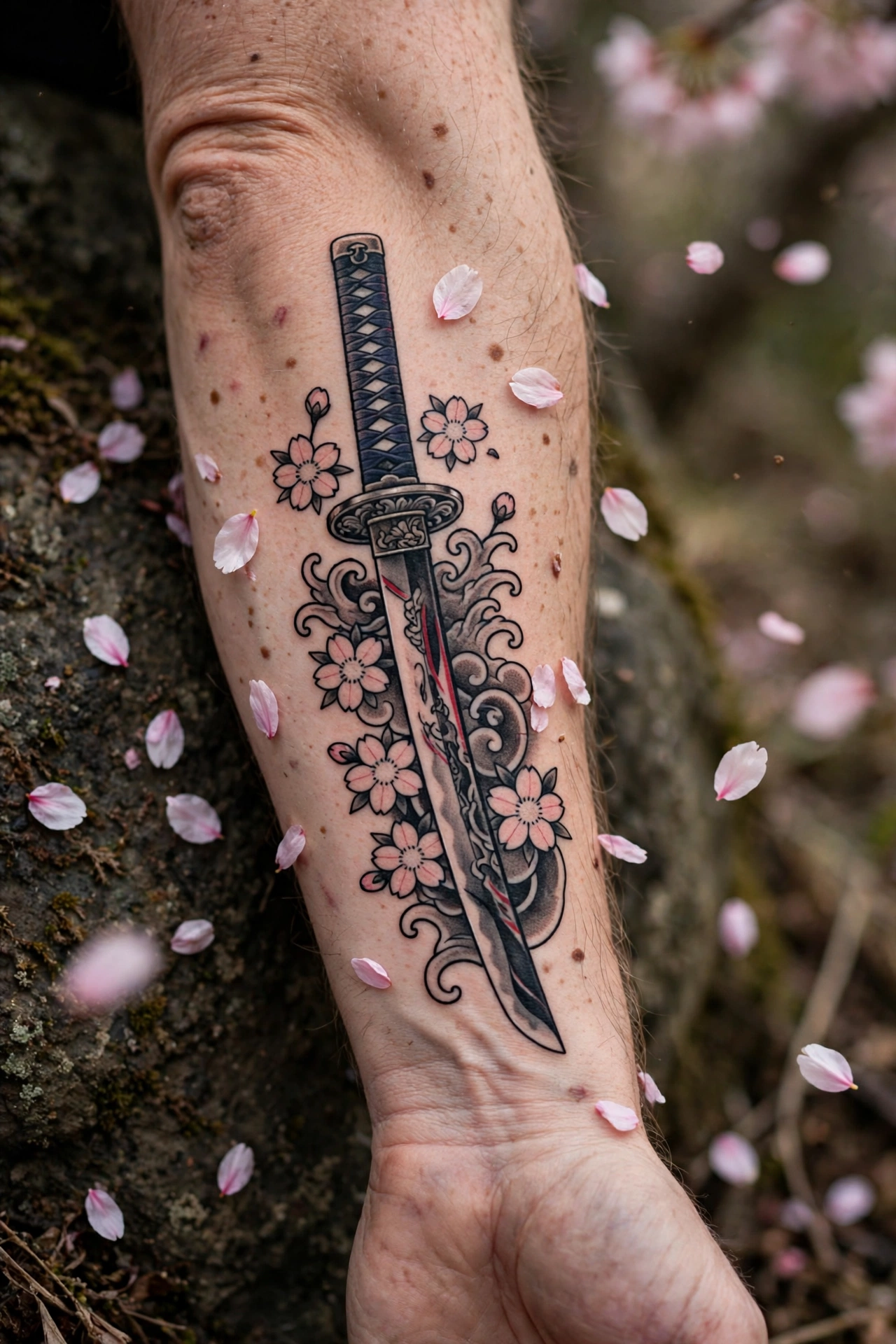
The katana means honour, precision and the discipline of the sword — a weapon treated as an art object and a soul. Paired with falling cherry blossom, it becomes the classic samurai paradox: deadly steel and fleeting beauty in one image. Best placement: forearm, where the blade can follow the arm’s line. Honest downside: a straight blade on a curved arm distorts when you move, so the artist must map the blade to your arm, not to a flat drawing.
25. Torii Gate
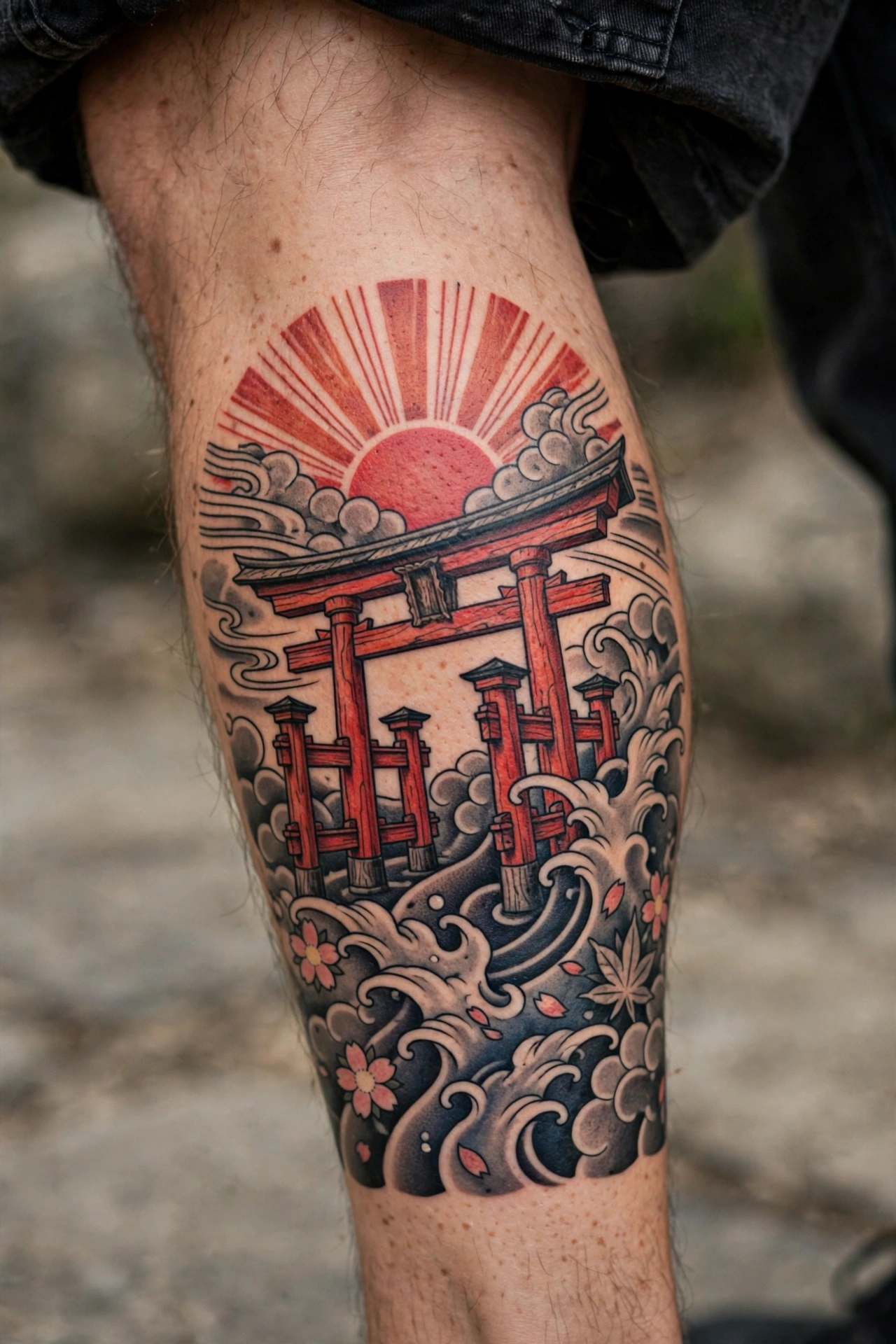
A torii gate marks the threshold between the everyday world and the sacred — the entrance to a Shinto shrine. As a tattoo it means transition, sacred space and stepping into a new chapter of life. Best placement: calf, forearm or back. Honest downside: a torii is a religious structure, so treat it with the respect you would give any sacred symbol, and keep its proportions clean — a wonky gate ruins the whole piece.
26. Enso Circle
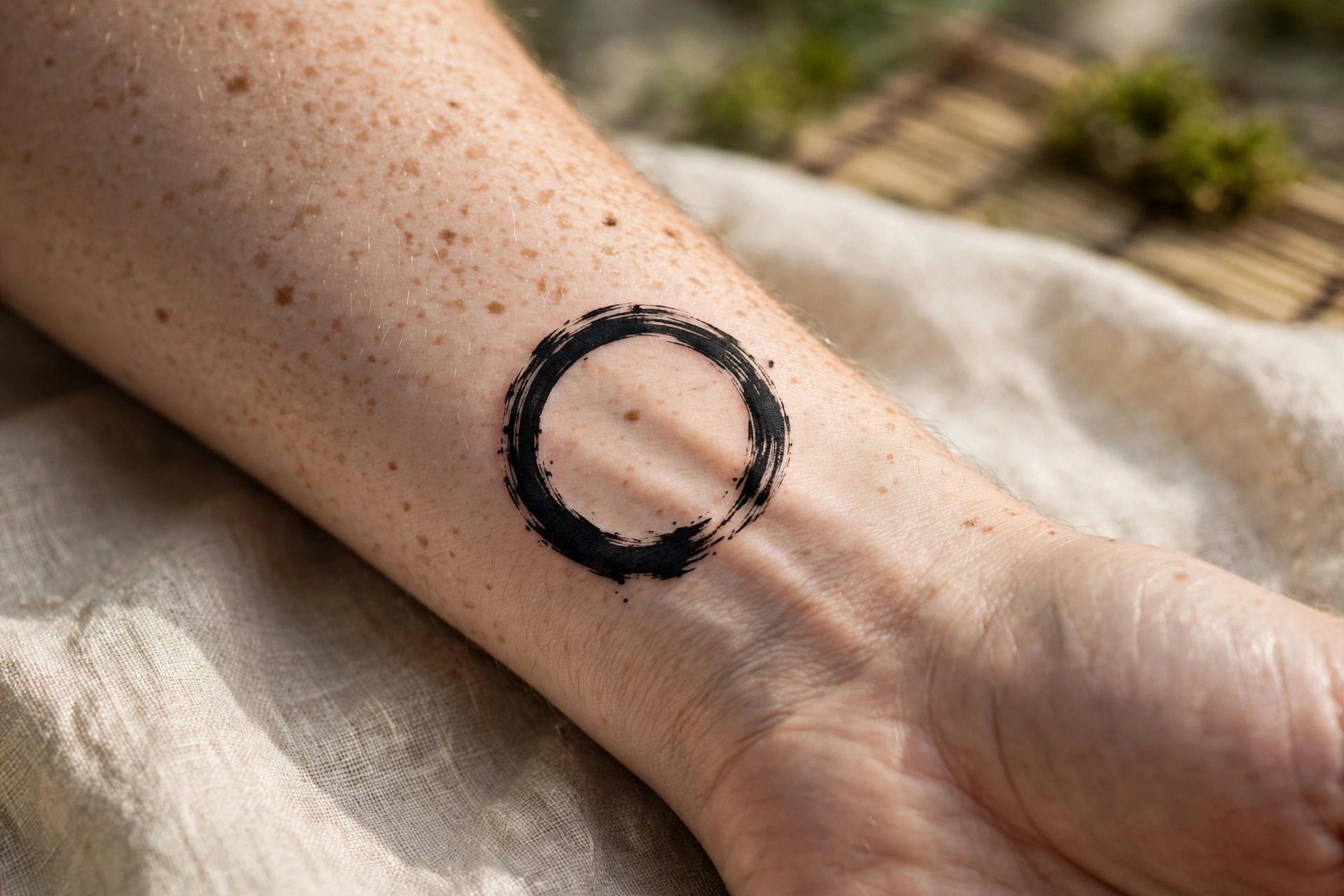
Enso is a single hand-drawn circle in Zen calligraphy: enlightenment, emptiness, the universe and the beauty of imperfection, all in one brushstroke. It is the quietest design on this list and, for some people, the most powerful. Best placement: wrist, forearm or back of the neck. Honest downside: a perfect-looking machine circle misses the point — the brushstroke’s roughness is the meaning, so find an artist who understands calligraphy.
27. Kanji for Courage
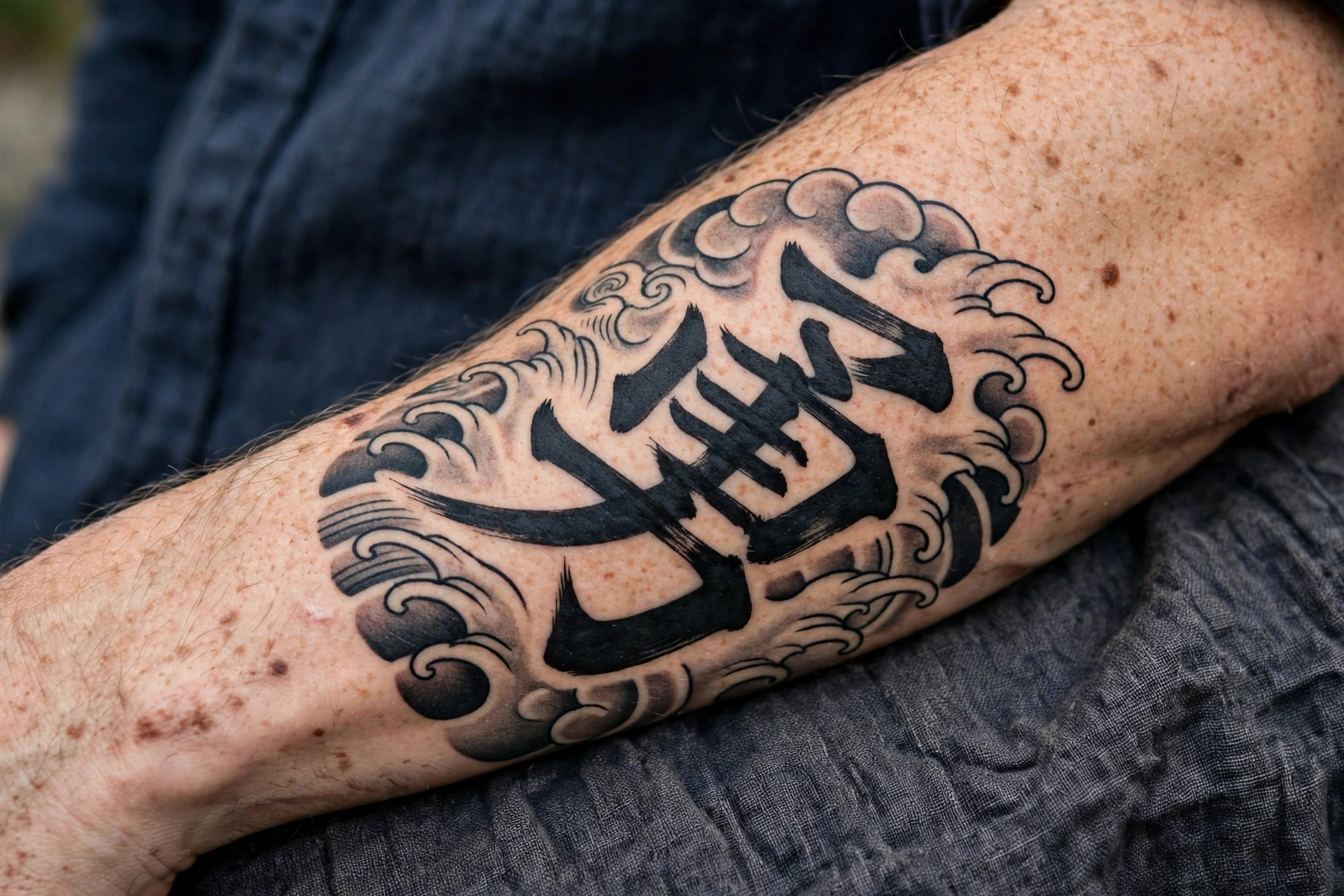
Kanji tattoos carry the word itself, so the stakes are simple and high: get the character right, or wear a mistake forever. The character for courage (yuuki) is a popular, honest choice — but verify it with a native reader, never with a single app or a flash sheet. Best placement: forearm, spine or ribs. Honest downside: kanji is the most commonly botched tattoo in the world, and a wrong stroke is permanent, so double-checking is not optional.
Classic Pairings and Full Compositions
Traditional Japanese tattooing is built on pairings: creature with flower, warrior with wind, fish with water. These twelve designs show how the classic combinations work — and why a good artist plans the whole scene, not just the star of it.
28. Koi and Lotus Pond
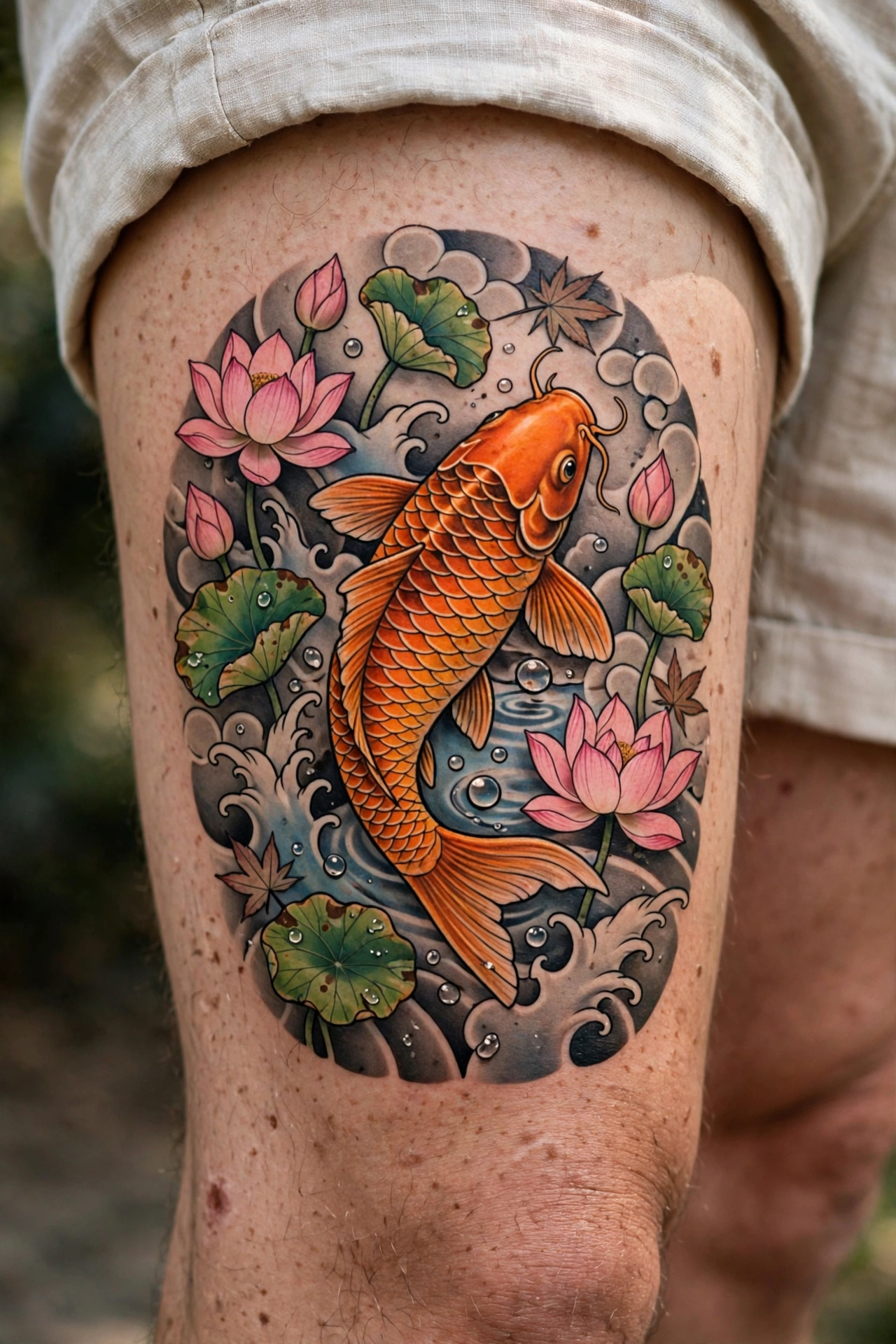
Koi and lotus belong together because both live in the water and both mean rising above difficulty — the fish through effort, the flower through purity. A pond scene, with the koi circling the lotus, is one of the most harmonious compositions in the style. Best placement: thigh or back. Honest downside: a pond scene needs background water to read properly, so budget for more than just the two motifs.
29. Dragon and Clouds Back Piece
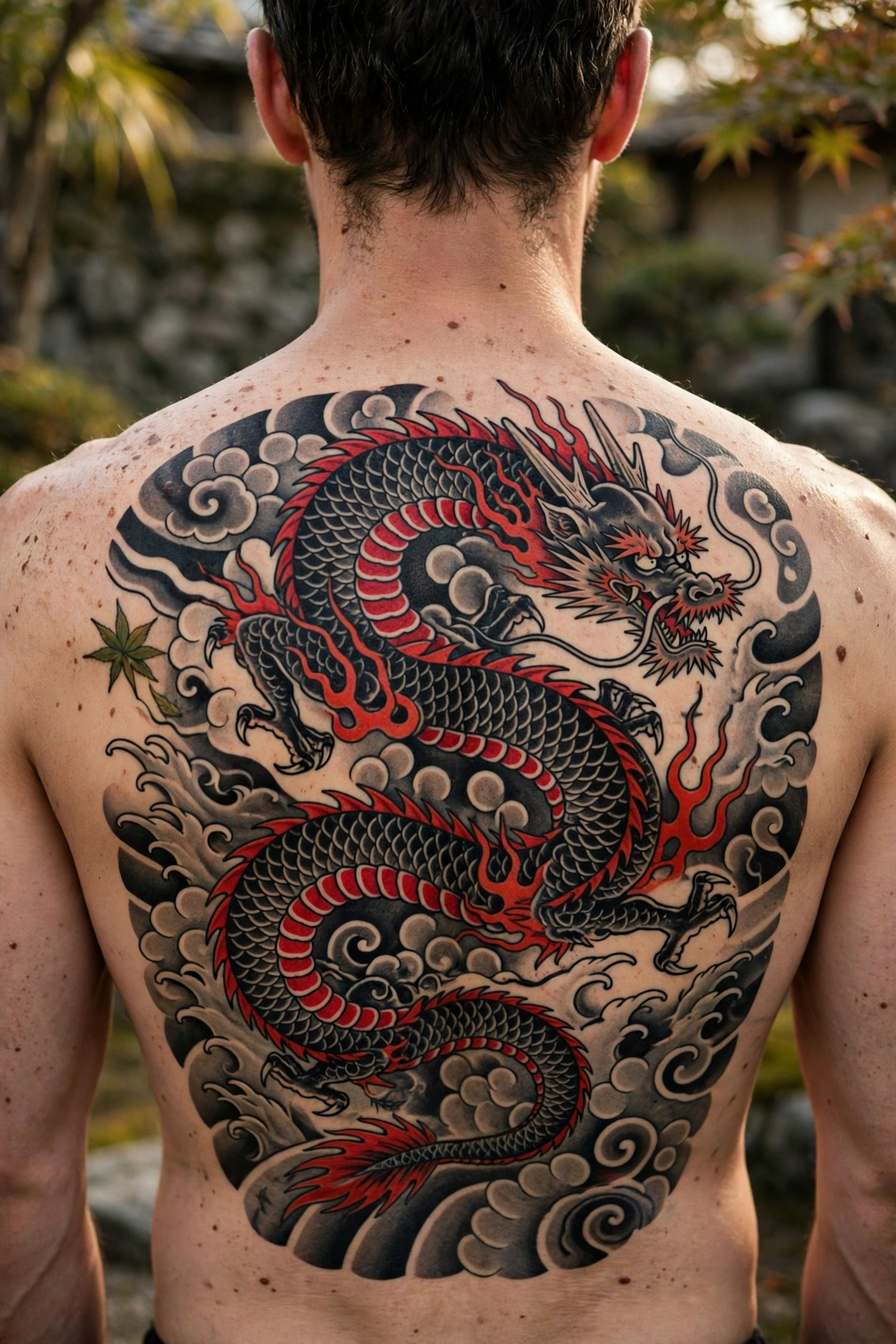
A dragon among wind clouds is the definitive Japanese back piece: the long body coils across the shoulders while clouds carry the eye around the whole canvas. This is the design people picture when they hear “irezumi.” Best placement: full back. Honest downside: this is a year-plus, multi-thousand-dollar project, and starting it without finishing funds leaves you with half a dragon — plan the money before the first session.
30. Tiger and Bamboo
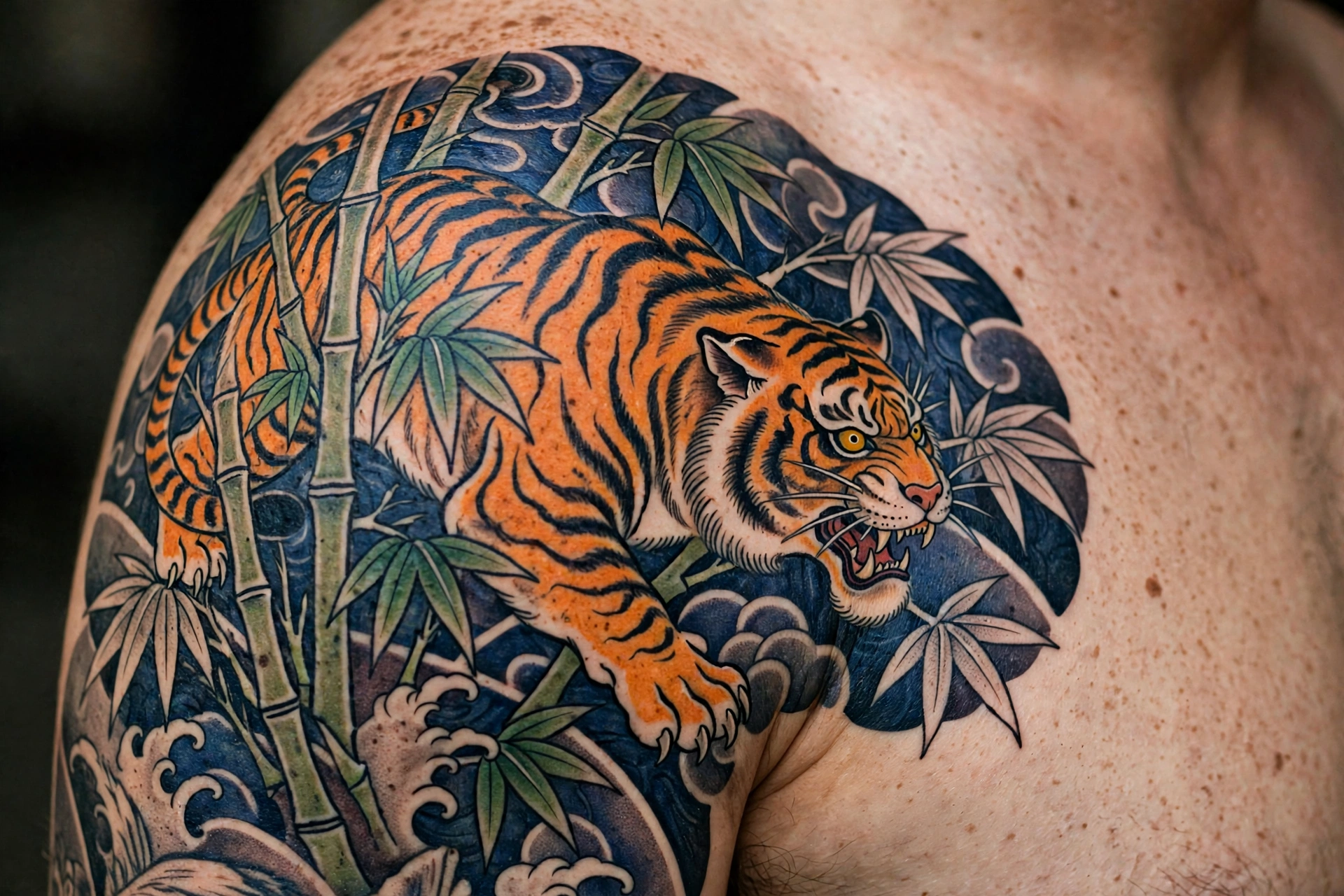
Tiger and bamboo is a traditional pairing for a reason: the tiger’s power against the bamboo’s flexibility is the whole philosophy of strength in one image — hard and yielding at once. The vertical bamboo also gives the composition its structure. Best placement: shoulder or thigh. Honest downside: the tiger must not be dwarfed by the bamboo; scale the two together or the scene falls flat.
31. Crane and Pine
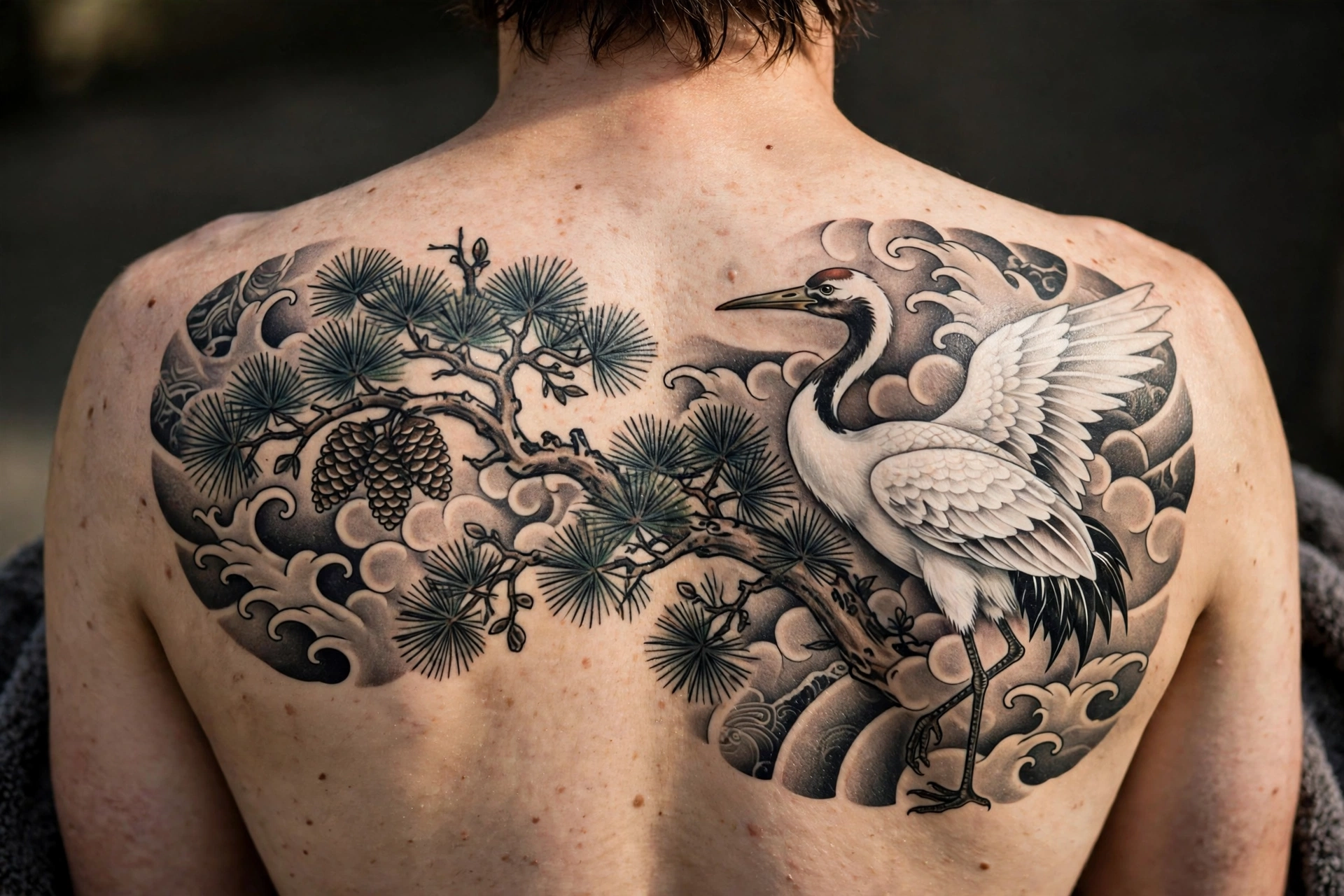
Crane and pine is a classic good-fortune pairing: the crane for long life, the pine — evergreen through winter — for endurance and steadfastness. Together they are a wish for a long, unshaken life, and they look quietly magnificent. Best placement: back or thigh. Honest downside: two pale, delicate subjects can wash each other out, so the artist needs strong dark outlines to separate them.
32. Snake and Peony
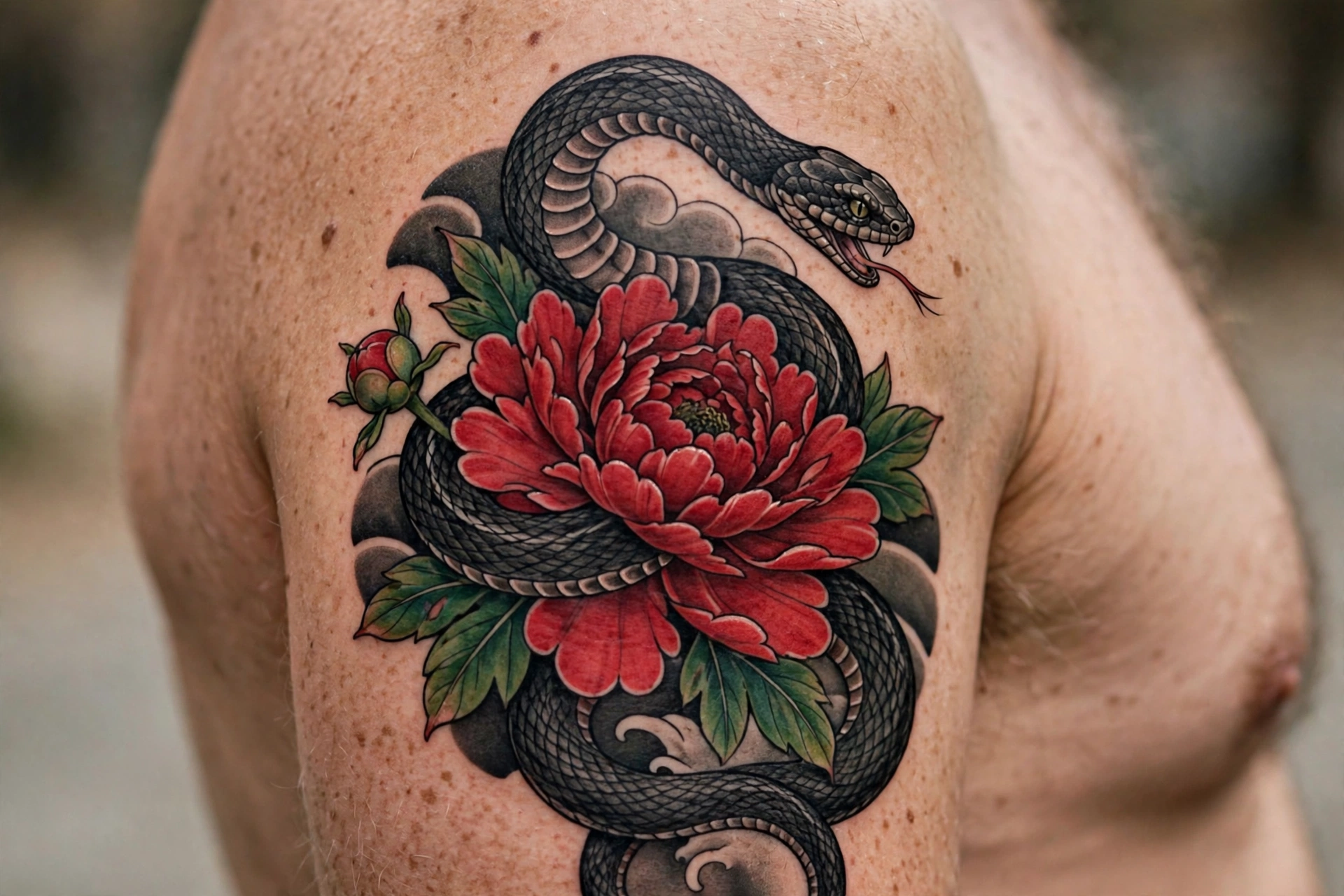
Snake and peony is the pairing of protection and prosperity: the snake guards, the “king of flowers” blesses. The coil of the snake around the layered petals creates natural movement that flatters arms and legs. Best placement: upper arm or thigh. Honest downside: this is a detail-heavy design, and small versions lose both the scales and the petals — go medium or larger.
33. Oni and Maple Leaves
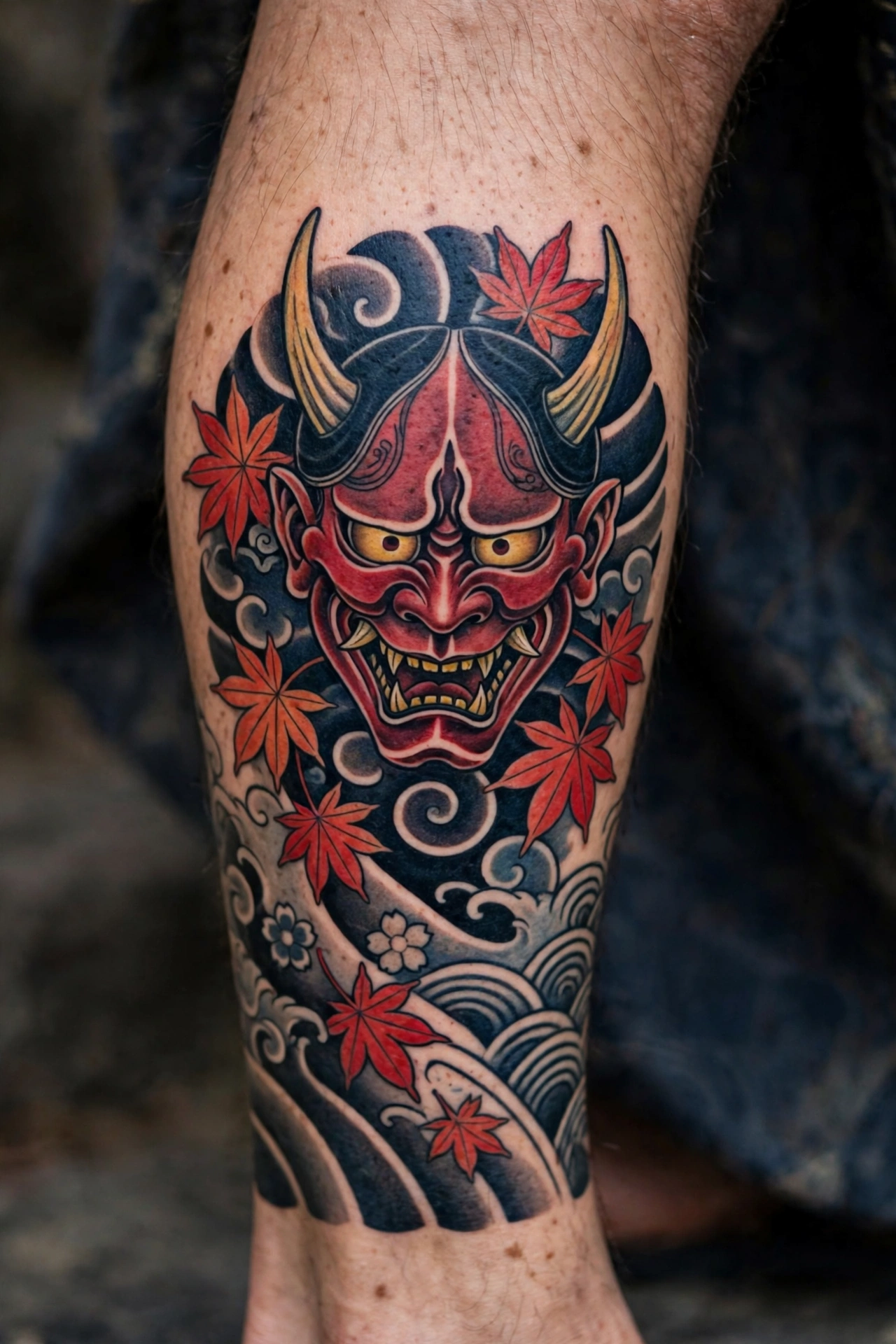
Oni with red maple is the menace-and-beauty balance that Japanese art does better than any other style: the demon’s snarl against autumn leaves that are already falling. The red-on-red palette is dramatic without needing extra colours. Best placement: calf or thigh. Honest downside: red ink fades faster than black, so the maple will need touch-ups sooner than the oni.
34. Hannya and Cherry Blossom
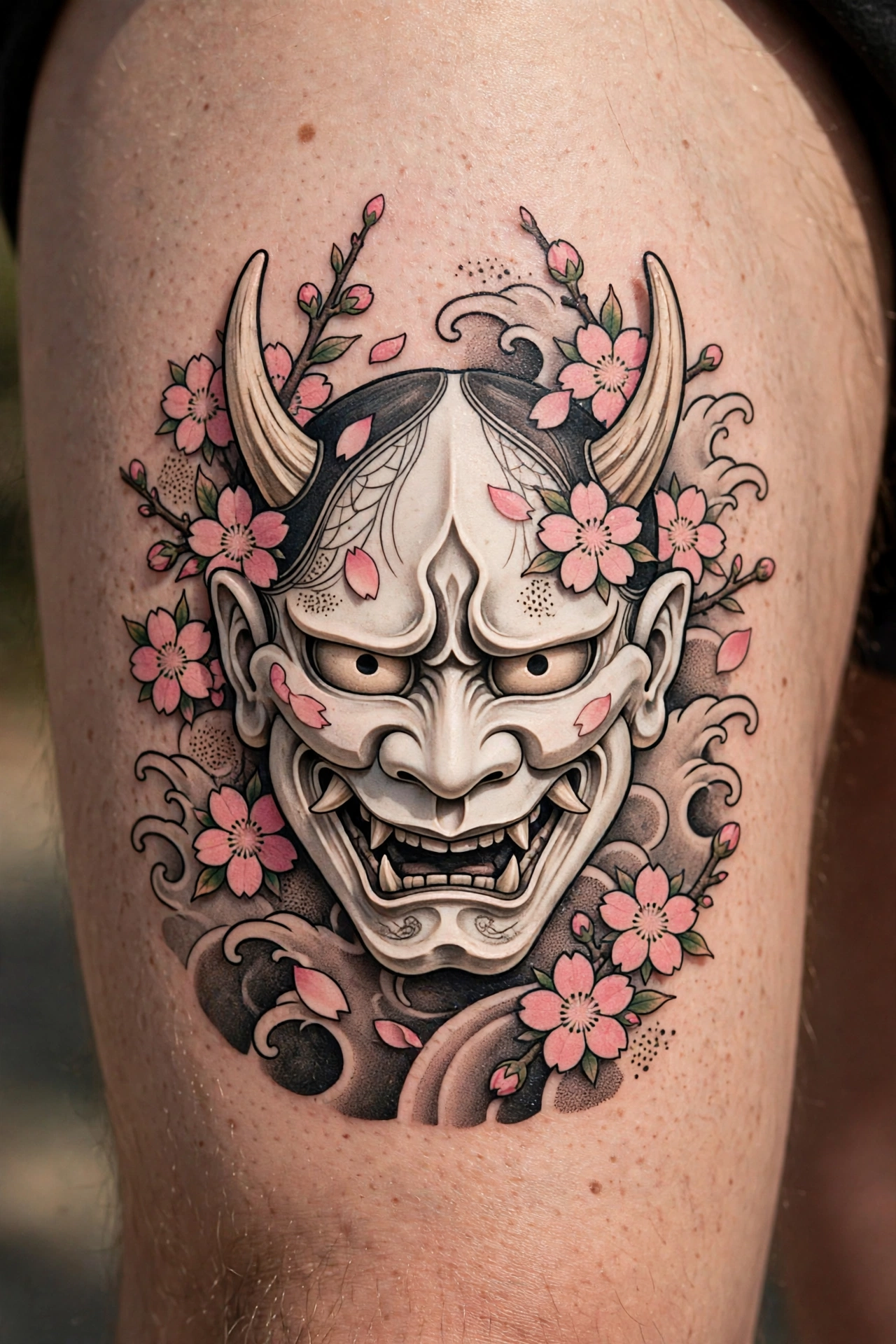
Hannya with sakura is the most emotionally loaded pairing on this list: jealousy and heartbreak against beauty that lasts only days. It says that dark feelings, like blossoms, pass — and that surviving them is the point. Best placement: thigh or upper arm. Honest downside: the emotional weight is real, so choose this one for a feeling you have actually lived through, not just a look.
Modern Japanese Style
Not every Japanese tattoo has to be a bodysuit. These six designs keep the motifs and the meaning but shrink the scale, soften the palette or simplify the line — for people who love the style but live in a world of short sleeves and office dress codes.
35. Minimal Fine-Line Koi
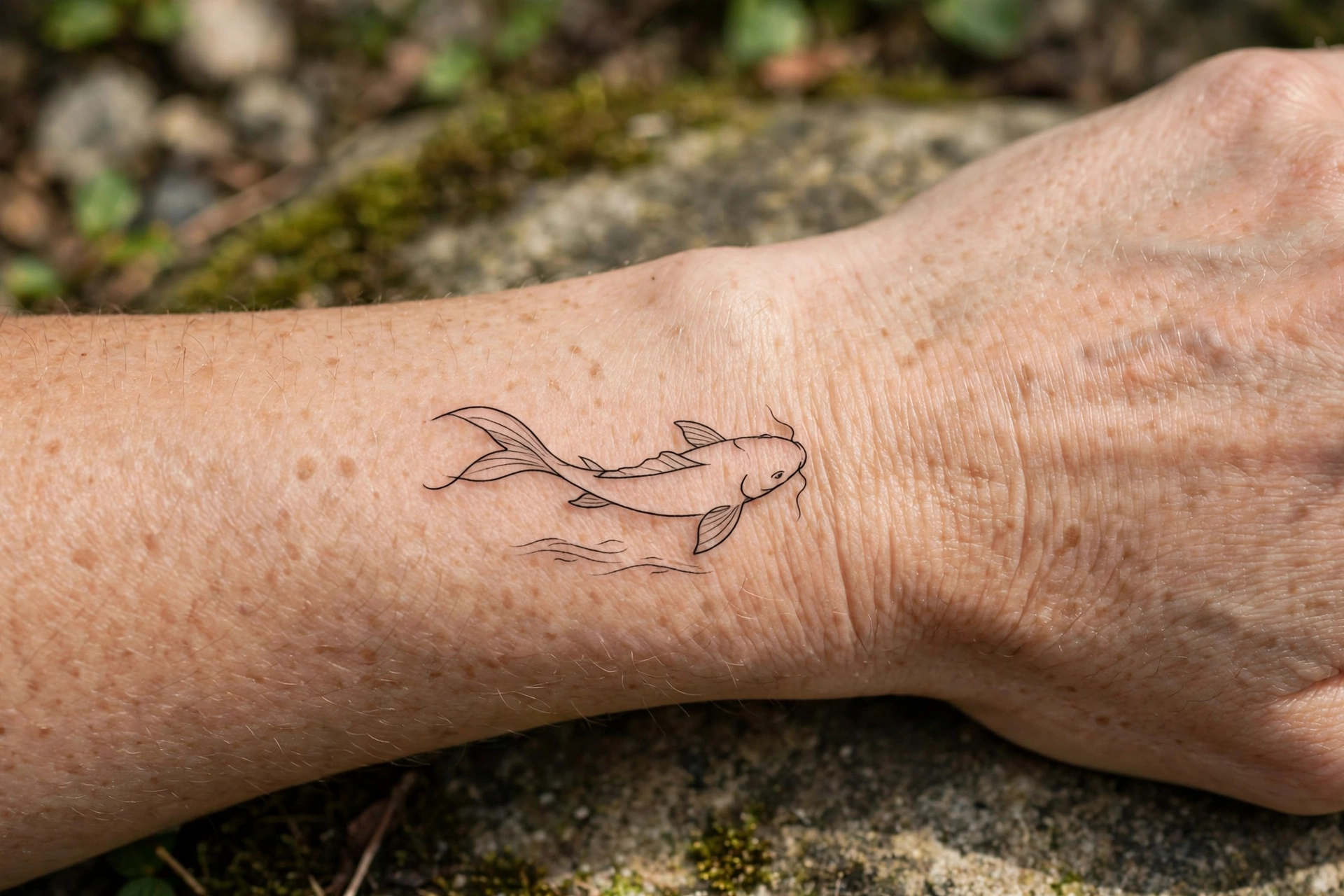
A single-line koi strips the classic design down to its movement: one flowing fish, no background, no colour. It keeps the perseverance meaning while fitting a wrist, ankle or behind the ear. Best placement: wrist, ankle or forearm. Honest downside: fine lines fade and spread fastest of all, so expect a touch-up every 2–3 years, and keep it out of the sun.
36. Blackwork Wave Band
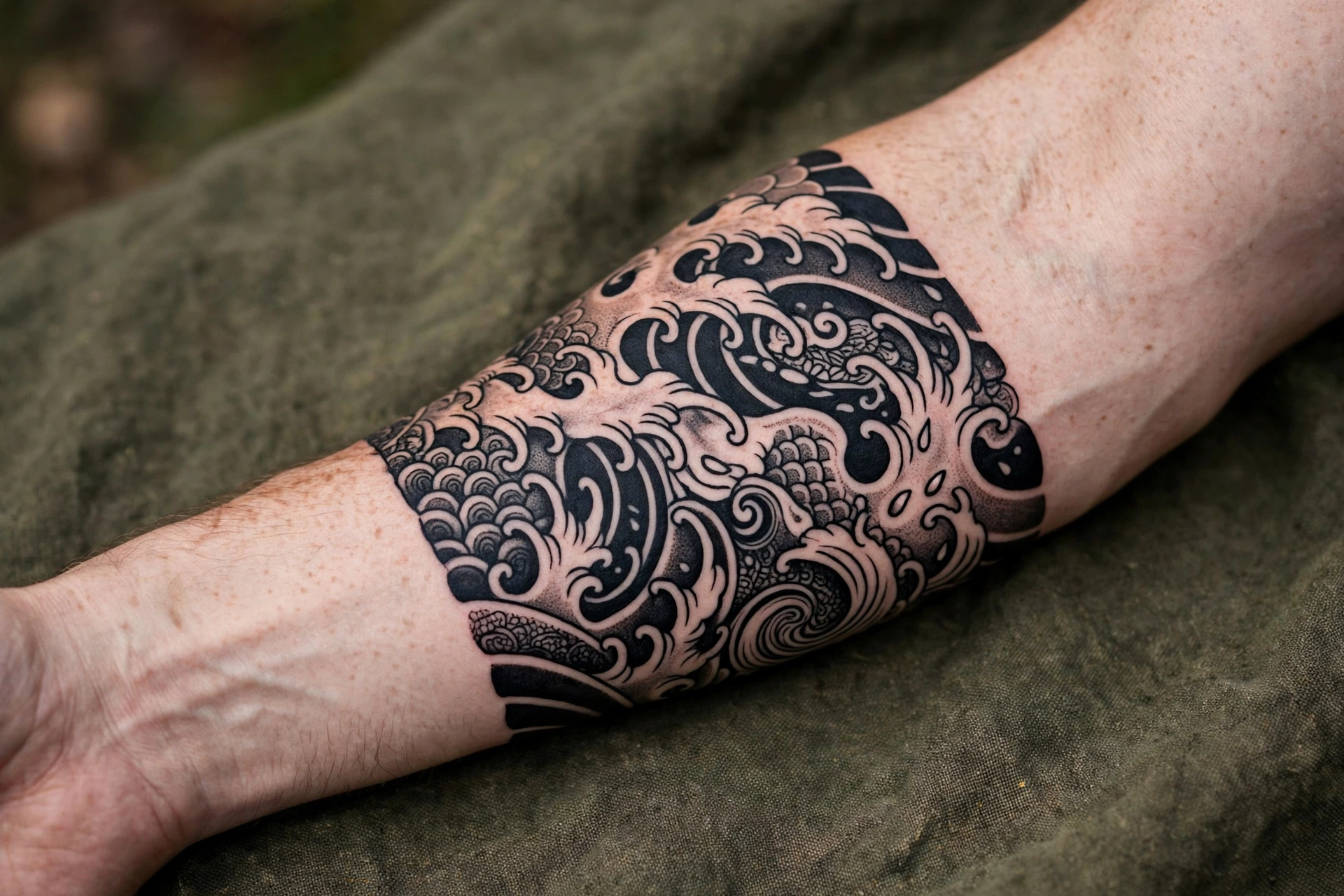
Bold black waves, no colour, wrapped as a band: all the power of the great wave with none of the colour maintenance. Blackwork holds its shape longer than any other palette, which makes this the lowest-maintenance Japanese design on the list. Best placement: forearm or upper arm band. Honest downside: a band that is not perfectly level looks crooked forever, so the stencil placement session matters as much as the tattooing.
37. Neo-Traditional Tiger Head
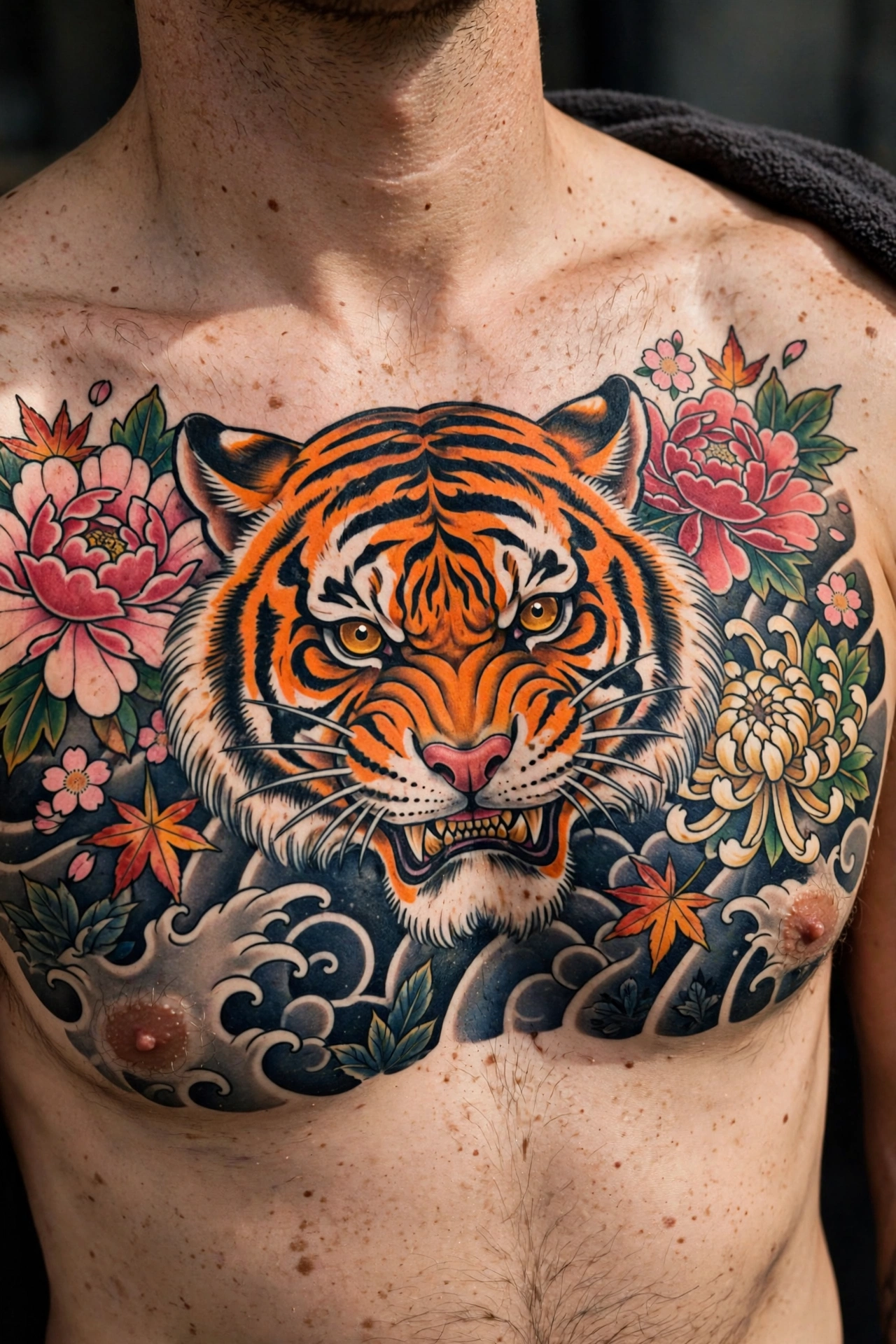
Neo-traditional Japanese work keeps the classic tiger but adds bolder colour, thicker outlines and decorative flowers around the head. It is louder and more graphic than old-school irezumi, and it photographs beautifully. Best placement: chest or thigh. Honest downside: the extra decoration can crowd the tiger’s face, so let the head dominate and keep the flowers as a frame, not a rival.
38. Watercolor Sakura Spray
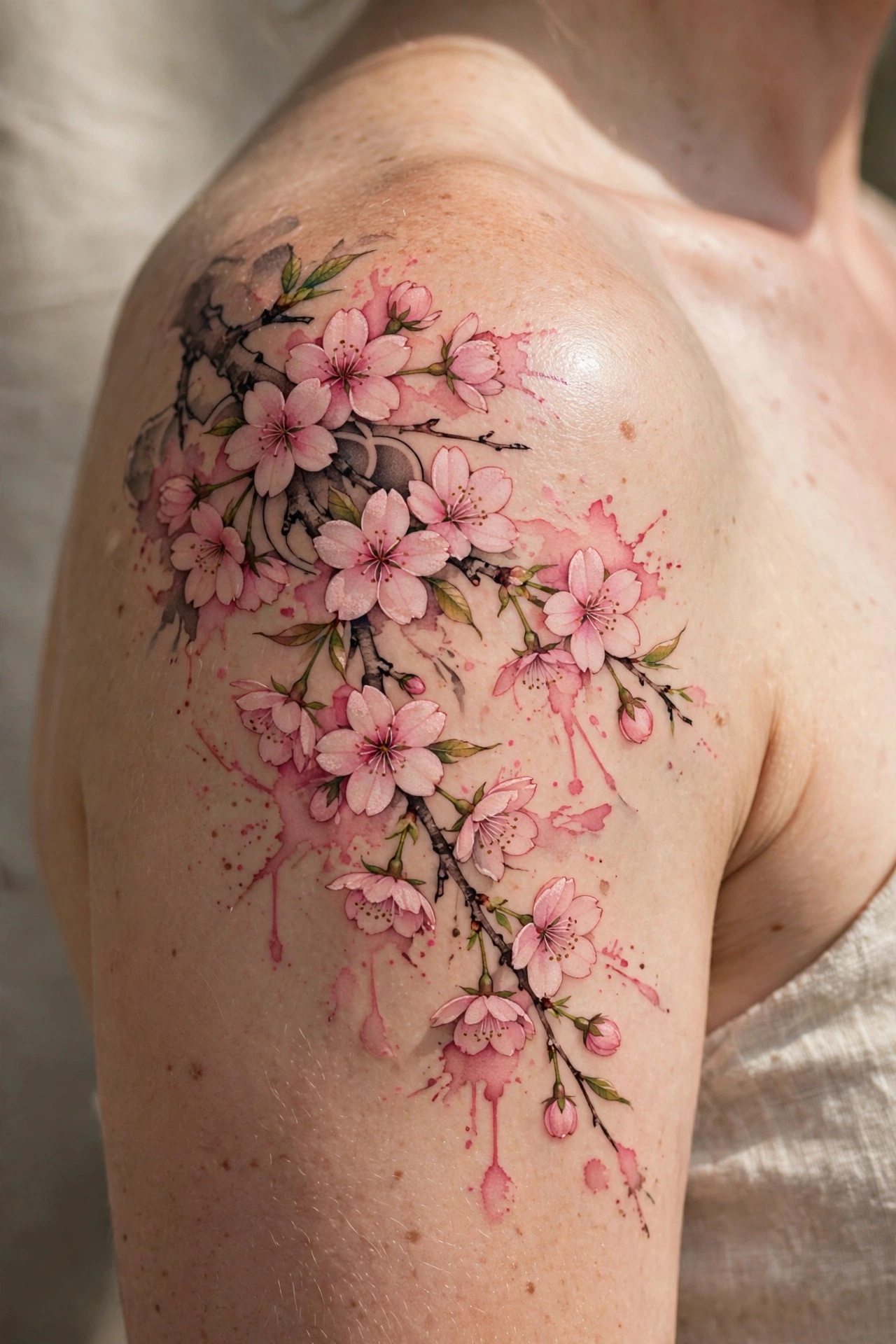
Watercolor sakura trades bold outlines for soft, painterly petals that look like they were brushed on rather than tattooed. It is the gentlest Japanese design here and a favourite first tattoo in the style. Best placement: shoulder or collarbone. Honest downside: watercolor without outlines fades fastest of all styles — this is a design you will retouch, so budget for it from the start.
39. Dotwork Crane in Flight
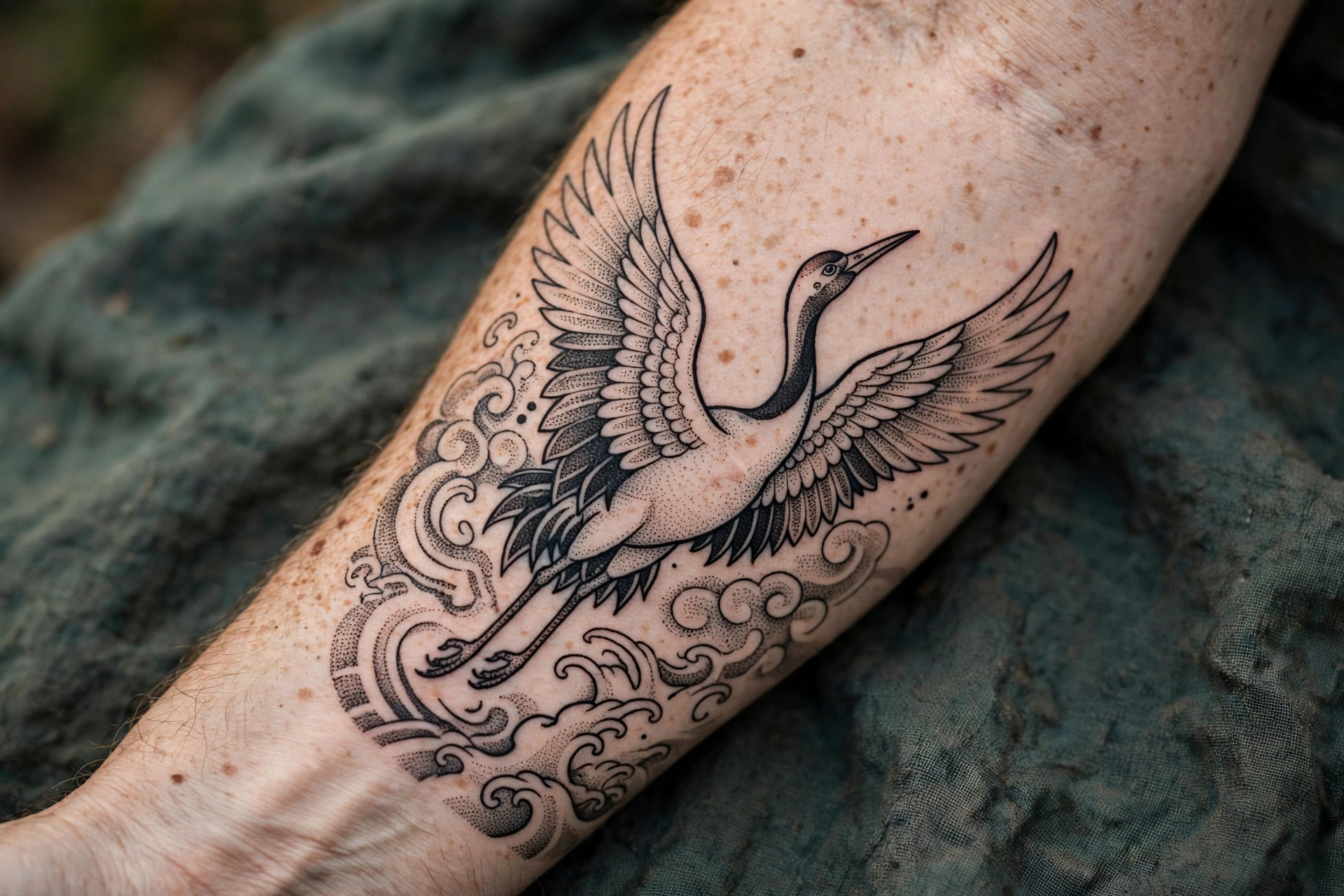
Dotwork builds the crane from thousands of tiny dots instead of solid shading, giving a soft, almost misty bird in flight. It suits people who want the crane’s meaning without a heavy traditional look. Best placement: forearm or shoulder blade. Honest downside: dotwork is slow and expensive per square inch, and a rushed dotwork piece looks patchy rather than misty.
40. Small Fuji and Sunrise
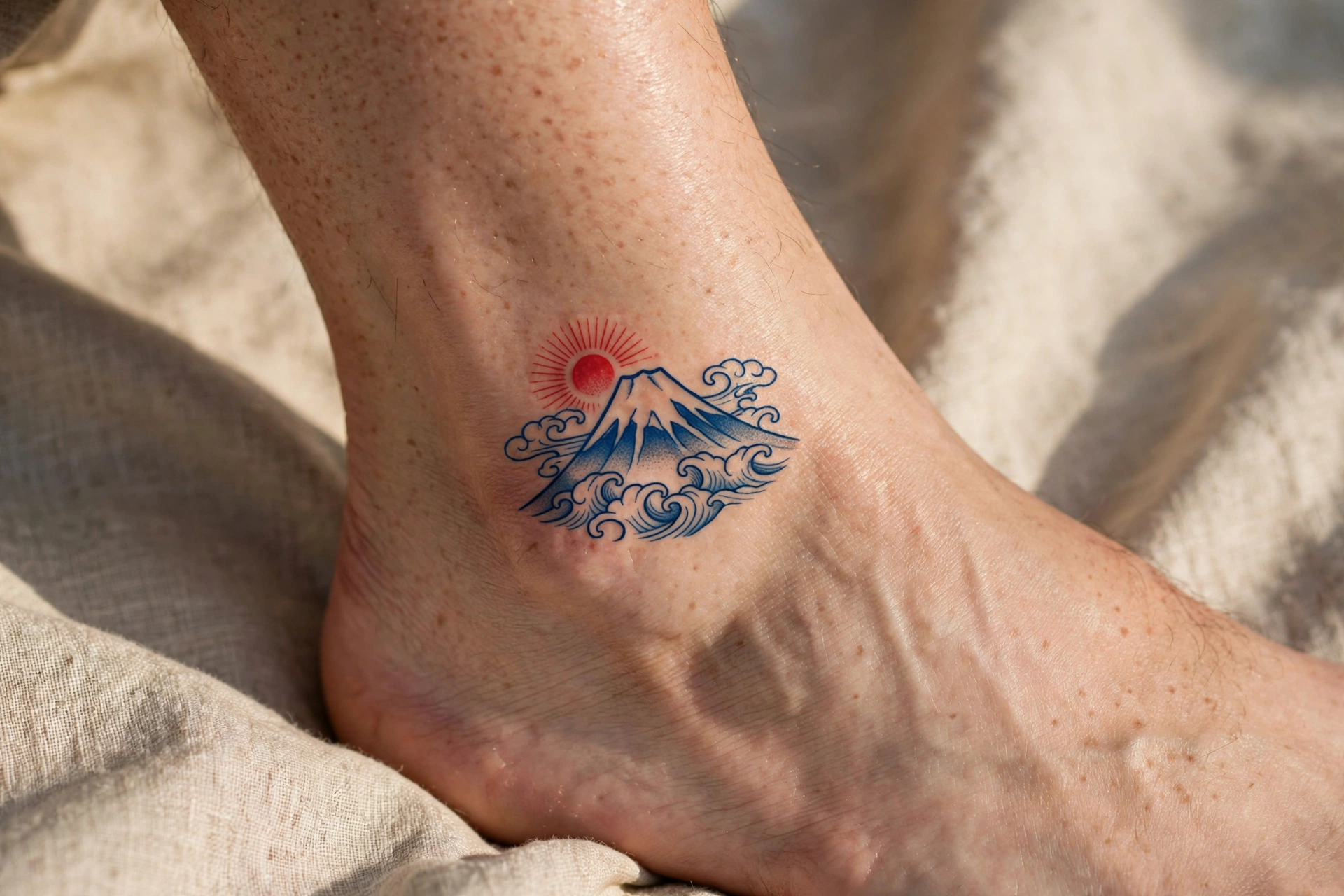
A tiny Fuji with a red sun is the smallest design on this list and one of the most meaningful: endurance and hope in a piece smaller than a coin. It works as a first Japanese tattoo, a travel memory, or a quiet personal emblem. Best placement: ankle, wrist or behind the ear. Honest downside: at this size the mountain’s snowcap is a few millimetres wide, so find an artist who genuinely does micro work — most traditional artists will honestly tell you to go bigger.
Japanese Tattoo Pain: Placement by Placement
Japanese pieces are often large, so pain is not a five-minute question — it is a sessions-long reality. These ratings assume a competent artist and a healthy adult; your mileage will vary, but the ranking holds. Full detail lives in our tattoo pain chart.
- Forearm — 4/10. Meaty, few nerve endings, the friendliest large canvas. A great first Japanese placement.
- Upper arm / shoulder — 5/10. Dull pressure more than sharp pain; sleeves usually start here for a reason.
- Thigh — 5/10. Plenty of muscle and fat; the outer thigh is notably easier than the inner thigh (6–7/10).
- Calf — 6/10. Manageable, though the shin edge and ankle approach 7/10.
- Back — 6–7/10. The shoulder blades and spine are the hot spots; the broad flat areas between them are much easier.
- Chest — 6–7/10. Thin skin over bone near the collarbone and sternum; the centre chest is the sharpest part.
- Spine and ribs — 8–9/10. The hardest placements in the style, and unfortunately the ones large back pieces cross constantly. Vibration through the ribs is the part people remember.
- Wrist and ankle — 6–7/10. Bony, thin-skinned, and surprisingly sharp for small pieces.
Tebori pain deserves its own note: without machine vibration it feels like a rhythmic poke rather than a buzz, which some people find easier and others find more intense because there is no vibration to distract from it. Ask to feel a few test pokes before committing to a tebori session — any traditional artist will understand.
Japanese Tattoo Cost: What You Actually Pay
Japanese tattooing is priced by time and by artist reputation, and the range is enormous because the scale is enormous. Our full breakdown is in the tattoo prices guide, but the Japanese-specific picture is:
- Small single motif (koi, enso, small Fuji): $150–$400, one session of 1–2 hours.
- Medium piece (tiger shoulder, peony thigh, wave band): $400–$1,000, one or two sessions.
- Half sleeve: $1,500–$4,000, spread over several sessions across months.
- Full sleeve: $3,000–$8,000, 15–25 hours of work.
- Back piece: $4,000–$8,000, 20–40+ hours.
- Full bodysuit: $20,000–$60,000+, over 3–10 years, with most people taking breaks for cost and life.
Specialist Japanese artists typically charge $150–$300 per hour, and tebori work costs more because it takes roughly twice as long. Two cost traps to avoid: starting a bodysuit without a finishing budget (half a dragon is worse than no dragon), and choosing a cheap artist for a style where the background work — wind, water, clouds — is what separates a masterpiece from a mess. The background is not filler; it is half the tattoo, and it is where inexperienced artists fail first.
Placement Pros and Cons
| Placement | Best for | Watch out for |
|---|---|---|
| Full back | Dragons, phoenix, full scenes | Highest cost, longest commitment, spine pain 8–9/10 |
| Sleeve (arm) | Koi journeys, waves, tigers | Visible in short sleeves; joints fade faster |
| Thigh | Peonies, kitsune, hannya | Inner thigh hurts more; hidden most of the year |
| Chest panel | Cranes, tengu, protective deities | Collarbone pain; shows with open shirts |
| Forearm | Koi, katana, Fuji, enso | Highly visible at work; sun exposure fades colour |
| Calf | Oni, torii, waves, bamboo | Shin edge is sharp; leg hair complicates healing |
| Small (wrist/ankle) | Minimal koi, enso, small Fuji | Detail blurs fast at small sizes; frequent touch-ups |
One placement rule matters more in Japanese work than anywhere else: the design must follow your muscles. A koi that looks perfect while you stand still can kink badly when you bend your arm, and a wave band that ignores your elbow will distort every time you move. Always do the stencil test — wear the stencil, move, bend, twist, and look in a mirror — before the first needle. A good Japanese artist insists on this; if yours does not, that is a red flag.
Healing and Aftercare Essentials
Surface healing takes 3–4 weeks, with peeling and itching around days 5–7, and the deeper skin takes up to 3 months to fully settle. Large pieces heal in sections — your artist will usually work on one area while the last one settles — so the aftercare below applies after every session, not just the first. The complete guide is our tattoo aftercare guide.
- Wash gently with lukewarm water and mild, fragrance-free soap, then pat dry. Never scrub a healing tattoo.
- Moisturise thinly with a fragrance-free lotion — a thick layer suffocates the skin and invites infection.
- Do not pick or scratch scabs, however itchy they get. Picking pulls ink out and leaves patchy colour.
- No soaking while healing: no baths, pools, saunas — and no onsen, which matters doubly for Japanese-style collectors travelling to Japan.
- No sun or tanning beds on new ink. Once healed, SPF 30+ broad-spectrum sunscreen is non-negotiable, because sun is the single biggest fader of Japanese colour work.
- Wear loose clothing over fresh work. Tight fabric rubs large pieces raw, especially sleeves and back pieces.
For bodysuits, one extra rule: do not book sessions so close together that the previous section has not settled. A tired, overworked patch of skin heals worse and holds ink worse, and no deadline is worth a patchy bodysuit.
Common Mistakes to Avoid
- A koi swimming the wrong way. Upstream means ambition and perseverance; downstream weakens the meaning. Check the direction with your artist before the stencil goes on.
- Picking a motif for looks alone. Hannya, oni and warrior imagery carry stories and, in some cases, gang associations. Understand before you ink.
- Mixing seasons carelessly. Sakura with autumn maple, or a summer lotus with winter pine, breaks the pairing rules that make a composition feel right.
- Going too small for a bold style. Japanese work is built on bold outlines and background. Shrinking a dragon to coin size guarantees a blur.
- Skipping the movement test. If the stencil is not tested while you move, the finished tattoo will distort in exactly the places you move most.
- Ignoring Japan itself. If you plan to visit Japan, know that many onsen and some gyms ban visible tattoos. Cover-up stickers and private onsen exist — plan before you travel, not at the door.
- Choosing an artist without Japanese-style experience. The wind bars, water and clouds are the hardest part. A portfolio without strong background work is a warning sign.
- Trusting one app for kanji. Verify every character with a native reader. A wrong stroke is permanent.
Frequently Asked Questions
What does irezumi mean?
Irezumi is the traditional Japanese art of tattooing, developed in the Edo period (1603–1868). It means large, flowing compositions — creatures, flowers and spirits connected by backgrounds of wind, water and clouds — where every motif carries a specific meaning, from the koi’s perseverance to the dragon’s wisdom.
How much does a Japanese tattoo cost?
A small motif costs $150–$400, a medium piece $400–$1,000, a half sleeve $1,500–$4,000, a full sleeve $3,000–$8,000, a back piece $4,000–$8,000, and a full bodysuit $20,000–$60,000+ over several years. Specialist artists charge roughly $150–$300 per hour, and tebori hand-poking costs more because it takes about twice as long.
How painful is a Japanese tattoo?
It depends on placement: forearms around 4/10, backs 6–7/10, and ribs and spine 8–9/10. Tebori feels different from machine work — a rhythmic poke rather than a buzz — which some people find easier and others find more intense. Large pieces also mean pain spread over many sessions, not one sitting.
How long does a full Japanese bodysuit take?
Typically 3–10 years, with sessions every week or two and breaks for cost, healing and life. A back piece alone takes 20–40+ hours, and a full sleeve 15–25 hours. Most people who start bodysuits take longer than they first expect, so treat the timeline as a journey, not a deadline.
Which direction should a koi tattoo swim?
Upstream — against the current, ideally upward along the body. The legend is that a koi climbs the Dragon Gate waterfall and becomes a dragon, so swimming up means ambition, perseverance and transformation. A koi swimming down the body carries a weaker, less fortunate meaning in traditional reading.
Can anyone get a Japanese tattoo, or is it disrespectful?
Anyone can, respectfully: learn the motif’s meaning, avoid symbols tied to yakuza membership or to a faith you do not practise, and choose an artist who understands the tradition. Appreciation with research is welcomed by most artists; wearing a sacred or gang-linked symbol as decoration is where respect breaks down.
Can you go to an onsen with a tattoo in Japan?
Many onsen and some gyms still ban visible tattoos, a legacy of the association with organised crime. Options include private (kashikiri) onsen, tattoo-friendly venues — which are growing — and cover-up stickers for small pieces. Check the venue’s policy before you go rather than risking a refusal at the door.
What is the difference between tebori and machine tattooing?
Tebori is hand-poking with a bamboo-handled needle tool: slower (about twice the time), often more expensive, with a rhythmic poke sensation and softer, saturated colour. Machine work is faster and more consistent, especially for linework. Many modern Japanese-style artists combine both, using machines for outlines and hand techniques for shading.
Do Japanese tattoos fade faster than other styles?
Bold traditional work with thick outlines and saturated colour actually ages among the best of all styles. What fades fast is the modern end of the spectrum: fine-line, watercolor and pale shading (sakura pink, crane white) need touch-ups every 2–3 years, and any colour exposed to constant sun fades regardless of style. SPF 30+ once healed is the single best anti-fade habit.
What should I ask a Japanese tattoo artist before booking?
Ask to see healed work (not just fresh photos), ask how they handle background — wind, water and clouds — and whether they do a movement stencil test. Ask about their method (tebori, machine or both), their timeline for a piece your size, and their touch-up policy. If they cannot show healed Japanese-style background work, keep looking.
Quick Summary
Japanese tattoos reward patience: learn the meaning, pick a motif whose story is yours, give it the size it needs, and choose an artist whose background work — wind, water, clouds — is as strong as their creatures. A koi swimming upstream, a dragon in its clouds, a single falling sakura petal: the best Japanese tattoos are not the loudest ones, they are the ones that still mean something in ten years. Start with one motif you understand deeply, and let the composition grow from there.
About the Author
Sara Mitchell — Tattoo Ideas Editor at Borcd Panda. Sara researches and curates tattoo designs, meanings and care guides for Borcd Panda readers, drawing on artist interviews, traditional symbolism and real studio advice to help readers choose ink they will still love years later.
References
- American Academy of Dermatology — Tattoo aftercare and skin care guidance. aad.org
- Britannica — Ukiyo-e and Edo-period Japanese art history.
- Japan Tattoo Institute — Traditional irezumi practice and history (via published interviews).
- Smithsonian Magazine — Japanese tattoo history and cultural context.
Which one is your favorite? Tell us in the comments — and if you already wear a Japanese piece, share what it means to you.